
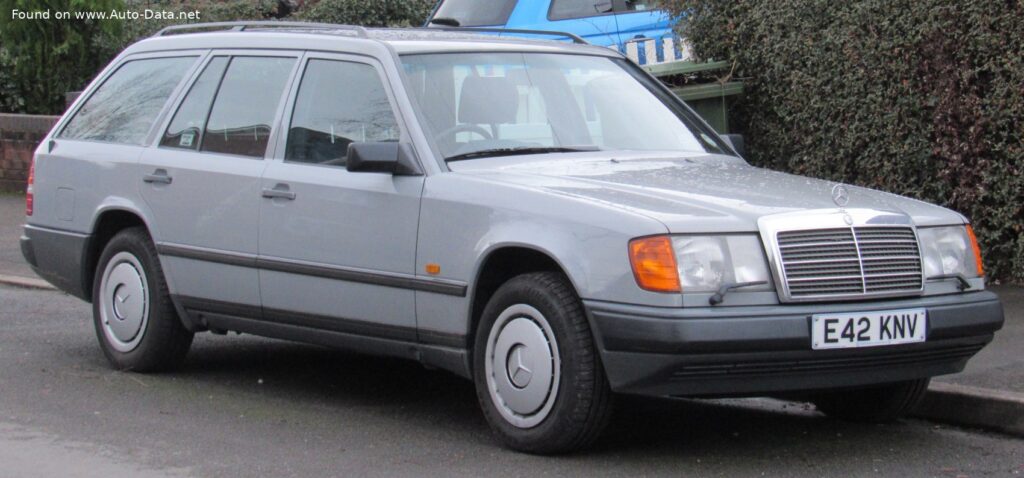
The Mercedes-Benz S124 300 TE CAT (180 Hp) Automatic represents a significant chapter in the history of luxury automobiles, embodying the German manufacturer’s commitment to robust engineering, timeless design, and exceptional practicality. As part of the iconic W124 generation, which commenced production in May 1985, the S124 series specifically designates the station wagon (or “estate” in European parlance) variant. This particular model, produced from May 1985 to August 1989, quickly established itself as a benchmark in the premium station wagon segment, particularly in its primary European markets, though it also found considerable success in North America. Revered for its unparalleled build quality and sophisticated road manners, the W124 chassis is often hailed as “the last over-engineered Mercedes-Benz,” a testament to its enduring durability and mechanical integrity. The 300 TE CAT, with its potent inline-six engine and standard catalytic converter (CAT) for emissions compliance, offered a compelling blend of performance, luxury, and utility, making it a highly desirable vehicle for discerning families and professionals alike.
Powertrain & Engine Architecture
At the heart of the Mercedes-Benz S124 300 TE CAT (180 Hp) Automatic lies the venerable M103 E 30 / 103.983 engine, a 3.0-liter (2962 cm³, or 180.75 cu. in.) naturally aspirated inline-six powerplant. This engine configuration, a hallmark of Mercedes-Benz engineering, is celebrated for its inherent balance, smoothness, and robust reliability. Featuring a Single Overhead Camshaft (SOHC) valvetrain with two valves per cylinder, the M103 utilized a Bosch K-Jetronic fuel injection system to deliver precise fuel metering, ensuring efficient combustion and responsive throttle input. This mechanical fuel injection system, while complex, was known for its reliability and ability to maintain consistent performance under varying conditions. With a compression ratio of 9.2:1, this engine generated a respectable 180 horsepower at 5700 rpm and a substantial 188.08 lb.-ft. (255 Nm) of torque at 4400 rpm. The engine block itself is constructed from cast iron, contributing to its longevity, while the cylinder head is made of aluminum alloy, aiding in heat dissipation.
Power was transmitted to the rear wheels via a durable and smooth-shifting 4-speed automatic transmission, specifically the 4G-TRONIC unit. This transmission, a staple in Mercedes-Benz vehicles of the era, was designed for refined operation and reliability. It features a torque converter for smooth launches and gear changes, and its electronic control system (for later iterations of the 4G-TRONIC) optimized shift points based on driving conditions. The transmission’s gear ratios were geared towards comfortable cruising and effortless acceleration rather than outright performance.
Driving Characteristics
The 300 TE CAT Automatic offered a driving experience focused on comfort and refinement. While not a sports car, the 180 hp engine and 188 lb-ft of torque provided adequate performance for everyday driving and highway cruising. The automatic transmission, while smooth, did result in some power loss compared to the available manual transmission. Acceleration from 0 to 60 mph took approximately 8.6 seconds, and the top speed was around 128.62 mph (207 km/h). The gear ratios were optimized for relaxed cruising, with the first gear being relatively tall and the fourth gear providing a comfortable overdrive for highway speeds. Compared to the higher-output 300E sedan, the station wagon’s added weight slightly diminished acceleration, but the difference was not substantial. The 300 TE CAT’s driving experience was distinctly different from the more performance-oriented BMW 5 Series Touring or the turbocharged 300D diesel, which prioritized fuel economy and low-end torque.
Equipment & Trim Levels
The 300 TE CAT Automatic was positioned as a mid-to-upper range trim within the W124 station wagon lineup. Standard equipment included power windows, central locking, a sunroof, and air conditioning. The interior was typically upholstered in high-quality cloth or optional leather. The dashboard featured a classic Mercedes-Benz design with wood trim and analog gauges. Optional extras included automatic climate control, heated seats, a premium sound system, and a rear-facing third-row seat, which increased seating capacity to seven. The level of standard equipment was generous for the time, reflecting Mercedes-Benz’s commitment to providing a luxurious and well-appointed vehicle. The exterior typically featured body-colored bumpers and trim, although chrome accents were also available. Alloy wheels were often included as standard or optional equipment.
Chassis & Braking
The S124 300 TE CAT utilized a sophisticated chassis design for its time. The front suspension featured independent wishbones with coil springs and shock absorbers, while the rear suspension employed a multi-link independent setup. This configuration provided a comfortable ride and good handling characteristics. The steering was a recirculating ball system with hydraulic power assistance, offering precise control and a relatively light steering feel. Braking duties were handled by ventilated discs at the front and solid discs at the rear. Anti-lock braking system (ABS) was available as an option, significantly improving braking performance and safety, particularly in adverse conditions. Stabilizer bars were fitted to both the front and rear axles to reduce body roll during cornering. The suspension was tuned to prioritize ride comfort, making it well-suited for long-distance driving.
Market Reception & Comparison
The Mercedes-Benz S124 300 TE CAT Automatic was generally well-received by automotive critics. It was praised for its build quality, comfortable ride, spacious interior, and refined driving experience. However, some critics noted that the automatic transmission slightly dulled the engine’s performance compared to the manual version. Fuel economy was considered reasonable for a vehicle of its size and class, with urban consumption around 17 US mpg (13.8 l/100 km) and extra-urban consumption around 25 US mpg (9.4 l/100 km). Compared to the 300E sedan, the TE offered similar performance but with the added practicality of a station wagon body style. The 300 TE CAT was also compared to competitors like the BMW 5 Series Touring and Volvo 740/940 estates. While the BMW offered a sportier driving experience, the Mercedes-Benz was generally considered to be more luxurious and refined. The Volvo emphasized safety and practicality, but lacked the prestige and sophistication of the Mercedes-Benz.
Technical Specifications
| Category | Specification |
| General Information | |
| Brand | Mercedes-Benz |
| Model | W124 |
| Generation | S124 |
| Type (Engine) | 300 TE CAT (180 Hp) Automatic |
| Start of production | May, 1985 |
| End of production | August, 1989 |
| Powertrain Architecture | Internal Combustion engine |
| Body type | Station wagon (estate) |
| Seats | 5 |
| Doors | 5 |
| Performance Specs | |
| Fuel consumption (economy) – urban | 13.8 l/100 km (17 US mpg) |
| Fuel consumption (economy) – extra urban | 9.4 l/100 km (25 US mpg) |
| Fuel Type | Petrol (Gasoline) |
| Acceleration 0 – 60 mph | 8.6 sec |
| Acceleration 0 – 62 mph (0-100 km/h) | 9 sec |
| Maximum speed | 128.62 mph (207 km/h) |
| Weight-to-power ratio | 8.2 kg/Hp (122.4 Hp/tonne) |
| Weight-to-torque ratio | 5.8 kg/Nm (173.5 Nm/tonne) |
| Engine Specs | |
| Power | 180 Hp @ 5700 rpm |
| Power per liter | 60.8 Hp/l |
| Torque | 188.08 lb.-ft. (255 Nm) @ 4400 rpm |
| Engine layout | Front, Longitudinal |
| Engine Model/Code | M 103 E 30 / 103.983 |
| Engine displacement | 3.0 liters (2962 cm³ / 180.75 cu. in.) |
| Number of cylinders | 6 |
| Engine configuration | Inline |
| Cylinder Bore | 3.48 in. (88.5 mm) |
| Piston Stroke | 3.16 in. (80.25 mm) |
| Compression ratio | 9.2:1 |
| Number of valves per cylinder | 2 |
| Fuel injection system | Multi-port manifold injection |
| Engine aspiration | Naturally aspirated engine |
| Valvetrain | SOHC |
| Engine oil capacity | 6.5 liters (6.87 US qt) |
| Coolant capacity | 9 liters (9.51 US qt) |
| Space, Volume and Weights | |
| Kerb Weight | 3240.8 lbs. (1470 kg) |
| Max. weight | 4607.66 lbs. (2090 kg) |
| Max load | 1366.87 lbs. (620 kg) |
| Fuel tank capacity | 19.02 US gal (72 liters) |
| Dimensions | |
| Length | 187.6 in. (4765 mm) |
| Width | 68.5 in. (1740 mm) |
| Height | 58.66 in. (1490 mm) |
| Wheelbase | 110.24 in. (2800 mm) |
| Front track | 58.94 in. (1497 mm) |
| Rear (Back) track | 58.58 in. (1488 mm) |
| Drivetrain, Brakes and Suspension Specs | |
| Drivetrain Architecture | The Internal combustion engine (ICE) drives the rear wheels of the vehicle. |
| Drive wheel | Rear wheel drive |
| Number of gears and type of gearbox | 4 gears, automatic transmission |
| Front suspension | Wishbone |
| Rear suspension | Independent multi-link suspension |
| Front brakes | Ventilated discs |
| Rear brakes | Disc |
| Steering type | Cone worm with recirculation balls |
| Power steering | Hydraulic Steering |
| Tires size | Front: 195/65 R15, Rear: 195/65 R15 |
| Wheel rims size | Front: 6.5J x 15, Rear: 6.5J x 15 |
Legacy
The Mercedes-Benz S124 300 TE CAT Automatic, as part of the broader W124 generation, carved out an indelible legacy in the automotive world. It is universally lauded for its exceptional build quality, often cited as a prime example of Mercedes-Benz’s “over-engineering” philosophy from that era. This commitment to durability translated into vehicles that could withstand decades of use, maintaining their structural integrity and mechanical reliability long after many contemporaries had succumbed to age. The M103 engine, in particular, is known for its longevity and relative simplicity, making it a favorite among enthusiasts. This reputation for longevity has contributed to the W124’s enduring appeal in the classic car market, where well-maintained examples continue to command respect and often premium prices. The 4G-TRONIC automatic transmission, while requiring periodic maintenance, is also known for its robustness.
Today, the 300 TE CAT remains a desirable classic, prized for its combination of luxury, practicality, and reliability. While maintenance costs can be higher than for more modern vehicles, the W124’s robust construction and readily available parts supply make it a viable option for enthusiasts willing to invest in its upkeep. The 300 TE CAT stands as a testament to a bygone era of automotive engineering, where quality and durability were paramount.
