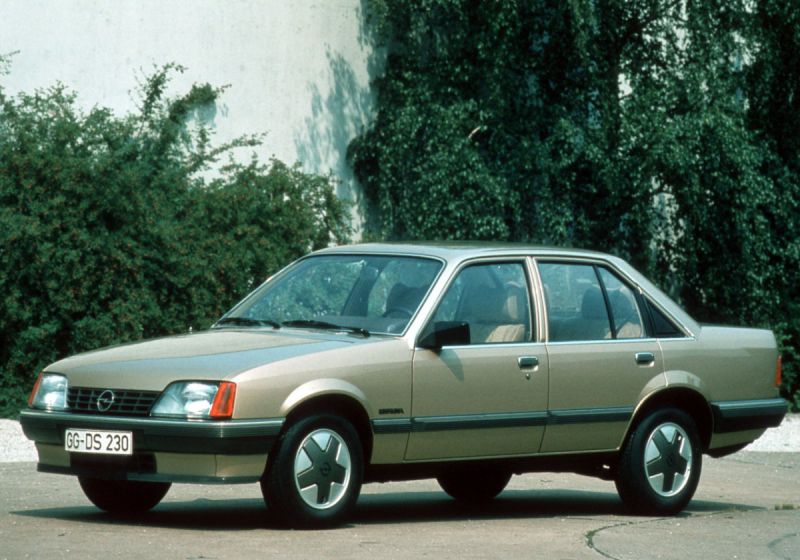
The Opel Rekord E (facelift 1982) 1.8i CAT (100 Hp) represents a significant chapter in European automotive history, embodying the practical, reliable, and family-oriented sedan prevalent in the 1980s. Manufactured by the German automaker Opel, a subsidiary of General Motors, the Rekord series had long been a cornerstone of the mid-size and executive car segments across Europe. The E generation, introduced in 1977 and facelifted in 1982, was a continuation of this legacy, offering a blend of spaciousness, straightforward engineering, and respectable performance for its class. The 1.8i CAT (100 Hp) variant, specifically produced between August 1985 and August 1986, marked a transitional period for the Rekord, integrating early emissions control technology with its well-established inline-four engine. While never officially sold in the United States, the Rekord E played a crucial role in providing accessible and dependable transportation for millions of European families and businesses, competing vigorously in a highly competitive market segment.
The 1.8i CAT Variant: Positioning and Role
The 1.8i CAT (100 Hp) occupied a mid-range position within the Rekord E lineup. It wasn’t the base model, which typically featured smaller displacement engines with lower horsepower, nor was it the top-of-the-line offering, reserved for the larger six-cylinder variants like the 2.0 or 2.2-liter engines. This 1.8-liter version aimed to strike a balance between affordability, fuel efficiency, and acceptable performance for the average driver. It was targeted towards families and individuals who needed a spacious and reliable sedan for daily commuting and longer journeys, without necessarily prioritizing sporty handling or outright speed.
Powertrain & Engine Architecture
At the heart of the Opel Rekord E (facelift 1982) 1.8i CAT (100 Hp) lies a robust and proven 1.8-liter (1796 cm3 or 109.6 cu. in.) inline-four cylinder engine, designated with the code C18NV. This naturally aspirated powerplant features a Single Overhead Camshaft (SOHC) valvetrain with two valves per cylinder, a common and reliable configuration for its era, prioritizing durability and ease of maintenance. The engine produced a respectable 100 horsepower at 5800 rpm, delivering a power-per-liter ratio of 55.7 Hp/l. Torque output stood at 140 Nm (103.26 lb.-ft.) at a relatively low 3000 rpm, providing a strong, accessible pull for daily driving and highway cruising.
A key distinguishing feature of this particular model was the “i CAT” designation, indicating a multi-port manifold fuel injection system coupled with a catalytic converter. This technology, while standard on most vehicles today, was a progressive step in the mid-1980s for European cars, signaling Opel’s commitment to meeting nascent emissions standards. The fuel injection system was a Bosch Jetronic system, providing precise fuel delivery for improved efficiency and reduced emissions. The catalytic converter, a three-way design, further reduced harmful exhaust gases. The engine was typically paired with either a five-speed manual transmission or a four-speed automatic transmission, the latter being a popular choice for drivers prioritizing comfort and ease of use.
Transmission Details
The four-speed automatic transmission used in the 1.8i CAT Rekord E was a General Motors-sourced unit, known for its smooth operation and reliability. While not offering the most modern gear ratios, it was well-suited to the engine’s torque characteristics, providing adequate acceleration and comfortable cruising speeds. The transmission featured a torque converter for smooth launches and a conventional hydraulic control system. It wasn’t known for being particularly fuel-efficient compared to a manual transmission, but it offered a significant convenience factor for many drivers.
Driving Characteristics
The 1.8i CAT (100 Hp) model, particularly when equipped with the automatic transmission, offered a comfortable and predictable driving experience. Acceleration from 0 to 60 mph was calculated at 12.4 seconds (or 0 to 100 km/h in 13 seconds), reaching a maximum speed of 109.98 mph (177 km/h). These figures positioned it as a competent, if not overtly sporty, performer within its class. The automatic transmission contributed to a relaxed driving style, with smooth gear changes and minimal driver input required. Compared to the manual transmission version, the automatic offered slightly slower acceleration but a more refined and effortless experience.
The Rekord E’s suspension, tuned for comfort, absorbed bumps and imperfections in the road effectively. Steering was relatively light and precise, making it easy to maneuver in urban environments. However, it lacked the sharp responsiveness of more performance-oriented sedans. The overall driving experience was geared towards practicality and comfort, making it a suitable vehicle for long journeys and everyday use.
Equipment & Trim Levels
The 1.8i CAT variant typically came with a reasonable level of standard equipment. Interior upholstery was generally cloth, available in a range of colors and patterns. The dashboard featured a straightforward layout with clear instrumentation, including a speedometer, tachometer, fuel gauge, and coolant temperature gauge. Power steering was often included as standard, enhancing ease of maneuverability. Other common features included a radio with cassette player, heated rear window, and front and rear windscreen wipers.
Optional extras available for the 1.8i CAT included electric windows, central locking, a sunroof, and upgraded audio systems. Higher trim levels might also offer features such as velour upholstery, woodgrain interior trim, and alloy wheels. The Rekord E was not typically offered with a wide range of customization options, but buyers could choose from a selection of exterior colors and interior fabrics to personalize their vehicle.
Chassis & Braking
The Opel Rekord E featured a conventional body-on-frame construction, providing a robust and durable chassis. The suspension consisted of independent front suspension with MacPherson struts and a solid rear axle with leaf springs. This setup prioritized ride comfort and load-carrying capacity over sporty handling. The braking system comprised ventilated discs at the front and drum brakes at the rear, a common setup that provided adequate stopping power for the vehicle’s weight and performance. Power assistance was typically included for the brakes, reducing driver effort.
Stabilizer bars were fitted to both the front and rear axles, helping to reduce body roll during cornering. The Rekord E’s tires were typically 175/70 R14 or 185/65 R14, providing a good balance between grip and ride comfort. The overall chassis design was geared towards providing a stable and predictable driving experience, rather than outright performance.
Market Reception & Comparison
Critics generally viewed the Opel Rekord E 1.8i CAT as a competent and reliable family sedan. It was praised for its spacious interior, comfortable ride, and reasonable fuel economy. However, it was also criticized for its somewhat conservative styling and lack of sporty handling. Compared to the larger six-cylinder Rekord variants, the 1.8i CAT offered a more affordable entry point into the range, but at the expense of performance. Compared to rivals like the Ford Granada, the Rekord E was often seen as offering better value for money, while the Volkswagen Passat was considered to be more refined but also more expensive.
Fuel economy for the combined cycle was rated at 9 liters per 100 kilometers, which translates to approximately 26.1 US mpg, a reasonable figure for a mid-size sedan of its time, especially considering its weight-to-power ratio of 11.2 kg/Hp. Reliability was generally good, with the C18NV engine proving to be durable and relatively easy to maintain. However, like all cars of its era, the Rekord E was susceptible to rust, particularly in regions with harsh winters.
Technical Specifications: Opel Rekord E (facelift 1982) 1.8i CAT (100 Hp)
| Category | Specification |
| Brand | Opel |
| Model | Rekord |
| Generation | Rekord E (facelift 1982) |
| Type (Engine) | 1.8i CAT (100 Hp) |
| Production Start | August, 1985 |
| Production End | August, 1986 |
| Powertrain Architecture | Internal Combustion engine |
| Body type | Sedan |
| Seats | 5 |
| Doors | 4 |
| Performance Specs | |
| Fuel consumption (combined) | 9 l/100 km |
| Fuel Type | Petrol (Gasoline) |
| Acceleration 0-60 mph | 12.4 sec |
| Acceleration 0-100 km/h | 13 sec |
| Maximum speed | 177 km/h |
| Weight-to-power ratio | 11.2 kg/Hp |
| Engine Specs | |
| Power | 100 Hp @ 5800 rpm |
| Power per liter | 55.7 Hp/l |
| Torque | 140 Nm @ 3000 rpm |
| Engine Model/Code | C18NV |
| Engine displacement | 1796 cm3 |
| Number of cylinders | 4 |
| Engine configuration | Inline |
| Cylinder Bore | 84.8 mm |
| Piston Stroke | 79.5 mm |
| Compression ratio | 8.9:1 |
| Valves per cylinder | 2 |
| Fuel injection system | Multi-port manifold injection |
| Engine aspiration | Naturally aspirated engine |
| Valvetrain | SOHC |
| Space, Volume and Weights | |
| Kerb Weight | 1120 kg |
| Max. weight | 1655 kg |
| Trunk (boot) space – minimum | 490 l |
| Fuel tank capacity | 65 l |
| Dimensions | |
| Length | 4652 mm |
| Width | 1726 mm |
| Height | 1420 mm |
| Wheelbase | 2668 mm |
| Minimum turning circle | 10.8 m |
Legacy
The Opel Rekord E 1.8i CAT (100 Hp) powertrain, while not particularly groundbreaking, proved to be reliable and durable. The C18NV engine, in particular, was known for its longevity and relatively low maintenance costs. Today, examples of the Rekord E are becoming increasingly sought after by classic car enthusiasts, particularly those who appreciate its understated styling and practical design. The automatic transmission, while not as desirable as the manual for some, remains a reliable unit when properly maintained. The Rekord E’s legacy lies in its role as a dependable and affordable family sedan that served millions of European drivers during a pivotal era in automotive history.