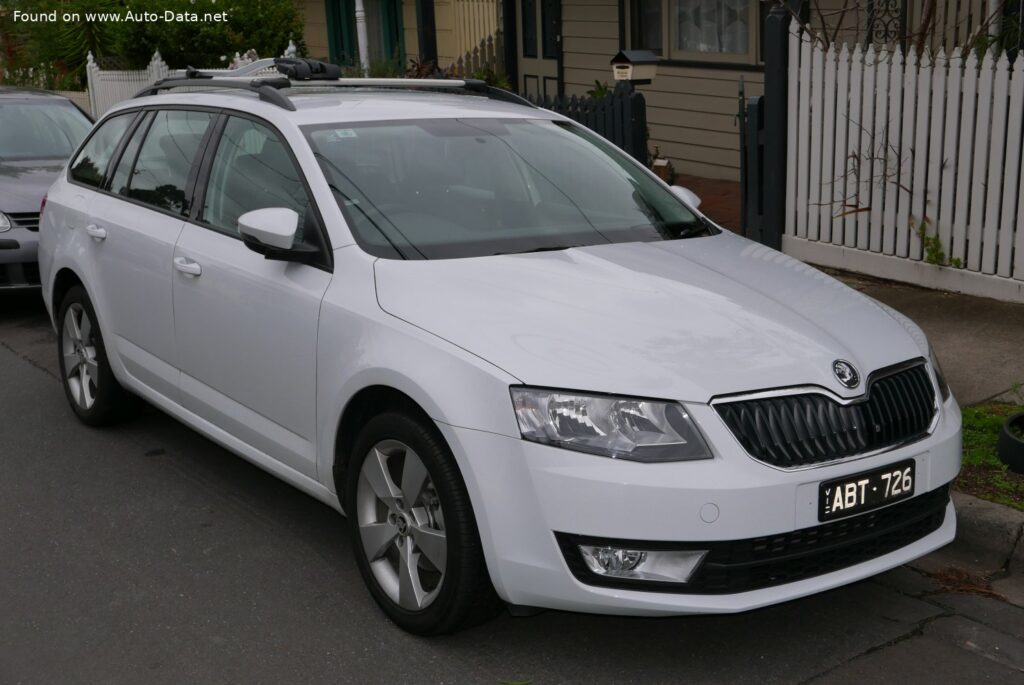
The Skoda Octavia, a cornerstone of the Czech automaker’s lineup, has long been celebrated for its exceptional blend of practicality, value, and robust engineering, largely thanks to its integration within the Volkswagen Group. The third generation, known internally as the A7, debuted in 2012, further cementing the model’s reputation as a formidable contender in the compact family car segment. This particular variant, the Skoda Octavia III Combi 1.6 TDI (110 Hp) 4×4, represents a highly specific and particularly well-suited offering for the European market, where diesel engines, station wagons, and all-wheel drive capabilities hold significant appeal.
Produced from May 2013 to 2017, the Octavia III Combi 1.6 TDI (110 Hp) 4×4 combined a fuel-efficient turbodiesel engine with a versatile station wagon body and an intelligent all-wheel-drive system. While Skoda vehicles are not traditionally sold in the United States, their global impact, especially in Europe and Asia, is substantial. The Octavia, in particular, is often lauded as a benchmark for spaciousness and functionality, offering a near-mid-size package at a compact car price point. This specific configuration aimed to provide drivers with enhanced traction and capability in challenging weather conditions or on unpaved roads, without compromising on the impressive fuel economy expected from a modern diesel powertrain. It embodied Skoda’s philosophy of “Simply Clever” solutions, delivering a highly functional and dependable vehicle for a wide array of customers.
Powertrain & Engine Architecture
At the core of the Skoda Octavia III Combi 1.6 TDI (110 Hp) 4×4 lies a proven 1.6-liter (1598 cm³ or 97.52 cubic inches) inline four-cylinder turbodiesel engine, known by its internal codes EA288, CRKB, CXXB, or DBKA. This unit is mounted transversely at the front of the vehicle, a common configuration for front-wheel-drive-based platforms, even when equipped with all-wheel drive. The engine delivers a respectable 110 horsepower (Hp) at a broad range of 3200-4000 rpm, providing a good balance of power for daily driving and highway cruising. More critically for a diesel, it produces a robust 250 Nm (184.39 lb-ft) of torque, available early in the rev range, specifically between 1500-3000 rpm. This low-end torque is crucial for effortless acceleration, especially when carrying a full load or towing.
The powertrain benefits from a sophisticated Diesel Commonrail fuel injection system, ensuring precise fuel delivery and optimal combustion efficiency. Coupled with a turbocharger and intercooler, the engine’s performance is boosted while maintaining excellent fuel economy. The valvetrain utilizes a Double Overhead Camshaft (DOHC) design with four valves per cylinder, promoting efficient airflow. The engine’s compression ratio stands at 16.2:1, typical for a modern diesel.
Power is channeled through a precise 6-speed manual transmission, offering drivers direct control over the vehicle’s dynamics. The defining characteristic of this variant is its all-wheel-drive (4×4) architecture. This system is a front-wheel-drive biased setup, meaning the internal combustion engine permanently drives the front wheels, and the rear wheels are engaged as needed via an electrically or mechanically operated clutch. This “on-demand” system, typically a Haldex-type coupling within the VW Group, provides enhanced traction and stability in slippery conditions without the continuous fuel consumption penalty of a full-time 4×4 system.
Driving Characteristics
The Octavia III Combi 1.6 TDI (110 Hp) 4×4 prioritizes fuel efficiency and usability over outright performance. The 110 hp engine, while adequate for everyday driving, doesn’t offer the brisk acceleration of higher-powered Octavia variants like the 2.0 TDI. The 6-speed manual transmission is well-matched to the engine’s characteristics, allowing drivers to keep the engine in its optimal torque band. The all-wheel-drive system provides noticeable improvements in traction, particularly on slippery surfaces, but adds a slight weight penalty compared to front-wheel-drive models. Gear ratios are tuned for economy, with a relatively long final drive. This results in relaxed highway cruising but requires more frequent downshifts when overtaking or climbing hills. Compared to the 1.8 TSI gasoline engine, the 1.6 TDI offers significantly more low-end torque but less peak power. The 1.6 TDI 4×4 is geared towards drivers who prioritize fuel economy, all-weather capability, and a comfortable ride over sporty handling.
Equipment & Trim Levels
The Octavia III Combi 1.6 TDI (110 Hp) 4×4 typically occupied a mid-range position within the Octavia lineup. Standard equipment generally included air conditioning, electric front windows, a basic audio system with USB connectivity, alloy wheels, and stability control. Interior upholstery was typically cloth, with a functional and durable design. Dashboard configuration was consistent across most Octavia III models, featuring a clean and intuitive layout. Optional extras commonly included a touchscreen infotainment system with navigation, rear parking sensors, cruise control, automatic climate control, and heated front seats. Higher trim levels offered leather upholstery, upgraded audio systems, and more advanced safety features like automatic emergency braking. The “Simply Clever” features, such as the ticket holder on the windscreen, the ice scraper in the fuel filler flap, and the umbrella in the driver’s door, were standard across the range.
Chassis & Braking
The chassis and suspension setup are designed for comfort and predictable handling. The front suspension employs an independent McPherson strut system with coil springs and an anti-roll bar, a common and effective design for front-wheel-drive-based vehicles. The rear suspension utilizes a coil spring torsion beam setup, which is compact and cost-effective, allowing for maximum cargo space. Braking performance is handled by ventilated discs at the front and solid discs at the rear, complemented by an Anti-lock Braking System (ABS) for enhanced safety. The 4×4 variant’s increased weight necessitates slightly firmer rear springs compared to front-wheel-drive models. Steering is managed by an electric power-assisted rack and pinion system, providing light steering effort at low speeds for easy maneuvering and more feedback at higher speeds. The vehicle’s minimum turning circle of 36.25 feet (11.05 meters) ensures good agility in urban environments.
Market Reception & Comparison
Critics generally praised the Octavia III Combi 1.6 TDI (110 Hp) 4×4 for its practicality, fuel efficiency, and all-weather capability. It was often highlighted as a strong value proposition, offering a spacious and well-equipped estate car at a competitive price point. However, some reviewers noted that the 1.6 TDI engine could feel underpowered when fully loaded or on steep inclines. Compared to the 2.0 TDI variants, the 1.6 TDI offered lower running costs but less performance. Fuel economy was consistently rated as excellent, with real-world figures often exceeding 50 mpg. Reliability was generally good, with the EA288 diesel engine proving to be a durable and dependable unit. The all-wheel-drive system added a layer of security and confidence, particularly for drivers in regions with harsh winters or challenging road conditions.
Technical Specifications
| General Information | |
| Brand | Skoda |
| Model | Octavia |
| Generation | Octavia III Combi |
| Type (Engine) | 1.6 TDI (110 Hp) 4×4 |
| Start of Production | May, 2013 |
| End of Production | 2017 |
| Powertrain Architecture | Internal Combustion engine |
| Body type | Station wagon (estate) |
| Seats | 5 |
| Doors | 5 |
| Performance Specifications | |
| Fuel consumption (economy) – urban (NEDC) | 5.6 l/100 km (42 US mpg) |
| Fuel consumption (economy) – extra urban (NEDC) | 4 l/100 km (58.8 US mpg) |
| Fuel consumption (economy) – combined (NEDC) | 4.6 l/100 km (51.1 US mpg) |
| CO2 emissions (NEDC) | 121 g/km |
| Fuel Type | Diesel |
| Acceleration 0 – 60 mph | 10.9 sec |
| Acceleration 0 – 100 km/h | 11.5 sec |
| Maximum speed | 118.68 mph (191 km/h) |
| Emission standard | Euro 6 |
| Weight-to-power ratio | 12.4 kg/Hp, 80.9 Hp/tonne |
| Weight-to-torque ratio | 5.4 kg/Nm, 183.8 Nm/tonne |
| Engine Specifications | |
| Power | 110 Hp @ 3200-4000 rpm |
| Power per liter | 68.8 Hp/l |
| Torque | 250 Nm (184.39 lb.-ft.) @ 1500-3000 rpm |
| Engine layout | Front, Transverse |
| Engine Model/Code | EA288 / CRKB, CXXB, DBKA |
| Engine displacement | 1598 cm³ (97.52 cu. in.) |
| Number of cylinders | 4 |
| Engine configuration | Inline |
| Cylinder Bore | 79.5 mm (3.13 in.) |
| Piston Stroke | 80.5 mm (3.17 in.) |
| Compression ratio | 16.2:1 |
| Number of valves per cylinder | 4 |
| Fuel injection system | Diesel Commonrail |
| Engine aspiration | Turbocharger, Intercooler |
| Valvetrain | DOHC |
| Engine oil capacity | 4.6 l (4.86 US qt) |
| Coolant | 8.4 l (8.88 US qt) |
| Engine systems | Start & Stop System, Particulate filter |
| Space, Volume and Weights | |
| Kerb Weight | 1360 kg (2998.29 lbs.) |
| Max. weight | 1998 kg (4404.84 lbs.) |
| Max load | 638 kg (1406.55 lbs.) |
| Trunk (boot) space – minimum | 610 l (21.54 cu. ft.) |
| Trunk (boot) space – maximum | 1740 l (61.45 cu. ft.) |
| Fuel tank capacity | 55 l (14.53 US gal) |
| Max. roof load | 75 kg (165.35 lbs.) |
| Permitted trailer load with brakes (12%) | 1700 kg (3747.86 lbs.) |
| Permitted trailer load without brakes | 710 kg (1565.28 lbs.) |
| Permitted towbar download | 75 kg (165.35 lbs.) |
| Dimensions | |
| Length | 4659 mm (183.43 in.) |
| Width | 1814 mm (71.42 in.) |
| Width including mirrors | 2017 mm (79.41 in.) |
| Height | 1465 mm (57.68 in.) |
| Wheelbase | 2686 mm (105.75 in.) |
| Front track | 1549 mm (60.98 in.) |
| Rear (Back) track | 1518 mm (59.76 in.) |
| Front overhang | 886 mm (34.88 in.) |
| Rear overhang | 1087 mm (42.8 in.) |
| Ride height (ground clearance) | 140 mm (5.51 in.) |
| Drag coefficient (Cd) | 0.298 |
| Minimum turning circle (turning diameter) | 11.05 m (36.25 ft.) |
| Approach angle | 13.9° |
| Departure angle | 12.2° |
| Drivetrain, Brakes and Suspension Specifications | |
| Drivetrain Architecture | The Internal combustion engine (ICE) drives the front wheels permanently, and the rear wheels are driven through an electrically or mechanically operated clutch if necessary. |
| Drive wheel | All wheel drive (4×4) |
| Number of gears and type of gearbox | 6 gears, manual transmission |
| Front suspension | Independent, type McPherson with coil spring and anti-roll bar |
| Rear suspension | Coil spring, Torsion |
| Front brakes | Ventilated discs |
| Rear brakes | Disc |
| Assisting systems | ABS (Anti-lock braking system) |
| Steering type | Steering rack and pinion |
| Power steering | Electric Steering |
| Tires size | 195/65 R15; 205/55 R16 |
| Wheel rims size | 6J x 15; 6.5J x 16 |
Legacy
The Skoda Octavia III generation, including the specific 1.6 TDI (110 Hp) 4×4 Combi, played a pivotal role in solidifying Skoda’s position as a respected and highly competitive brand within the European automotive landscape. This model, like its predecessors, benefited immensely from its Volkswagen Group parentage, sharing platforms (specifically the MQB platform), engines, and technologies with vehicles like the Volkswagen Golf and Audi A3, but offering them in a more spacious and often more affordably priced package. This value proposition, combined with robust build quality and reliability, fostered a strong reputation for the Octavia. On the used car market today, the Octavia III Combi 1.6 TDI 4×4 remains a popular choice, particularly for buyers seeking a practical, fuel-efficient, and reliable estate car. The EA288 engine, while not without its potential issues (such as diesel particulate filter clogging and timing chain wear), has proven to be generally durable with proper maintenance. Well-maintained examples continue to offer excellent value for money and represent a sensible choice for families and individuals alike.