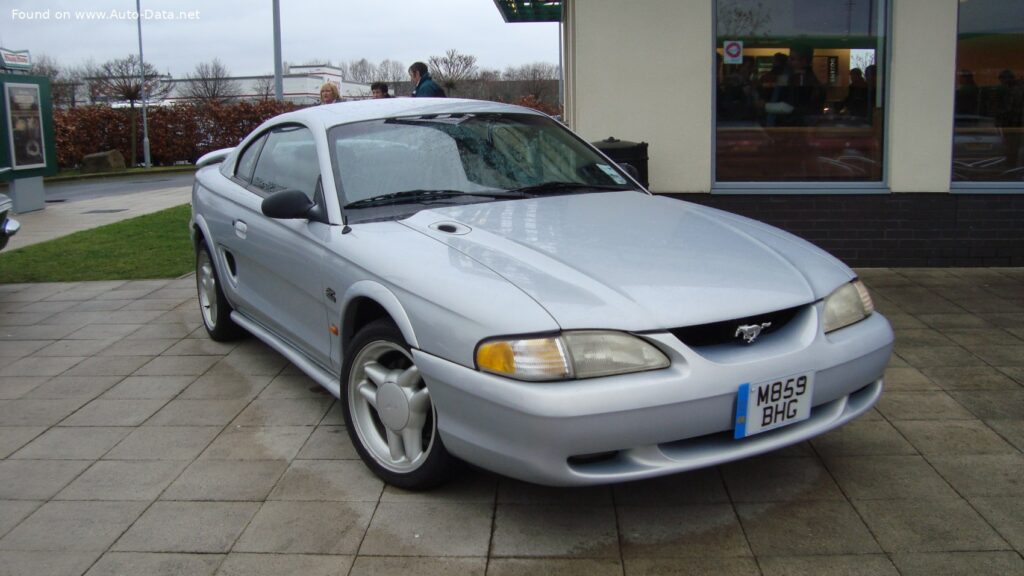
The Ford Mustang IV 3.8 V6 (147 Hp) represents a significant chapter in the evolution of America’s iconic pony car. Introduced as part of the SN95 generation for the 1994 model year, it marked a substantial departure from the long-running Fox Body platform, which had defined the Mustang since 1979. This fourth generation brought a more contemporary design, improved interior quality, and enhanced structural rigidity while retaining the classic rear-wheel-drive architecture. The 3.8-liter V6 variant served as the accessible entry point into the Mustang lineup, balancing performance, affordability, and improved fuel efficiency. Produced from 1993 to 1997, this model broadened the Mustang’s appeal, making ownership attainable for a wider audience.
Powertrain & Engine Architecture
At the heart of the Ford Mustang IV 3.8 V6 (147 Hp) lies the 3.8-liter (3797 cc or 231.71 cubic inches) Essex V6 engine. This naturally aspirated, 60-degree V6 was a mainstay in Ford’s powertrain offerings, known for its reliability and cost-effectiveness. The engine featured a front, longitudinal layout, driving the rear wheels – a traditional Mustang configuration. It produced 147 horsepower (hp) at 4000 rpm and 292 Nm (215.37 lb-ft) of torque at 2500 rpm. This torque curve was particularly advantageous for everyday driving, providing responsive acceleration without requiring high engine speeds.
The Essex V6 utilized a multi-port fuel injection system for precise fuel delivery, contributing to its efficiency and smooth operation. It had a compression ratio of 9:1 and two valves per cylinder, prioritizing durability and ease of maintenance. The engine was typically paired with a 5-speed manual transmission, allowing drivers to fully utilize the engine’s power band. A 4-speed automatic transmission was also available, catering to those preferring a more relaxed driving experience. The automatic transmission, a Ford C5 variant, featured electronic control for smoother shifting and improved fuel economy compared to earlier iterations. The transmission’s gear ratios were optimized for both acceleration and highway cruising, though it wasn’t designed for particularly aggressive performance.
Driving Characteristics
The 147 hp / Automatic combination in the Ford Mustang IV delivered a driving experience focused on comfortable cruising and everyday usability. Compared to the 5.0-liter V8 GT models, the V6 Automatic was noticeably less powerful, resulting in slower acceleration times. However, the V6’s torque characteristics provided adequate power for merging onto highways and passing slower vehicles. The automatic transmission, while convenient, did result in some power loss compared to the manual transmission option. The gear ratios were spaced to prioritize fuel economy and smooth operation, rather than outright performance.
The V6 Automatic Mustang offered a more refined and less demanding driving experience than its V8 counterpart. It was less prone to wheelspin and required less driver skill to operate smoothly. While not a sports car in the traditional sense, the V6 Automatic Mustang provided a satisfying driving experience for those seeking a stylish and affordable coupe. The steering was light and responsive, making it easy to maneuver in city traffic, while the suspension provided a comfortable ride over most road surfaces.
Equipment & Trim Levels
The Ford Mustang IV 3.8 V6 (147 Hp) served as the base model in the SN95 lineup. Standard equipment included power windows, power door locks, a basic AM/FM stereo, and cloth upholstery. Air conditioning was often included, but sometimes offered as an option depending on the package. The interior featured a redesigned dashboard with a dual-cockpit layout, offering improved ergonomics compared to the Fox Body generation. The standard seats were relatively basic, but offered adequate support for everyday driving.
Optional extras included upgraded audio systems, a power sunroof, cruise control, and upgraded interior trim. Appearance packages were also available, offering features like color-keyed exterior accents and alloy wheels. The Mustang’s trim levels were relatively simple during this period, with the V6 model representing the entry-level option. The GT model, equipped with the 5.0-liter V8, offered a more comprehensive list of standard features and performance upgrades.
Chassis & Braking
The SN95 Mustang retained a conventional chassis design, featuring a wishbone front suspension and a solid rear axle with coil springs. The suspension was tuned for a balance of ride comfort and handling, providing a stable and predictable driving experience. The front suspension utilized MacPherson struts, while the rear suspension employed a four-link design with coil springs. Stabilizer bars were included at both the front and rear to reduce body roll during cornering.
Braking duties were handled by disc brakes at all four wheels, a significant improvement over the rear drum brakes found on some earlier Mustang models. An Anti-lock Braking System (ABS) was available as an option, enhancing safety under hard braking conditions. The braking system provided adequate stopping power for everyday driving, though it wasn’t as powerful as the systems found on higher-performance sports cars. The Mustang rode on 205/65R15 tires, providing a balance of grip and ride comfort.
Market Reception & Comparison
The Ford Mustang IV 3.8 V6 (147 Hp) received generally positive reviews from automotive critics. It was praised for its stylish design, improved interior quality, and affordable price point. While its performance wasn’t on par with the V8 GT models, the V6 was considered a capable and enjoyable car for everyday driving. Critics noted that the V6 offered a good balance of performance, fuel economy, and affordability, making it an attractive option for budget-conscious buyers.
Compared to the V8 GT models, the V6 Automatic Mustang offered significantly better fuel economy. The V6 typically achieved around 18-22 mpg in city driving and 25-29 mpg on the highway, while the V8 GT models often struggled to exceed 20 mpg in city driving. In terms of reliability, the V6 engine was generally considered to be more reliable than the 5.0-liter V8, due to its simpler design and lower stress levels. However, both engines were known to be relatively durable and long-lasting with proper maintenance.
Technical Specifications
| Category | Specification |
| Brand | Ford |
| Model | Mustang |
| Generation | Mustang IV (SN95) |
| Type (Engine) | 3.8 V6 (147 Hp) |
| Start of Production | 1993 |
| End of Production | 1997 |
| Powertrain Architecture | Internal Combustion engine |
| Body type | Coupe |
| Seats | 4 |
| Doors | 2 |
| Fuel Type | Petrol (Gasoline) |
| Weight-to-power ratio | 9.5 kg/Hp, 105.8 Hp/tonne |
| Weight-to-torque ratio | 4.8 kg/Nm, 210.1 Nm/tonne |
| Power | 147 Hp @ 4000 rpm |
| Power per liter | 38.7 Hp/l |
| Torque | 292 Nm @ 2500 rpm (215.37 lb.-ft. @ 2500 rpm) |
| Engine layout | Front, Longitudinal |
| Engine Model/Code | Essex / 994 |
| Engine displacement | 3797 cm3 (231.71 cu. in.) |
| Number of cylinders | 6 |
| Engine configuration | V-engine |
| Cylinder Bore | 96.8 mm (3.81 in.) |
| Piston Stroke | 86 mm (3.39 in.) |
| Compression ratio | 9:1 |
| Number of valves per cylinder | 2 |
| Fuel injection system | Multi-port manifold injection |
| Engine aspiration | Naturally aspirated engine |
| Engine oil capacity | 4.7 l (4.97 US qt | 4.14 UK qt) |
| Coolant | 11.2 l (11.83 US qt | 9.85 UK qt) |
| Kerb Weight | 1390 kg (3064.43 lbs) |
| Fuel tank capacity | 58 l (15.32 US gal | 12.76 UK gal) |
| Length | 4610 mm (181.5 in.) |
| Width | 1823 mm (71.77 in.) |
| Height | 1342 mm (52.83 in.) |
| Wheelbase | 2572 mm (101.26 in.) |
| Drivetrain Architecture | The Internal combustion engine (ICE) drives the rear wheels of the vehicle. |
| Drive wheel | Rear wheel drive |
| Number of gears and type of gearbox | 4 gears, automatic transmission |
| Front suspension | Wishbone |
| Rear suspension | Coil spring |
| Front brakes | Disc |
| Rear brakes | Disc |
| Assisting systems | ABS (Anti-lock braking system) optional |
| Steering type | Steering rack and pinion |
| Power steering | Hydraulic Steering |
| Tires size | 205/65 R15 |
Legacy
The Ford Mustang IV 3.8 V6 (147 Hp) has proven to be a surprisingly durable and reliable vehicle. The Essex V6 engine, while not known for its high performance, is generally considered to be a robust and long-lasting powerplant. With proper maintenance, these engines can easily exceed 200,000 miles. The SN95 Mustang, as a whole, has gained a loyal following among enthusiasts, and the V6 models are becoming increasingly popular as affordable project cars and daily drivers.
In the used car market today, these Mustangs are readily available and typically priced affordably. They represent a good value for those seeking a stylish and reliable coupe. While they may not offer the same level of performance as the V8 GT models, the V6 Mustangs provide a comfortable and enjoyable driving experience. Their simplicity and affordability make them an attractive option for first-time car buyers or those looking for a classic American muscle car without breaking the bank. The Ford Mustang IV 3.8 V6 (147 Hp) remains a testament to the enduring appeal of the Mustang nameplate and its ability to adapt to changing times.