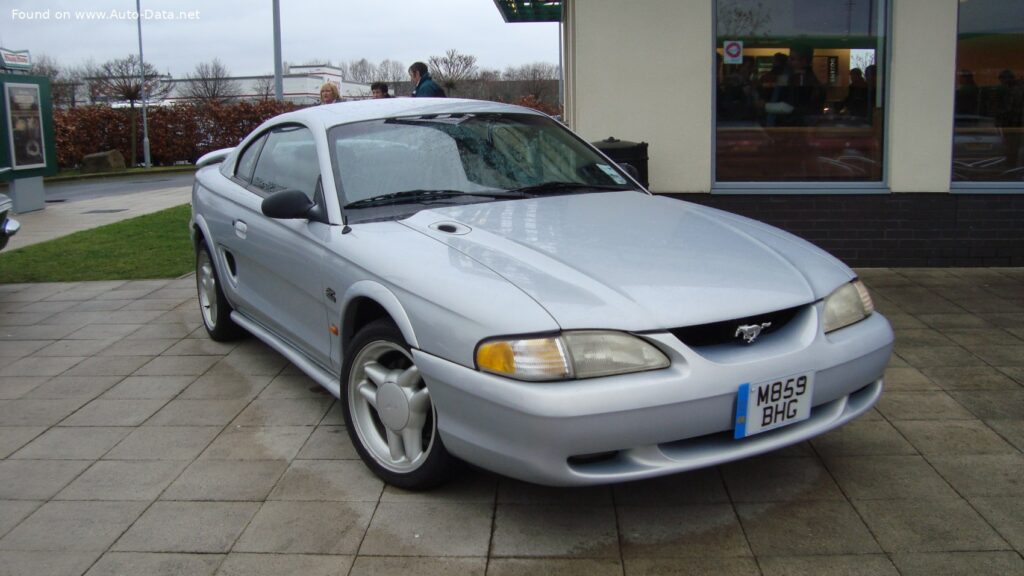
The Ford Mustang IV, internally designated “SN95,” represented a pivotal redesign for the iconic American pony car. Introduced for the 1994 model year, this fourth-generation Mustang moved away from the long-running Fox-body platform, boasting a more aerodynamic and contemporary aesthetic alongside significant mechanical improvements. The Ford Mustang IV 3.8 V6 (152 Hp) served as the accessible entry point into the Mustang lineup from 1994 to 1997, blending classic Mustang styling, rear-wheel drive, and an economical V6 engine. Positioned as a stylish and sporty coupe, it aimed to attract a broad demographic, offering an appealing alternative to the more expensive V8 models while retaining the Mustang’s inherent appeal in the American sports coupe market.
The Fourth Generation: Ford Mustang IV
Development of the SN95 began in the late 1980s, culminating in its December 1993 debut. Ford aimed to modernize the Mustang’s image while preserving its heritage. Unlike previous generations sharing platforms with sedans, the SN95 utilized an updated version of the Fox platform, known as “Fox-4,” specifically tailored for the Mustang. This resulted in improved handling, ride comfort, and structural rigidity. The design language was a radical departure, moving from the boxy Fox-body to a more rounded, flowing, and aggressive silhouette, incorporating styling cues from earlier Mustangs, such as prominent side scoops and tri-bar taillights. The introduction of the Ford Mustang IV was a critical moment for the brand, ensuring its relevance in a market increasingly dominated by imported sports coupes and domestic performance sedans.
Powertrain & Engine Architecture of the 3.8L V6
The entry-level Ford Mustang IV 3.8 V6 (152 Hp) was powered by Ford’s Essex V6 engine. Specifically, the 3.8-liter (3797 cm3 or 231.71 cubic inches) naturally aspirated V6 was known for its reliability and decent torque delivery, particularly at lower RPMs. This engine, often associated with the Essex / 994 series, featured two valves per cylinder and a multi-port fuel injection system for efficient fuel delivery. It produced 152 horsepower at 4000 RPM, sufficient for daily driving and a spirited feel, though less than its V8 counterparts. The engine delivered 291 Nm (214.63 lb.-ft.) of torque at 2750 RPM, contributing to responsive acceleration and good highway passing capability.
Power was sent to the rear wheels via a standard 5-speed manual transmission, emphasizing the driver-centric nature of the Mustang. A 4-speed automatic transmission was also available, and this configuration – the 3.8L V6 paired with the automatic – was a popular choice for buyers prioritizing ease of use over outright performance. The drivetrain architecture, with its front, longitudinal engine layout and rear-wheel drive, maintained the classic American muscle/pony car formula. The automatic transmission, typically the AODE (Automatic Overdrive Electronic) unit, featured electronic control for smoother shifting and improved fuel efficiency. It offered a relatively conservative shift pattern, prioritizing comfort and fuel economy over aggressive downshifts.
Driving Characteristics
The 3.8L V6 with the automatic transmission offered a comfortable and predictable driving experience. Compared to the manual transmission version, the automatic slightly dulled the responsiveness, but provided a smoother, more relaxed driving style. Acceleration from 0 to 60 mph typically took around 8.5-9.5 seconds, depending on vehicle weight and condition. Compared to the 5.0L V8 Mustangs of the same generation, the 3.8L automatic was significantly slower, but offered a noticeable improvement in fuel economy. The automatic transmission’s gear ratios were optimized for cruising, with a relatively tall overdrive gear for highway efficiency. While not a performance-oriented setup, the 3.8L automatic provided adequate power for everyday driving and occasional spirited runs.
Equipment & Trim Levels
The 3.8L V6 Mustang served as the base model, offering a good level of standard equipment. Standard features typically included air conditioning, a basic AM/FM stereo, cloth upholstery, power steering, and power brakes. Optional extras included upgraded sound systems, power windows and locks, cruise control, and a sunroof. Interior upholstery was generally a durable cloth material in various color schemes. The dashboard featured a straightforward layout with analog gauges. The Mustang IV offered several trim packages, such as the “LX” trim, which added some cosmetic enhancements and additional features. The 3.8L automatic was often chosen by buyers who prioritized comfort and convenience features over performance upgrades.
Chassis & Braking
The SN95 Mustang featured an independent front suspension with coil springs and a live rear axle with coil springs. The suspension was tuned for a balance of ride comfort and handling. The 3.8L V6 models typically had a smaller diameter stabilizer bar compared to the V8 GT models, resulting in slightly more body roll during cornering. Braking duties were handled by ventilated discs at the front and solid discs at the rear. Anti-lock brakes (ABS) were available as an option, providing improved stopping power and control in adverse conditions. The chassis was designed to be relatively lightweight, contributing to improved handling and fuel efficiency. Tire size was typically 205/65R15, offering a good balance of grip and ride comfort.
Market Reception & Comparison
Critics generally viewed the 3.8L V6 automatic Mustang as a competent and affordable sports coupe. While it lacked the raw power of the V8 models, it offered a good value proposition for buyers seeking a stylish and reliable vehicle. Fuel economy was a significant advantage over the V8, making it a more practical choice for daily commuting. Compared to the V8 GT, the 3.8L automatic was less expensive to insure and maintain. However, some critics noted that the automatic transmission could feel sluggish at times, and the engine lacked the exhilarating performance of the V8. In terms of reliability, the 3.8L V6 engine was generally considered to be very durable, with few major issues reported. The automatic transmission, while reliable, could require occasional servicing to maintain optimal performance.
Technical Specifications
| Category | Specification |
| General Information | Ford |
| Model | Mustang |
| Generation | Mustang IV |
| Engine Type | 3.8 V6 (152 Hp) |
| Start of Production | 1994 |
| End of Production | 1997 |
| Powertrain Architecture | Internal Combustion engine |
| Body Type | Coupe |
| Seats | 4 |
| Doors | 2 |
| Performance Specs | |
| Fuel Consumption (Urban) | 11.8 l/100 km (19.9 US mpg) |
| Fuel Consumption (Extra Urban) | 7.9 l/100 km (29.8 US mpg) |
| Fuel Type | Petrol (Gasoline) |
| Weight-to-Power Ratio | 9.1 kg/Hp (109.4 Hp/tonne) |
| Engine Specs | |
| Power | 152 Hp @ 4000 rpm |
| Torque | 291 Nm @ 2750 rpm (214.63 lb.-ft. @ 2750 rpm) |
| Engine Layout | Front, Longitudinal |
| Engine Displacement | 3797 cm3 (231.71 cu. in.) |
| Number of Cylinders | 6 |
| Engine Configuration | V-engine |
| Fuel Injection System | Multi-port manifold injection |
| Engine Aspiration | Naturally aspirated engine |
| Space, Volume and Weights | |
| Kerb Weight | 1390 kg (3064.43 lbs.) |
| Trunk (Boot) Space – Minimum | 310 l (10.95 cu. ft.) |
| Fuel Tank Capacity | 59 l (15.59 US gal) |
| Dimensions | |
| Length | 4610 mm (181.5 in.) |
| Width | 1820 mm (71.65 in.) |
| Height | 1350 mm (53.15 in.) |
| Wheelbase | 2570 mm (101.18 in.) |
Legacy
The Ford Mustang IV 3.8L V6 automatic remains a popular choice in the used car market, offering an affordable and reliable entry point into Mustang ownership. The 3.8L V6 engine is known for its durability and relatively low maintenance costs. While not a high-performance machine, it provides a comfortable and enjoyable driving experience. The SN95 generation, as a whole, is appreciated for its modern styling and improved refinement compared to the Fox-body. The 3.8L automatic variant is often sought after by buyers who prioritize practicality and affordability over outright performance, making it a lasting symbol of the Mustang’s enduring appeal to a broad range of drivers.