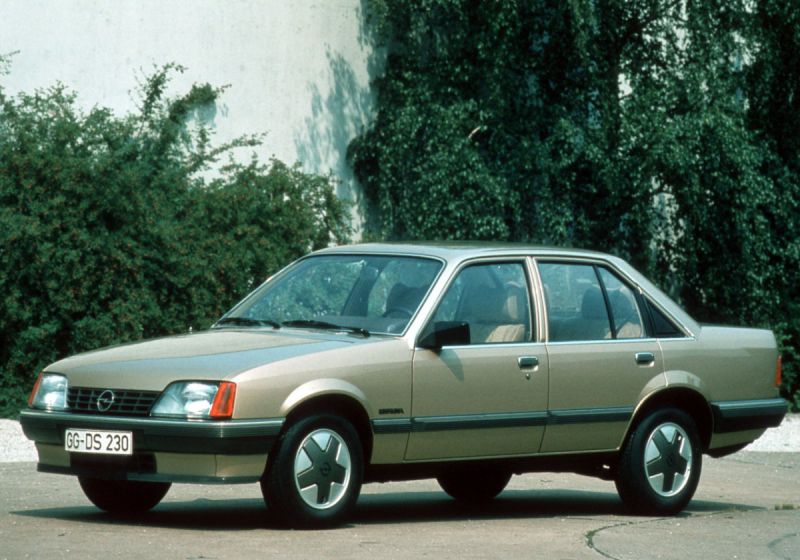
The Opel Rekord E (facelift 1982) 2.2 D Automatic represents a significant chapter in the history of European mid-size sedans, particularly for the German automaker Opel. Produced by General Motors’ German subsidiary, the Rekord line had been a staple in the European market for decades, known for its robust construction, practicality, and affordability. The E-generation, launched in 1977, received a substantial facelift in 1982, bringing updated styling and revised powertrains. The variant under scrutiny here, the Opel Rekord E (facelift 1982) 2.2 D (71 hp) Automatic, was a diesel-powered sedan aimed squarely at the economy-conscious family and fleet buyer, produced from August 1983 to September 1986. This model occupied the mainstream executive car segment, offering a balance between comfort and fuel efficiency.
The 2.2 D Automatic: Positioning and Market Context
Positioned as a mainstream executive car in its primary European markets, the Rekord E competed in a fiercely contested segment. While never officially sold in the United States, its design philosophy and engineering principles echoed those of its American GM cousins, albeit adapted to European tastes and regulations. This particular model, with its naturally aspirated diesel engine and automatic transmission, embodied the era’s focus on fuel efficiency and durability, a common trade-off for diesel vehicles of the early 1980s. Compared to its gasoline-powered siblings, such as the 1.8 and 2.0-liter versions, the 2.2 D Automatic offered significantly better fuel economy but considerably less performance. It also differed from the more sporting Rekord models, which featured manual transmissions and higher-output engines. The target audience was primarily those prioritizing low running costs and long-distance comfort over driving excitement.
Powertrain & Engine Architecture
Under the hood of the Opel Rekord E (facelift 1982) 2.2 D lay the robust 23D engine, an inline four-cylinder diesel unit. With an engine displacement of 2,260 cubic centimeters (approximately 2.3 liters), this powerplant was designed for longevity and economical operation rather than exhilarating speed. It produced a modest 71 horsepower at 4,400 revolutions per minute, and 99.57 lb-ft of torque at a relatively low 2,400 rpm. The engine featured a SOHC (Single Overhead Camshaft) valvetrain with two valves per cylinder and utilized a precombustion chamber injection system, a common technology for naturally aspirated diesels of the era. This system, while smoother than direct injection, was less efficient. The high compression ratio of 22:1 was typical for diesel engines, ensuring efficient ignition without spark plugs.
Mated to this diesel engine was a 3-speed automatic transmission, a common choice for comfort and convenience in the mid-1980s. This transmission, while offering ease of driving, contributed to the leisurely performance figures. The automatic transmission used a traditional hydraulic control system, offering smooth but not particularly quick shifts. The gear ratios were optimized for fuel economy and relaxed cruising, rather than rapid acceleration.
Driving Characteristics
The Opel Rekord E 2.2 D Automatic offered a driving experience focused on comfort and economy. Acceleration from 0 to 60 miles per hour took a rather relaxed 21.4 seconds, with 0 to 62 mph (100 km/h) taking 22.5 seconds. Its top speed was approximately 96.31 mph (155 km/h). These figures clearly indicate that the vehicle was not intended for spirited driving but rather for comfortable, long-distance cruising. The automatic transmission, while convenient, further dampened performance compared to the available manual transmissions. The engine’s torque delivery was relatively flat, providing adequate pulling power for everyday driving and highway overtaking, but lacking the responsiveness of higher-output engines. The steering was light and precise, making it easy to maneuver in urban environments, while the suspension provided a comfortable ride, absorbing bumps and imperfections in the road surface.
Equipment & Trim Levels
The Rekord E 2.2 D Automatic typically came with a fairly standard level of equipment for a mid-range European sedan of the early 1980s. Standard features included cloth upholstery, basic instrumentation (speedometer, fuel gauge, temperature gauge), and a four-spoke steering wheel. Power steering was often included, but air conditioning was typically an optional extra. Other available options included a sunroof, upgraded audio systems, and electric windows. The interior trim was generally functional and durable, with materials chosen for longevity rather than luxury. The dashboard layout was straightforward and ergonomic, with all essential controls within easy reach of the driver. The exterior trim was relatively understated, with chrome accents and body-colored bumpers.
Chassis & Braking
The Opel Rekord E 2.2 D Automatic utilized a traditional rear-wheel-drive layout with a robust chassis. The suspension consisted of independent front suspension with MacPherson struts and a live axle with trailing arms at the rear. This setup provided a comfortable ride and predictable handling characteristics. The braking system featured ventilated disc brakes at the front and drum brakes at the rear, a common and cost-effective setup for a rear-wheel-drive sedan of its caliber. The brakes were adequate for normal driving conditions, but lacked the stopping power of more modern braking systems. Stabilizer bars were fitted to both the front and rear axles to reduce body roll during cornering.
Market Reception & Comparison
Critics generally viewed the Opel Rekord E 2.2 D Automatic as a practical and reliable family sedan, but acknowledged its lack of performance. Its fuel economy was praised, making it an attractive option for those covering long distances. However, its leisurely acceleration and relatively basic interior were often criticized. Compared to its gasoline-powered siblings, the 2.2 D Automatic offered significantly better fuel economy but considerably less performance. It also lagged behind more upmarket competitors in terms of refinement and features. However, its competitive pricing and robust construction made it a popular choice for fleet buyers and families on a budget. Fuel consumption was rated at a respectable 30.9 US miles per gallon, making it one of the most fuel-efficient vehicles in its class.
Technical Specifications
| Category | Specification |
| Brand | Opel |
| Model | Rekord E (facelift 1982) 2.2 D (71 Hp) Automatic |
| Production Start | August, 1983 |
| Production End | September, 1986 |
| Body Type | Sedan |
| Doors | 4 |
| Seats | 5 |
| Fuel Type | Diesel |
| Combined Fuel Consumption | 7.6 l/100 km (30.9 US mpg) |
| Acceleration 0-60 mph | 21.4 sec |
| Acceleration 0-62 mph (100 km/h) | 22.5 sec |
| Maximum Speed | 96.31 mph (155 km/h) |
| Weight-to-power ratio | 17.7 kg/Hp (56.3 Hp/tonne) |
| Weight-to-torque ratio | 9.3 kg/Nm (107.1 Nm/tonne) |
| Power | 71 Hp @ 4400 rpm |
| Torque | 135 Nm (99.57 lb.-ft.) @ 2400 rpm |
| Engine Model/Code | 23D |
| Engine Displacement | 2,260 cm³ (137.91 cu. in. / 2.3 liters) |
| Number of Cylinders | 4, Inline |
| Cylinder Bore | 92 mm (3.62 in.) |
| Piston Stroke | 85 mm (3.35 in.) |
| Compression Ratio | 22:1 |
| Valves per Cylinder | 2 |
| Fuel Injection System | Precombustion chamber injection |
| Engine Aspiration | Naturally aspirated |
| Valvetrain | SOHC |
| Engine Oil Capacity | 5.5 l (5.81 US qt) |
| Coolant Capacity | 11.5 l (12.15 US qt) |
| Kerb Weight | 1,260 kg (2,777.82 lbs) |
| Max. Weight | 1,780 kg (3,924.23 lbs) |
| Max Load | 520 kg (1,146.4 lbs) |
| Trunk (boot) Space – minimum | 490 l (17.3 cu. ft.) |
| Fuel Tank Capacity | 65 l (17.17 US gal) |
| Permitted Trailer Load with brakes (12%) | 1,100 kg (2,425.08 lbs) |
| Length | 4,652 mm (183.15 in.) |
| Width | 1,726 mm (67.95 in.) |
| Height | 1,420 mm (55.91 in.) |
| Wheelbase | 2,668 mm (105.04 in.) |
| Front Brakes | Ventilated discs |
| Rear Brakes | Drum |
Legacy
The Opel Rekord E, particularly its diesel variants like the 2.2 D, carved out a significant niche in the European automotive landscape of the 1980s. It was a car that represented reliability, affordability, and practical transportation for millions. Its reputation as a dependable workhorse made it a popular choice for families, small businesses, and government fleets across Europe. The 23D diesel engine, while not known for its power, proved to be remarkably durable and long-lasting. Today, surviving examples are relatively common in the classic car market, and well-maintained vehicles can still provide reliable transportation. While not highly sought after by collectors, the Rekord E 2.2 D Automatic remains a testament to a bygone era of automotive engineering, where practicality and durability were prioritized over performance and luxury.