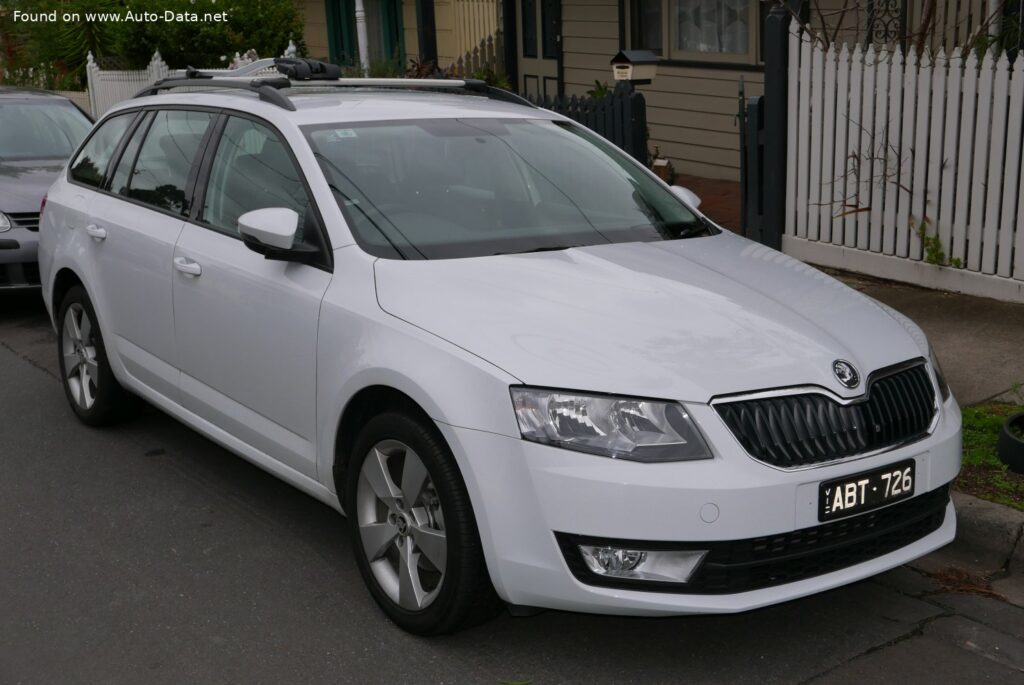
The Skoda Octavia III Combi 2.0 TDI (184 Hp) DSG 4×4 represents a significant offering from Skoda, a Czech automaker known for its blend of practicality, value, and engineering derived from the Volkswagen Group. Produced between 2013 and 2017, this variant of the third-generation Octavia Combi (station wagon) was designed for the European market. While Skoda is not sold in the United States, this model’s capabilities demonstrate the diverse needs of international consumers. It combined a powerful turbodiesel engine with an advanced automatic transmission and all-wheel drive, making it a compelling choice for families and those in regions with challenging weather conditions. This vehicle is built on the Volkswagen Group’s PQ35 platform, also known as the A5 platform.
The 2.0 TDI 184 Hp: Positioning and Overview
Positioned within the competitive compact family car segment, the Octavia III Combi distinguished itself with its spacious cargo area, comfortable ride, and sophisticated powertrain. The 2.0 TDI engine, a staple of the Volkswagen Group, offered a balance of performance and fuel economy, while the DSG (Direct Shift Gearbox) provided smooth gear changes. The addition of a 4×4 drivetrain enhanced its appeal, providing superior traction. This variant sat in the mid-to-upper range of the Octavia Combi lineup, offering more performance and capability than the base 1.6 TDI models, but representing a more practical and value-oriented choice than the petrol-powered variants like the 1.8 TSI.
Powertrain & Engine Architecture
At the heart of the Skoda Octavia III Combi 2.0 TDI (184 Hp) DSG 4×4 is the EA288 family 2.0-liter turbodiesel engine, a four-cylinder inline unit with a DOHC valvetrain and a common rail fuel injection system. This engine was engineered for both performance and efficiency. It produced 184 horsepower (Hp) at 3500-4000 rpm, delivering a power-per-liter ratio of 93.5 Hp/l. The engine generated 280.27 lb.-ft. (380 Nm) of torque, available from 1750 to 3250 rpm. This ample torque ensured strong acceleration and effortless cruising.
Power was managed by a 6-speed DSG automatic transmission, known for its rapid and smooth gear changes. This dual-clutch gearbox allowed the Octavia Combi to accelerate from 0 to 60 mph in 6.8 seconds, with a top speed of 140.43 mph (226 km/h). The “4×4” designation signifies a Haldex-type all-wheel-drive system. This system primarily drives the front wheels, engaging the rear wheels via an electrically operated clutch when additional traction is needed. This on-demand approach optimizes fuel efficiency while providing enhanced grip.
The EA288 engine utilizes a sophisticated common rail direct injection system, typically operating at pressures exceeding 1800 bar. This allows for precise fuel metering and optimized combustion. The engine also features a variable geometry turbocharger (VGT), which adjusts the turbine vanes to optimize boost pressure across the engine’s rev range, improving both low-end torque and high-end power. The engine codes commonly associated with this output level include CUNA, CUPA, and DJGA, depending on the specific production year and market.
Driving Characteristics
The 184 hp / Automatic setup provided a refined and capable driving experience. Compared to the lower-powered 1.6 TDI models, the 2.0 TDI offered significantly more responsive acceleration and effortless highway cruising. While not as sporty as the petrol-powered 1.8 TSI, the 2.0 TDI provided ample power for everyday driving and overtaking maneuvers. The DSG transmission contributed to smooth and quick gear changes, enhancing the overall driving experience. The 4×4 system provided enhanced stability and traction, particularly on slippery surfaces. The gear ratios were tuned for a balance of acceleration and fuel efficiency, with a relatively tall final drive ratio to maximize fuel economy at cruising speeds. The Haldex system’s seamless engagement of the rear wheels was largely transparent to the driver, providing added confidence in challenging conditions.
Equipment & Trim Levels
The Octavia Combi 2.0 TDI (184 Hp) DSG 4×4 typically came with a generous level of standard equipment. This included power steering, air conditioning, electric windows, and a multi-function steering wheel. Higher trim levels, such as the Style and Laurin & Klement, added features like alloy wheels, parking sensors, a touchscreen infotainment system with navigation, and leather upholstery. Interior upholstery was typically cloth on lower trims, with leather options available on higher trims. Dashboard configurations were generally consistent across the range, featuring a clean and functional design. Optional extras included a panoramic sunroof, adaptive cruise control, and a premium sound system.
Chassis & Braking
The Octavia Combi featured an independent suspension system, with McPherson struts at the front and a multi-link setup at the rear. This provided a comfortable ride and good handling characteristics. The 4×4 variant typically featured slightly stiffer springs and dampers to accommodate the added weight of the all-wheel-drive system. The braking system comprised ventilated discs at the front and solid discs at the rear, complemented by an Anti-lock Braking System (ABS) and Electronic Stability Control (ESC). Stabilizer bars were fitted to both the front and rear axles to reduce body roll during cornering. The steering system utilized an electromechanical power steering system, providing precise and responsive steering feel.
Market Reception & Comparison
Critics generally praised the Skoda Octavia III Combi 2.0 TDI (184 Hp) DSG 4×4 for its practicality, fuel efficiency, and comfortable ride. It was often compared favorably to rivals such as the Volkswagen Golf Estate, Ford Focus Estate, and Peugeot 308 SW. The Octavia Combi offered a larger cargo capacity than many of its competitors, making it a particularly appealing choice for families. Fuel economy was also a strong point, with the 2.0 TDI engine delivering impressive MPG figures. Reliability was generally good, although some owners reported minor issues with the DSG transmission. Compared to the lower-powered 1.6 TDI models, the 2.0 TDI offered a noticeable improvement in performance, while remaining relatively fuel-efficient. Compared to the petrol-powered 1.8 TSI, the 2.0 TDI offered better fuel economy and more torque, but less outright horsepower.
Technical Specifications
| Category | Specification |
| General Information | |
| Brand | Skoda |
| Model | Octavia |
| Generation | Octavia III Combi |
| Type (Engine) | 2.0 TDI (184 Hp) DSG 4×4 |
| Production Start | 2013 |
| Production End | 2017 |
| Powertrain Architecture | Internal Combustion engine |
| Body type | Station wagon (estate) 5 Doors, 5 Seats |
| Performance Specifications | |
| Fuel Consumption (Urban, NEDC) | 5.6 l/100 km (42 US mpg) |
| Fuel Consumption (Extra Urban, NEDC) | 4.4 l/100 km (53.5 US mpg) |
| Fuel Consumption (Combined, NEDC) | 4.9 l/100 km (48 US mpg) |
| CO2 Emissions (NEDC) | 129 g/km |
| Fuel Type | Diesel |
| Acceleration 0 – 60 mph | 6.8 seconds |
| Maximum Speed | 140.43 mph (226 km/h) |
| Emission Standard | Euro 6 |
| Weight-to-Power Ratio | 7.7 kg/Hp (130.5 Hp/tonne) |
| Weight-to-Torque Ratio | 3.7 kg/Nm (269.5 Nm/tonne) |
| Engine Specifications | |
| Power | 184 Hp @ 3500-4000 rpm |
| Power per liter | 93.5 Hp/l |
| Torque | 280.27 lb.-ft. (380 Nm) @ 1750-3250 rpm |
| Engine Layout | Front, Transverse |
| Engine Model/Code | EA288 / CUNA, CUPA, DJGA |
| Engine Displacement | 120.09 cu. in. (1968 cm3) |
| Number of Cylinders | 4 Inline |
| Cylinder Bore | 3.19 in. (81 mm) |
| Piston Stroke | 3.76 in. (95.5 mm) |
| Compression Ratio | 15.8:1 |
| Valves per Cylinder | 4 |
| Fuel Injection System | Diesel Commonrail |
| Engine Aspiration | Turbocharger, Intercooler |
| Valvetrain | DOHC |
| Engine Oil Capacity | 4.86 US qt (4.6 l) |
| Coolant Capacity | 12.26 US qt (11.6 l) |
| Engine Systems | Start & Stop System, Particulate filter |
| Space, Volume and Weights | |
| Kerb Weight | 3108.52 lbs. (1410 kg) |
| Max. Weight | 4515.07 lbs. (2048 kg) |
| Max Load | 1406.55 lbs. (638 kg) |
| Trunk (Boot) Space – Minimum | 21.54 cu. ft. (610 l) |
| Trunk (Boot) Space – Maximum | 61.45 cu. ft. (1740 l) |
| Fuel Tank Capacity | 13.21 US gal (50 l) |
| Max. Roof Load | 165.35 lbs. (75 kg) |
| Permitted Trailer Load with Brakes (12%) | 3968.32 lbs. (1800 kg) |
| Permitted Trailer Load without Brakes | 1609.37 lbs. (730 kg) |
| Permitted Towbar Download | 165.35 lbs. (75 kg) |
| Dimensions | |
| Length | 183.43 in. (4659 mm) |
| Width | 71.42 in. (1814 mm) |
| Width including mirrors | 79.41 in. (2017 mm) |
| Height | 57.6 in. (1463 mm) |
| Wheelbase | 105.51 in. (2680 mm) |
| Front Track | 60.75 in. (1543 mm) |
| Rear (Back) Track | 59.53 in. (1512 mm) |
| Ride Height (Ground Clearance) | 5.51 in. (140 mm) |
| Drag Coefficient (Cd) | 0.306 |
| Minimum Turning Circle | 36.22 ft. (11.04 m) |
| Approach Angle | 13.9° |
| Departure Angle | 12.2° |
| Drivetrain, Brakes and Suspension | |
| Drivetrain Architecture | The Internal combustion engine (ICE) drives the front wheels permanently, and the rear wheels are driven through an electrically or mechanically operated clutch if necessary. |
| Drive Wheel | All-wheel drive (4×4) |
| Number of Gears and Type of Gearbox | 6 gears, automatic transmission DSG |
| Front Suspension | Independent, type McPherson with coil spring and anti-roll bar |
| Rear Suspension | Independent multi-link spring suspension with stabilizer |
| Front Brakes | Ventilated discs |
| Rear Brakes | Disc |
| Assisting Systems | ABS (Anti-lock braking system) |
| Steering Type | Steering rack and pinion |
| Power Steering | Electric Steering |
| Tire Sizes | 205/55 R16; 225/45 R17; 225/40 R18; 225/35 R19 |
| Wheel Rim Sizes | 6.5J x 16; 7.5J x 17; 7.5J x 18; 7.5J x 19 |
Legacy
The Skoda Octavia III Combi 2.0 TDI (184 Hp) DSG 4×4 remains a popular choice in the used car market, particularly in Europe. Its combination of practicality, fuel efficiency, and all-wheel-drive capability continues to appeal to buyers. The EA288 engine, while known for some potential issues with the diesel particulate filter (DPF) and dual-mass flywheel, is generally considered to be a robust and reliable unit when properly maintained. The DSG transmission requires regular servicing, including fluid changes, to ensure long-term reliability. Overall, this variant represents a well-engineered and capable vehicle that offers excellent value for money.