
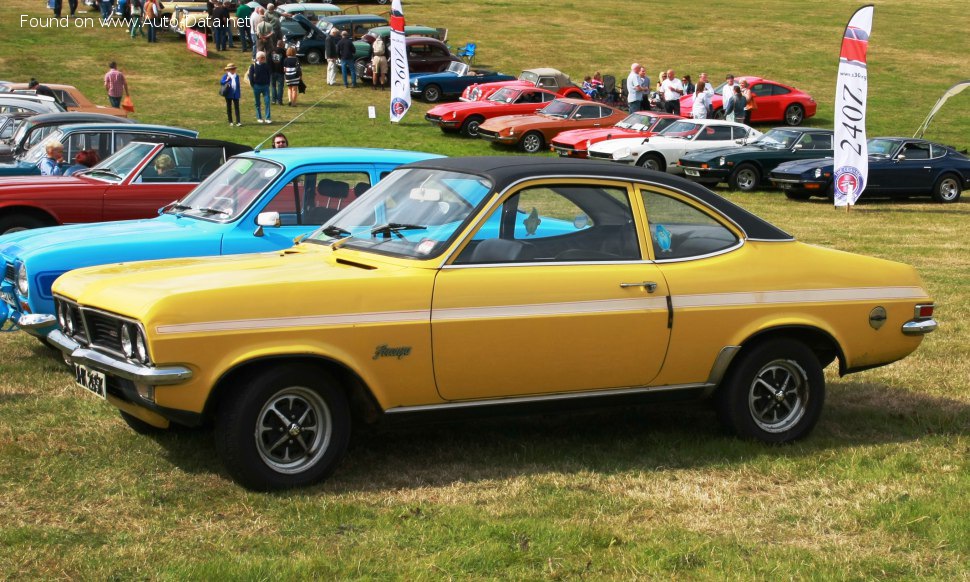
The Vauxhall Firenza Coupe 2300 represents a significant, albeit often overlooked, chapter in British automotive history, embodying Vauxhall’s efforts to inject sportiness and performance into its lineup during the early 1970s. Launched in 1972 as part of the Firenza Coupe generation, this particular variant, with its 2.3-liter engine producing 111 horsepower, stood as a more potent and enthusiast-focused offering within the range. Originating from Vauxhall, a brand primarily focused on the United Kingdom and European markets, the Firenza Coupe was never officially sold in the United States, yet it shares a design language and engineering philosophy common to many global coupes of its era. It was positioned as a stylish and relatively affordable performance coupe, designed to appeal to buyers seeking a blend of practicality and driving engagement. Its rear-wheel-drive architecture and robust engine were key components of its sporting appeal, making it a distinctive presence on British and European roads until the end of its production run in 1974.
Powertrain & Engine Architecture
At the heart of the Vauxhall Firenza Coupe 2300 was a naturally aspirated, internal combustion engine designed to deliver a spirited driving experience for its time. This 2.3-liter unit was a derivative of Vauxhall’s robust “Slant Four” engine family, known for its durability and tunability. The engine, typically identified by its engine code, offered respectable performance for a car of its class and era. The naturally aspirated design meant a linear power delivery, characteristic of engines from the early 1970s, without the complexities or lag associated with forced induction systems.
The “Slant Four” engine featured a cast iron block and an aluminum cylinder head. It utilized a single overhead camshaft (SOHC) valvetrain, operating two valves per cylinder. Fuel delivery was managed by a Zenith-Stromberg carburetor, a common setup for the period. This carburetor system, while reliable, was less precise than later fuel injection systems, impacting fuel economy and emissions. The engine’s 111 horsepower output was achieved at approximately 5,200 rpm, with peak torque of 135 lb-ft arriving at 3,200 rpm. The engine was paired exclusively with a three-speed automatic transmission, a Borg-Warner Type 35 unit. This transmission, while providing convenience, was not known for its particularly quick shifts or wide gear ratio spread.
Driving Characteristics
The Vauxhall Firenza Coupe 2300 with the 2.3-liter engine and automatic transmission offered a driving experience that prioritized comfortable cruising over outright performance. Compared to the available manual transmission versions, the automatic noticeably dulled acceleration. The three-speed automatic’s gear ratios were optimized for relaxed driving, resulting in a slower 0-60 mph time of around 11-12 seconds. The manual transmission variants, while less common, could achieve a 0-60 mph time closer to 9-10 seconds.
The rear-wheel-drive layout provided a balanced feel, although the relatively soft suspension tuning and the weight distribution (slightly front-heavy) meant it wasn’t a particularly nimble handler. Steering was unassisted, requiring a reasonable amount of effort, especially at low speeds. The automatic transmission, while convenient, lacked the driver engagement offered by a manual gearbox. Power delivery was smooth and predictable, making it a suitable car for everyday driving, but it lacked the responsiveness desired by more enthusiastic drivers. The automatic transmission also impacted fuel economy, typically returning around 18-22 mpg in mixed driving conditions.
Equipment & Trim Levels
The Firenza Coupe 2300 occupied a mid-range position within the Firenza lineup. It was positioned above the base models with smaller engines and fewer features, but below the later, more performance-focused HPF (High Performance Firenza) models. Standard equipment included cloth upholstery, a wood-trimmed dashboard, and basic instrumentation consisting of a speedometer, fuel gauge, and temperature gauge. A heater was standard, but air conditioning was a rare optional extra.
Optional extras included a vinyl roof, upgraded stereo systems, and a sunroof. Interior color schemes were typically conservative, with shades of brown, beige, and dark blue being common. The Firenza Coupe 2300 aimed for a balance between comfort and style, offering a reasonably well-equipped interior for its price point. The exterior trim was relatively understated, with chrome bumpers and brightwork adding a touch of elegance. The car featured halogen headlights, which were considered a modern feature at the time.
Chassis & Braking
The Vauxhall Firenza Coupe utilized a conventional body-on-frame construction, providing a robust and durable chassis. The suspension consisted of independent front suspension with coil springs and a live axle rear suspension with leaf springs. This setup prioritized ride comfort over handling precision. The front suspension featured anti-roll bar, helping to reduce body roll during cornering. The rear suspension lacked an anti-roll bar, contributing to a less controlled feel.
Braking was accomplished via disc brakes on the front wheels and drum brakes on the rear wheels. This configuration was typical for cars of its era and price range. The braking system was not particularly powerful by modern standards, and fade could be an issue during prolonged or hard braking. Steering was a recirculating ball system, providing a relatively indirect feel. The Firenza Coupe’s chassis and braking systems were adequate for its intended purpose, but they were not designed for high-performance driving.
Market Reception & Comparison
The Vauxhall Firenza Coupe 2300 received mixed reviews from automotive critics. While its styling was generally praised, its performance with the automatic transmission was often criticized as being underwhelming. Critics noted that the automatic gearbox detracted from the car’s sporting potential. Compared to its rivals, such as the Ford Capri and the Triumph Dolomite Sprint, the Firenza Coupe 2300 offered a more affordable entry point into the coupe market, but it lacked the outright performance and refinement of those competitors.
In terms of fuel economy, the Firenza Coupe 2300 with the automatic transmission was comparable to other cars in its class, achieving around 18-22 mpg. Reliability was generally good, thanks to the robust “Slant Four” engine. However, the automatic transmission could be prone to issues if not properly maintained. The Firenza Coupe 2300 appealed to buyers who prioritized style, comfort, and affordability over outright performance. It was a popular choice for families and individuals who wanted a practical and relatively stylish coupe.
Technical Specifications
| Category | Specification |
| Brand | Vauxhall |
| Model | Firenza Coupe |
| Generation | Firenza Coupe |
| Type (Engine) | 2300 (111 Hp) |
| Start of Production | 1972 |
| End of Production | 1974 |
| Powertrain Architecture | Internal Combustion engine |
| Body type | Coupe |
| Seats | 5 |
| Doors | 2 |
| Fuel Type | Petrol (Gasoline) |
| Power | 111 Hp |
| Engine Aspiration | Naturally aspirated engine |
| Engine Oil Capacity | 4.8 l (5.07 US qt) |
| Coolant Capacity | 8 l (8.45 US qt) |
| Drivetrain Architecture | The Internal combustion engine (ICE) drives the rear wheels of the vehicle. |
| Drive Wheel | Rear wheel drive |
Legacy
The Vauxhall Firenza Coupe, and particularly the 2300 variant, holds a unique place in the pantheon of British performance cars. While Vauxhall was often seen as a more conservative brand compared to its rivals, the Firenza Coupe was a bold attempt to challenge established players in the European sporting coupe segment. Its rear-wheel-drive layout and robust “Slant Four” engine provided a solid foundation for performance, offering a more engaging driving experience than many of its front-wheel-drive contemporaries.
Today, the Firenza Coupe is a cherished classic among British car enthusiasts, valued for its distinctive style, engaging driving dynamics, and its connection to a pivotal era in Vauxhall’s history. The 2300 model, while not as iconic as the later HPF “Droopsnoot,” is increasingly appreciated for its originality and its role as a precursor to the more famous variant. Well-maintained examples command a growing following in the classic car market. The “Slant Four” engine is known for its durability, and many Firenza Coupes are still on the road today. However, finding parts can be challenging, and specialist knowledge is often required for maintenance and repair. The Firenza Coupe stands as a testament to the diverse and often innovative automotive landscape of early 1970s Britain.
