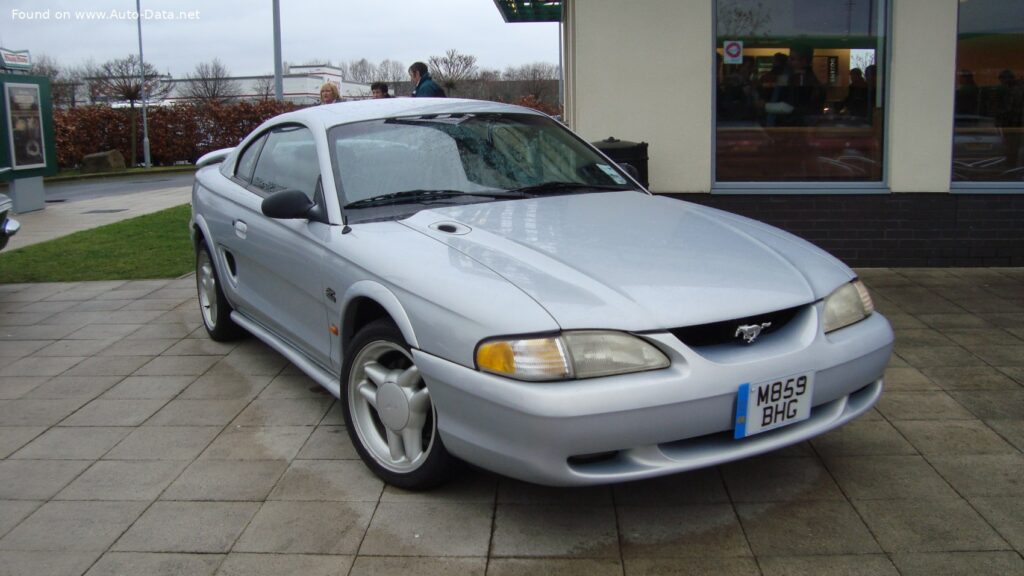
The Ford Mustang IV 4.6i V8 32V Mach I (305 Hp) represents a significant chapter in the storied history of the American pony car. Produced for a limited run between 2003 and 2004, this special edition model revived the iconic Mach 1 nameplate, last seen in 1978, for the fourth generation of the Mustang, often referred to as the SN95 generation. Positioned as a performance variant that bridged the gap between the standard Mustang GT and the top-tier SVT Cobra, the Mach 1 delivered a potent blend of retro styling cues, enhanced handling, and a distinctive powertrain. It was a celebration of Mustang heritage, offering enthusiasts a taste of classic muscle car spirit with modern-era refinements.
Powertrain & Engine Architecture
At the core of the Ford Mustang IV Mach 1’s appeal was its formidable powertrain. Under the distinctive “shaker” hood scoop resided a 4.6-liter (4601 cm3 or 280.77 cu. in.) naturally aspirated V8 engine. This wasn’t just any 4.6-liter V8; it was a 32-valve DOHC (Dual Overhead Camshaft) unit, a detuned version of the engine found in the contemporary SVT Cobra. Unlike the SOHC V8 in the GT, the DOHC configuration allowed for greater breathing efficiency and higher revving capability, contributing to its impressive output.
This V-engine, with its eight cylinders, was longitudinally mounted in the front, driving the rear wheels, a classic Mustang setup. It generated a robust 305 horsepower at 5800 rpm, translating to a power-per-liter ratio of 66.3 Hp/l. Torque figures were equally compelling, peaking at 434 Nm (320.1 lb.-ft.) at 4200 rpm, ensuring strong acceleration across the rev range. The engine featured a multi-port manifold injection system and a compression ratio of 10.1:1, optimized for premium gasoline.
Power was delivered through a standard 5-speed manual transmission, offering an engaging and direct driving experience that true enthusiasts craved. An automatic transmission was also available, a 4-speed 4R70W unit. This transmission featured electronic control and overdrive, contributing to improved fuel efficiency at highway speeds. The automatic version, while offering convenience, did slightly diminish the car’s overall acceleration performance compared to the manual.
Driving Characteristics
The 2003-2004 Mustang Mach 1 with the 4.6L DOHC V8 and 5-speed manual transmission provided a visceral driving experience. The engine’s powerband was relatively flat, delivering strong torque throughout the majority of the rev range. The manual gearbox offered precise shifts and allowed drivers to fully exploit the engine’s capabilities. The car felt responsive and eager to accelerate, making it enjoyable on both winding roads and open highways.
The automatic transmission version, while smooth and convenient, altered the driving dynamics. The 4R70W transmission, while reliable, had slightly taller gear ratios, resulting in a less immediate feel. Acceleration was still respectable, but the driver was more reliant on the transmission to select the optimal gear for a given situation. The automatic Mach 1 was often favored by drivers seeking a more comfortable and relaxed driving experience, prioritizing ease of use over outright performance.
Compared to the standard Mustang GT, the Mach 1 offered noticeably improved handling due to its upgraded suspension components. The steering felt more precise, and the car exhibited less body roll in corners. However, it didn’t quite match the handling prowess of the SVT Cobra, which featured an independent rear suspension.
Equipment & Trim Levels
The Mach 1 was positioned as a performance-oriented trim, offering a more comprehensive set of features than the base Mustang GT. Standard equipment included the unique retro-inspired exterior styling, including the shaker hood scoop, blacked-out grille, and rear spoiler. Inside, the Mach 1 featured sport seats with unique upholstery, aluminum pedals, and a leather-wrapped steering wheel.
Optional extras included a premium audio system, power-adjustable seats, and a sunroof. Many Mach 1s were also equipped with the automatic transmission, which added a degree of convenience. The interior color schemes were typically dark, with black and dark gray being the most common choices, reflecting the car’s performance-focused character. The Mach 1 did not offer the same level of customization options as some other Mustang trims, focusing instead on a consistent and purposeful package.
Chassis & Braking
The Ford Mustang IV Mach 1 utilized a traditional Mustang chassis configuration. The front suspension featured an independent wishbone setup, while the rear suspension employed a solid axle with coil springs. This setup, while not as sophisticated as the independent rear suspension found on the SVT Cobra, provided a good balance of ride comfort and handling performance. Upgraded shocks and springs were used compared to the standard Mustang GT, contributing to improved stability and control.
Braking duties were handled by disc brakes on all four wheels. The front brakes featured larger rotors and calipers than the standard Mustang GT, providing enhanced stopping power. Anti-lock Braking System (ABS) was standard equipment, improving safety and control during hard braking maneuvers. The Mach 1’s braking performance was considered adequate for its performance level, but it didn’t quite match the stopping power of some of its more focused competitors.
Market Reception & Comparison
The 2003-2004 Ford Mustang IV Mach 1 was generally well-received by automotive critics. It was praised for its retro styling, potent engine, and improved handling compared to the standard Mustang GT. However, some critics noted that it didn’t quite live up to the performance expectations set by the SVT Cobra. The Mach 1 was seen as a compelling alternative for enthusiasts who wanted a performance Mustang with a unique character and a more affordable price tag.
In terms of fuel economy, the Mach 1 offered respectable figures for a V8-powered performance coupe of its era, rated at an estimated 16.9 US mpg in urban driving and 25 US mpg on the highway. Reliability was generally good, with the 4.6L DOHC V8 proving to be a durable and dependable engine. However, some owners reported minor issues with the automatic transmission and certain electrical components. Compared to the Mustang GT, the Mach 1 offered a more refined and engaging driving experience, but at a slightly higher price point.
Technical Specifications
| Category | Specification |
| General Information | |
| Brand | Ford |
| Model | Mustang |
| Generation | Mustang IV (SN95) |
| Type (Engine) | 4.6i V8 32V Mach I (305 Hp) |
| Start of Production | 2003 year |
| End of Production | 2004 year |
| Powertrain Architecture | Internal Combustion engine |
| Body type | Coupe |
| Seats | 4 |
| Doors | 2 |
| Performance Specs | |
| Fuel consumption (economy) – urban | 13.9 l/100 km (16.9 US mpg) |
| Fuel consumption (economy) – extra urban | 9.4 l/100 km (25 US mpg) |
| Fuel Type | Petrol (Gasoline) |
| Weight-to-power ratio | 5.3 kg/Hp (190.4 Hp/tonne) |
| Weight-to-torque ratio | 3.7 kg/Nm (270.9 Nm/tonne) |
| Engine Specs | |
| Power | 305 Hp @ 5800 rpm |
| Power per liter | 66.3 Hp/l |
| Torque | 434 Nm @ 4200 rpm (320.1 lb.-ft.) |
| Engine layout | Front, Longitudinal |
| Engine displacement | 4601 cm3 (280.77 cu. in.) |
| Number of cylinders | 8 |
| Engine configuration | V-engine |
| Cylinder Bore | 90.2 mm (3.55 in.) |
| Piston Stroke | 90 mm (3.54 in.) |
| Compression ratio | 10.1:1 |
| Number of valves per cylinder | 4 |
| Fuel injection system | Multi-port manifold injection |
| Engine aspiration | Naturally aspirated engine |
| Valvetrain | DOHC |
| Engine oil capacity | 5.7 l (6.02 US qt) |
| Coolant capacity | 15.2 l (16.06 US qt) |
| Space, Volume and Weights | |
| Kerb Weight | 1602 kg (3531.81 lbs) |
| Trunk (boot) space – minimum | 310 l (10.95 cu. ft.) |
| Fuel tank capacity | 59 l (15.59 US gal) |
| Dimensions | |
| Length | 4654 mm (183.23 in.) |
| Width | 1857 mm (73.11 in.) |
| Height | 1330 mm (52.36 in.) |
| Wheelbase | 2573 mm (101.3 in.) |
| Front track | 1529 mm (60.2 in.) |
| Rear (Back) track | 1539 mm (60.59 in.) |
| Drivetrain, Brakes and Suspension Specs | |
| Drivetrain Architecture | The Internal combustion engine (ICE) drives the rear wheels of the vehicle. |
| Drive wheel | Rear wheel drive |
| Number of gears and type of gearbox | 5 gears, manual transmission / 4 gears, automatic transmission |
| Front suspension | Wishbone |
| Rear suspension | Coil spring |
| Front brakes | Disc |
| Rear brakes | Disc |
| Assisting systems | ABS (Anti-lock braking system) |
| Steering type | Steering rack and pinion |
| Power steering | Hydraulic Steering |
| Tires size | 245/45 R17 |
Legacy
The reintroduction of the Mach 1 nameplate for the Mustang IV generation was a strategic move by Ford, capitalizing on the model’s rich history and the growing demand for retro-inspired performance. In its brief two-year production run, the Ford Mustang IV 4.6i V8 32V Mach I (305 Hp) carved out a distinct niche in the American performance car market. It offered a compelling alternative to both the standard Mustang GT, which had a less powerful SOHC 4.6L V8, and the more expensive, independently-rear-suspended SVT Cobra.
Today, the 2003-2004 Mach 1 is gaining recognition as a modern classic. Its limited production numbers and unique styling have made it a desirable collectible among Mustang enthusiasts. The 4.6L DOHC V8 engine, while not the most powerful engine ever offered in a Mustang, is known for its reliability and durability. Well-maintained examples of the Mach 1 continue to command respectable prices in the used car market, reflecting their growing appeal and historical significance. The Mach 1 remains a testament to Ford’s commitment to its heritage, offering a driving experience that is both engaging and deeply rooted in American automotive culture.