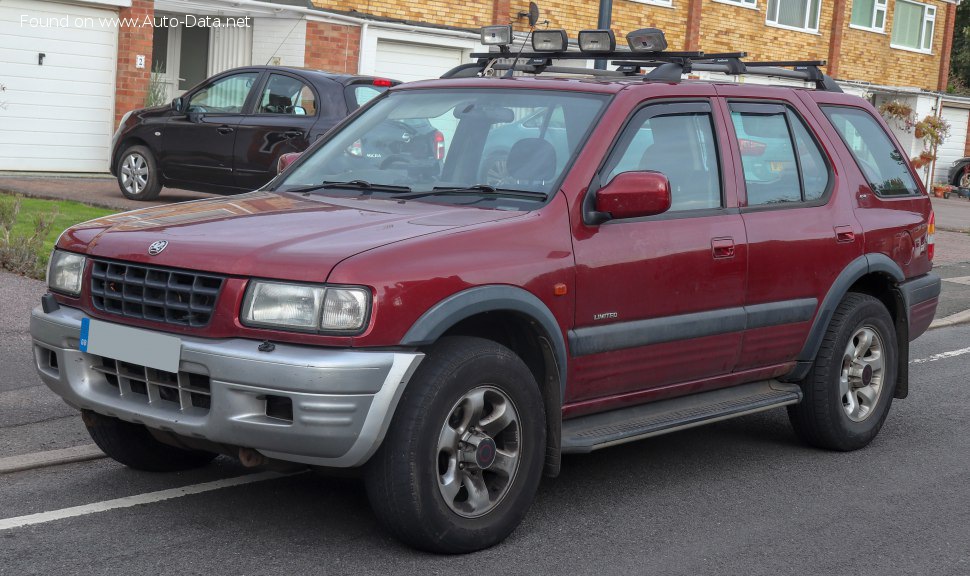
The Vauxhall Frontera 2.3 TD (100 Hp) represents a significant chapter in the evolution of the sport utility vehicle (SUV) segment in Europe during the early to mid-1990s. Launched in 1992, the first-generation Frontera was Vauxhall’s entry into the rapidly expanding market for rugged, go-anywhere vehicles that also served as practical family transport. While the Vauxhall brand itself is primarily associated with the United Kingdom and was not sold in the United States, the Frontera was a rebadged version of the Isuzu Rodeo (two-door variant known as the Isuzu Amigo), an American-market staple. This strategic rebadging allowed General Motors (GM), Vauxhall’s parent company, to offer a competitive and proven platform to European consumers without the expense of developing an entirely new vehicle from scratch. Produced between 1992 and 1995, this particular variant, the 2.3 TD with 100 horsepower, was a popular choice for its balance of capability, economy, and price point. It carved out a niche as a durable, no-nonsense SUV, appealing to buyers seeking a vehicle that could handle diverse driving conditions, from urban commuting to light off-road excursions. The Frontera was instrumental in popularizing the SUV concept in Europe, bridging the gap between traditional utilitarian 4x4s and the more comfortable, family-oriented SUVs that would dominate the market in later decades.
Powertrain & Engine Architecture
The heart of the Vauxhall Frontera 2.3 TD (100 Hp) was its 2.3-liter (2260 cm³ or 137.91 cu. in.) inline-four turbo-diesel engine, internally designated with the code 23DTR. This engine was a workhorse, designed for durability and low-end torque rather than outright speed. It produced 100 horsepower at 4200 rpm and a more substantial 215 Nm (158.58 lb.-ft.) of torque at 2200 rpm. The engine utilized a precombustion chamber injection system, a common diesel technology of the era. This system involved a small pre-chamber connected to the main combustion chamber, where fuel was initially injected and ignited, then transferred to the main chamber for complete combustion. This design helped to reduce engine noise and improve combustion efficiency. The addition of a turbocharger and intercooler significantly boosted power and efficiency compared to naturally aspirated diesel engines.
The Frontera 2.3 TD was exclusively offered with a 5-speed manual transmission. This transmission was chosen for its robustness and direct driver control, appealing to those who valued off-road capability. The transmission’s gear ratios were geared towards maximizing torque delivery, prioritizing pulling power over rapid acceleration. The all-wheel-drive (4×4) system was a part-time system, allowing the driver to switch between two-wheel drive (2H) for normal road conditions and four-wheel drive (4H) for increased traction on slippery surfaces or off-road terrain. A low-range gear selection was also available for particularly challenging off-road situations.
Driving Characteristics
The driving experience in the Frontera 2.3 TD was characterized by its robust feel and ample torque. While not a fast vehicle – 0 to 60 mph took a leisurely 18.3 seconds, with a top speed of 91.34 mph – it offered sufficient power for everyday driving and light off-road work. The turbocharger provided a noticeable boost in power once spooled up, but there was some turbo lag at lower engine speeds. The 5-speed manual transmission allowed drivers to keep the engine in its optimal torque range, maximizing pulling power. Compared to higher-output Frontera variants, such as those equipped with gasoline engines, the 2.3 TD offered significantly more torque at lower RPMs, making it better suited for towing and off-road driving. However, it lacked the responsiveness and overall speed of the gasoline-powered models. Compared to the later 2.5 TDI engine, the 2.3 TD offered a slightly smoother and quieter driving experience, but with less overall power.
Equipment & Trim Levels
The Vauxhall Frontera 2.3 TD was generally positioned as a mid-range offering within the Frontera lineup. Standard equipment included basic features such as power steering, central locking, and a basic stereo system. Interior upholstery was typically a durable cloth material, designed to withstand the rigors of family use and outdoor adventures. The dashboard layout was functional and straightforward, with clearly labeled controls. Optional extras included air conditioning, electric windows, and upgraded stereo systems. Higher trim levels, if available, might have added features like alloy wheels, upgraded interior trim, and a sunroof. The Frontera was not known for its luxurious appointments; its focus was on practicality and durability.
Chassis & Braking
The Frontera 2.3 TD utilized a traditional body-on-frame construction, providing a robust and durable chassis. The suspension system consisted of independent double wishbones at the front and a multi-link suspension at the rear. This setup provided a reasonable balance of on-road comfort and off-road capability. The braking system featured ventilated disc brakes on all four wheels, offering reliable stopping power. An Anti-lock Braking System (ABS) was available as an option, enhancing control during emergency braking. The steering system was a worm-reduction type, providing a direct and robust feel. The Frontera’s relatively high ground clearance and robust suspension allowed it to navigate moderately challenging off-road terrain.
Market Reception & Comparison
The Vauxhall Frontera 2.3 TD received generally positive reviews for its robustness, practicality, and affordability. Critics praised its diesel engine for its fuel efficiency and ample torque, making it a good choice for long-distance travel and towing. However, some reviewers noted its relatively slow acceleration and somewhat agricultural driving experience. Compared to other SUVs in the European market, the Frontera offered a compelling value proposition, combining proven Isuzu mechanicals with Vauxhall’s accessible pricing. Its fuel economy of 22.8 US mpg (10.3 l/100 km) was commendable for a full-frame 4×4 SUV of its size and weight. In terms of reliability, the Frontera 2.3 TD was generally considered to be a durable and dependable vehicle, although diesel engines of that era could be prone to issues with fuel injection systems and turbochargers if not properly maintained.
Technical Specifications
| Category | Specification |
| General Information | Brand: Vauxhall |
| Model: Frontera | |
| Generation: Frontera (First Generation) | |
| Type (Engine): 2.3 TD (100 Hp) | |
| Start of Production: 1992 | |
| End of Production: 1995 | |
| Powertrain Architecture: Internal Combustion Engine | |
| Body Type: SUV | |
| Seats: 5 | |
| Doors: 5 | |
| Performance Specifications | Fuel Consumption (Urban): 11.2 l/100 km (21 US mpg) |
| Fuel Consumption (Extra Urban): 8.1 l/100 km (29 US mpg) | |
| Fuel Consumption (Combined): 10.3 l/100 km (22.8 US mpg) | |
| Fuel Type: Diesel | |
| Acceleration 0 – 60 mph: 18.3 sec | |
| Maximum Speed: 147 km/h (91.34 mph) | |
| Weight-to-Power Ratio: 17.9 kg/Hp (56 Hp/tonne) | |
| Weight-to-Torque Ratio: 8.3 kg/Nm (120.4 Nm/tonne) | |
| Engine Specifications | Power: 100 Hp @ 4200 rpm |
| Power per Liter: 44.2 Hp/l | |
| Torque: 215 Nm @ 2200 rpm (158.58 lb.-ft. @ 2200 rpm) | |
| Engine Layout: Front, Longitudinal | |
| Engine Model/Code: 23DTR | |
| Engine Displacement: 2260 cm³ (137.91 cu. in.) | |
| Number of Cylinders: 4 | |
| Engine Configuration: Inline | |
| Cylinder Bore: 92 mm (3.62 in.) | |
| Piston Stroke: 85 mm (3.35 in.) | |
| Compression Ratio: 23:1 | |
| Number of Valves per Cylinder: 2 | |
| Fuel Injection System: Precombustion Chamber Injection | |
| Engine Aspiration: Turbocharger, Intercooler | |
| Engine Oil Capacity: 5.5 l (5.81 US qt) | |
| Coolant Capacity: 8.8 l (9.3 US qt) | |
| Space, Volume and Weights | Kerb Weight: 1785 kg (3935.25 lbs.) |
| Max. Weight: 2550 kg (5621.79 lbs.) | |
| Max Load: 765 kg (1686.54 lbs.) | |
| Trunk (boot) Space – Minimum: 430 l (15.19 cu. ft.) | |
| Trunk (boot) Space – Maximum: 1570 l (55.44 cu. ft.) | |
| Fuel Tank Capacity: 80 l (21.13 US gal) | |
| Dimensions | Length: 4480 mm (176.38 in.) |
| Width: 1730 mm (68.11 in.) | |
| Height: 1715 mm (67.52 in.) | |
| Wheelbase: 2760 mm (108.66 in.) | |
| Front Track: 1440 mm (56.69 in.) | |
| Rear Track: 1445 mm (56.89 in.) | |
| Drivetrain, Brakes and Suspension Specs | Drive Wheel: All-wheel drive (4×4) |
| Number of Gears and Type of Gearbox: 5 gears, manual transmission | |
| Front Brakes: Ventilated Discs | |
| Rear Brakes: Ventilated Discs | |
| Assisting Systems: ABS (Anti-lock Braking System) | |
| Steering Type: Worm-reduction unit | |
| Tires Size: 235/70 R15 | |
| Wheel Rims Size: 7J x 15 |
Legacy
The Vauxhall Frontera 2.3 TD, while now a classic vehicle, enjoys a reasonable reputation for reliability among enthusiasts and owners. The 23DTR engine, when properly maintained, is known to be a durable and long-lasting unit. However, as with any vehicle of this age, potential issues can arise with fuel injection components, turbochargers, and general wear and tear. In the used car market, the Frontera 2.3 TD is often sought after by those looking for a rugged and affordable 4×4. Its relatively simple mechanicals make it easier to maintain and repair compared to more modern SUVs. While it may not offer the refinement or features of contemporary vehicles, its robust construction and capable performance continue to appeal to a dedicated following. The Frontera 2.3 TD remains a reminder of a time when SUVs were more about practicality and durability than luxury and status.