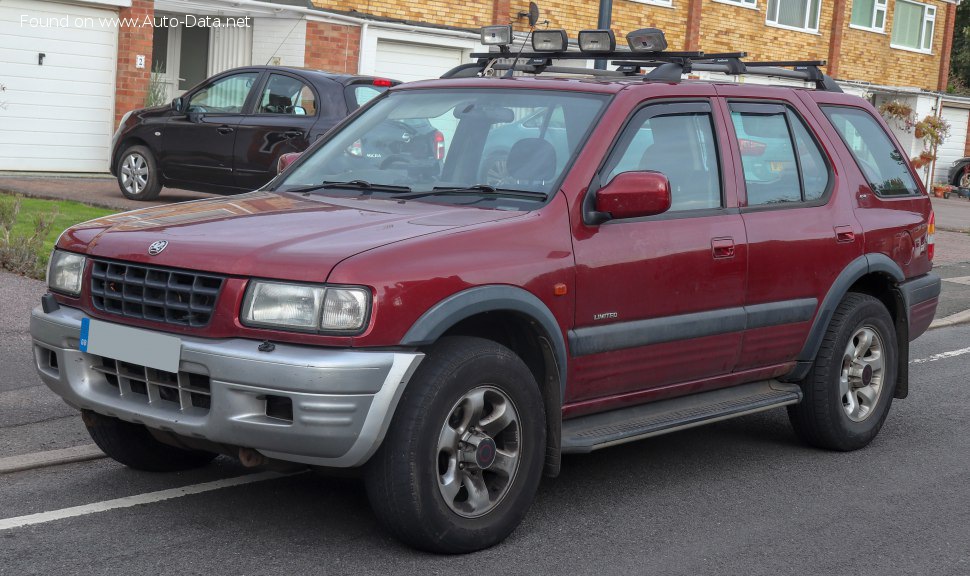
The Vauxhall Frontera 2.4i, produced from 1992 to 1995, represented a significant entry for the British marque Vauxhall into the burgeoning Sport Utility Vehicle (SUV) market in Europe and the United Kingdom. While never officially sold in the United States under the Vauxhall badge, the Frontera was a rebadged version of the Isuzu MU (Mysterious Utility) or Isuzu Wizard/Rodeo, a testament to General Motors’ global platform sharing strategy. This first-generation Frontera, positioned as a rugged, family-friendly off-roader, offered a blend of practical utility, robust construction, and a more car-like driving experience than traditional utilitarian 4x4s of the era. The 2.4i variant, equipped with a four-cylinder gasoline engine, was a popular choice, providing a balance of performance and efficiency for the demanding European market. Its introduction marked Vauxhall’s commitment to diversifying its lineup beyond conventional sedans and hatchbacks, tapping into the growing consumer demand for versatile, go-anywhere vehicles.
Powertrain & Engine Architecture
At the heart of the Vauxhall Frontera 2.4i was the C24NE engine, a naturally aspirated, inline four-cylinder gasoline (petrol) unit. This powerplant, with a displacement of 2,410 cubic centimeters (approximately 2.4 liters or 147.07 cubic inches), was designed for durability and a broad torque curve, characteristic of engines intended for utility vehicles. It featured a multi-port manifold fuel injection system, a relatively modern fuel delivery method for its time, which contributed to more precise fuel metering and improved emissions compared to older carburetor setups. The C24NE was a common engine within the GM family, also found in various Opel, Isuzu, and even Holden vehicles.
The engine produced a respectable 125 horsepower at 4,800 revolutions per minute (rpm), making it a competitive offering within its segment. More importantly for an SUV, it generated 195 Newton-meters (143.82 lb.-ft.) of torque at a relatively low 2,400 rpm. This low-end torque was crucial for off-road capability, towing, and carrying heavy loads, allowing the vehicle to pull away confidently without excessive revving. The power-to-liter ratio stood at 51.9 horsepower per liter, indicating a solid, workhorse design rather than a high-revving performance engine. The C24NE utilized a single overhead camshaft (SOHC) valvetrain with two valves per cylinder, a configuration chosen for its simplicity and reliability.
The Frontera 2.4i was primarily equipped with a four-speed automatic transmission. This transmission, while not known for its cutting-edge technology, was robust and well-suited to the engine’s characteristics. It featured a traditional torque converter and planetary gearsets. Gear ratios were optimized for low-speed torque and towing capacity rather than rapid acceleration. The automatic transmission contributed to the Frontera 2.4i’s appeal to buyers seeking a more comfortable and convenient driving experience, particularly in urban environments.
Driving Characteristics
The 1.8L 90 hp Automatic Frontera occupied the entry-level position in the Frontera lineup. Compared to the 2.4i, the 1.8L offered a more economical option, but at the cost of performance. The 1.8L engine, while still durable, felt noticeably underpowered when fully loaded or tackling steep inclines. Acceleration was significantly slower than the 2.4i, and overtaking required careful planning. The automatic transmission, while providing convenience, further diminished performance due to its conservative gearing and tendency to hunt for gears under load.
The 1.8L Automatic Frontera was geared towards buyers who prioritized fuel economy and affordability over outright performance. It was well-suited for urban driving and light off-road use, but less ideal for frequent highway journeys or demanding towing applications. Compared to the five-speed manual versions of the Frontera, the automatic suffered a noticeable loss of responsiveness and fuel efficiency. The manual transmission allowed drivers to better control the engine’s powerband and extract more performance from the engine.
The suspension tuning of the 1.8L Automatic Frontera was similar to that of the higher-powered models, providing a reasonably comfortable ride on paved roads. However, the added weight of the automatic transmission and the engine’s lower power output meant that the 1.8L felt less agile and more cumbersome in corners. The steering, while robust, lacked the precision of more modern systems.
Equipment & Trim Levels
The Frontera 2.4i, even in its base trim, offered a reasonable level of equipment for a vehicle of its era. Standard features typically included power steering, central locking, electric windows, and an AM/FM radio. Interior upholstery was typically cloth, with a durable and practical design. The dashboard layout was functional and straightforward, with clearly labeled controls. The Frontera 2.4i was available in a range of exterior colors, including metallic shades.
Optional extras included air conditioning, a sunroof, alloy wheels, and upgraded audio systems. Higher trim levels, such as the “Sport” or “Limited” editions, often included these features as standard. The availability of optional extras allowed buyers to customize their Frontera to suit their individual needs and preferences. The interior trim quality varied depending on the trim level, with higher-spec models featuring more luxurious materials and finishes.
The Frontera 2.4i was marketed as a family-friendly SUV, and its equipment levels reflected this. Features like the generous cargo space and the comfortable seating were key selling points for buyers with active lifestyles. The inclusion of safety features like ABS further enhanced its appeal to families.
Chassis & Braking
The Vauxhall Frontera utilized a traditional body-on-frame construction, providing a robust and durable chassis. This construction method allowed for excellent off-road capability and towing capacity. The front suspension featured independent double wishbones with coil springs and anti-roll bar, while the rear suspension employed a live axle with leaf springs. This setup provided a good balance of ride comfort and off-road performance.
The braking system consisted of ventilated disc brakes at the front and drum brakes at the rear. While the drum brakes at the rear were a cost-saving measure, they provided adequate stopping power for most driving conditions. The inclusion of ABS (Anti-lock Braking System) was a significant safety feature, improving stopping performance and control in adverse conditions. The Frontera 2.4i’s braking system was designed to handle the vehicle’s weight and the demands of off-road driving.
The Frontera 2.4i featured a robust steering system, utilizing a worm-reduction unit. While not as precise as modern rack-and-pinion systems, the worm-reduction unit was durable and reliable, capable of withstanding the stresses of off-road use. The steering ratio was optimized for low-speed maneuverability and off-road control.
Market Reception & Comparison
Critics generally viewed the Vauxhall Frontera 2.4i favorably, praising its rugged construction, spacious interior, and off-road capability. However, some reviewers noted that the engine was somewhat underpowered and that the ride quality was not as refined as some of its competitors. The Frontera’s fuel economy was also criticized, as it was relatively poor compared to more modern SUVs.
Compared to the 1.8L variant, the 2.4i offered a significant improvement in performance and towing capacity. However, it also came with a higher price tag and slightly worse fuel economy. The 2.4i was generally considered to be the sweet spot in the Frontera lineup, offering a good balance of performance, practicality, and affordability. Compared to the diesel-powered Fronteras, the 2.4i offered a smoother and quieter driving experience, but lacked the diesel’s superior fuel economy and low-end torque.
In terms of reliability, the Frontera 2.4i proved to be a relatively dependable vehicle. The C24NE engine was known for its durability, and the robust chassis and suspension components were able to withstand years of use. However, some owners reported issues with the automatic transmission and the electrical system.
Technical Specifications
| General Information | |
| Brand | Vauxhall |
| Model | Frontera |
| Generation | Frontera |
| Type (Engine) | 2.4i (125 Hp) |
| Start of Production | 1992 year |
| End of Production | 1995 year |
| Powertrain Architecture | Internal Combustion engine |
| Body Type | SUV |
| Seats | 5 |
| Doors | 5 |
| Performance Specs | |
| Fuel Consumption (Economy) – Urban | 13.3 l/100 km (17.7 US mpg) |
| Fuel Consumption (Economy) – Extra Urban | 8.7 l/100 km (27 US mpg) |
| Fuel Consumption (Economy) – Combined | 11.7 l/100 km (20.1 US mpg) |
| Fuel Type | Petrol (Gasoline) |
| Acceleration 0 – 60 mph | 15.7 sec |
| Maximum Speed | 153 km/h (95.07 mph) |
| Weight-to-Power Ratio | 13.8 kg/Hp (72.5 Hp/tonne) |
| Weight-to-Torque Ratio | 8.8 kg/Nm (113 Nm/tonne) |
| Engine Specs | |
| Power | 125 Hp @ 4800 rpm |
| Power per Liter | 51.9 Hp/l |
| Torque | 195 Nm @ 2400 rpm (143.82 lb.-ft. @ 2400 rpm) |
| Engine Layout | Front, Longitudinal |
| Engine Model/Code | C24NE |
| Engine Displacement | 2410 cm3 (147.07 cu. in.) |
| Number of Cylinders | 4 |
| Engine Configuration | Inline |
| Cylinder Bore | 95 mm (3.74 in.) |
| Piston Stroke | 85 mm (3.35 in.) |
| Compression Ratio | 9.2:1 |
| Number of Valves per Cylinder | 2 |
| Fuel Injection System | Multi-port manifold injection |
| Engine Aspiration | Naturally aspirated engine |
| Engine Oil Capacity | 5.5 l (5.81 US qt) |
| Coolant Capacity | 8.3 l (8.77 US qt) |
| Space, Volume and Weights | |
| Kerb Weight | 1725 kg (3802.97 lbs.) |
| Max. Weight | 2400 kg (5291.09 lbs.) |
| Max Load | 675 kg (1488.12 lbs.) |
| Trunk (Boot) Space – Minimum | 430 l (15.19 cu. ft.) |
| Trunk (Boot) Space – Maximum | 1570 l (55.44 cu. ft.) |
| Fuel Tank Capacity | 80 l (21.13 US gal) |
| Dimensions | |
| Length | 4480 mm (176.38 in.) |
| Width | 1730 mm (68.11 in.) |
| Height | 1715 mm (67.52 in.) |
| Wheelbase | 2760 mm (108.66 in.) |
| Front Track | 1440 mm (56.69 in.) |
| Rear (Back) Track | 1445 mm (56.89 in.) |
| Drivetrain, Brakes and Suspension Specs | |
| Drive Wheel | All-wheel drive (4×4) |
| Number of Gears and Type of Gearbox | 5 gears, manual transmission |
| Front Brakes | Ventilated discs |
| Rear Brakes | Drum |
| Assisting Systems | ABS (Anti-lock braking system) |
| Steering Type | Worm-reduction unit |
| Tires Size | 235/70 R16 |
| Wheel Rims Size | 7J x 16 |
Legacy
The Vauxhall Frontera, particularly the 2.4i variant, remains a popular choice among enthusiasts and collectors of classic SUVs. Its robust construction, off-road capability, and relatively simple mechanicals make it a practical and rewarding vehicle to own. Parts availability is generally good, thanks to the Frontera’s widespread use of GM components. However, as with any vehicle of its age, regular maintenance and careful inspection are essential to ensure its continued reliability.
On the used car market today, the Frontera 2.4i commands reasonable prices, reflecting its age and mileage. Well-maintained examples with low mileage are particularly sought after. The Frontera’s enduring appeal lies in its ability to provide a unique blend of ruggedness, practicality, and affordability. It represents a bygone era of SUV design, when durability and capability were prioritized over luxury and refinement. The Frontera 2.4i stands as a testament to Vauxhall’s early foray into the SUV market and its commitment to providing versatile vehicles for the British public.