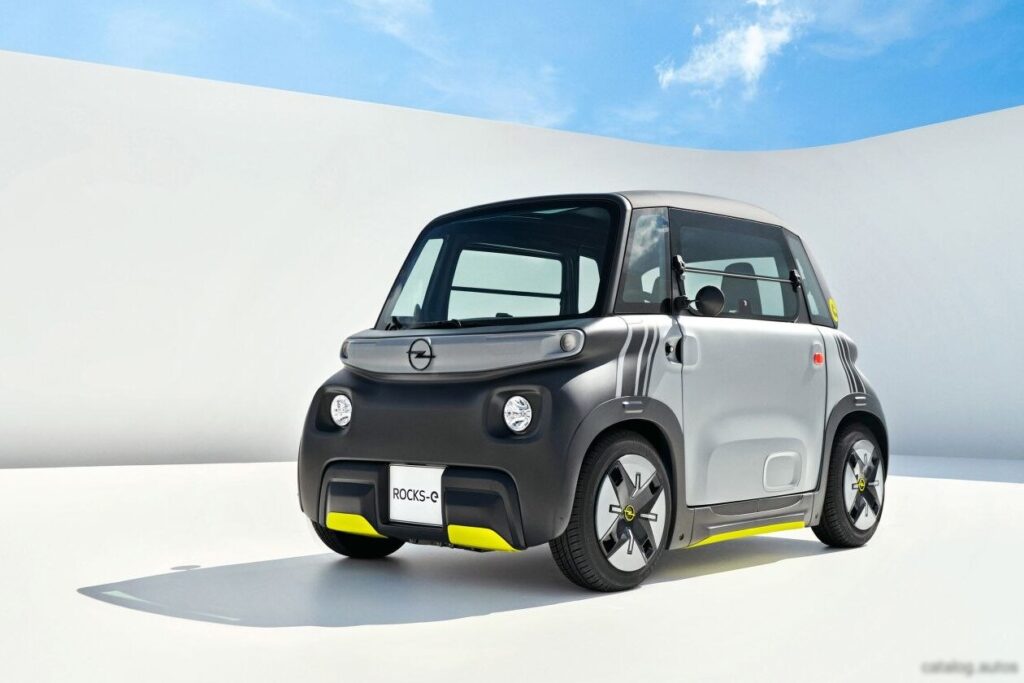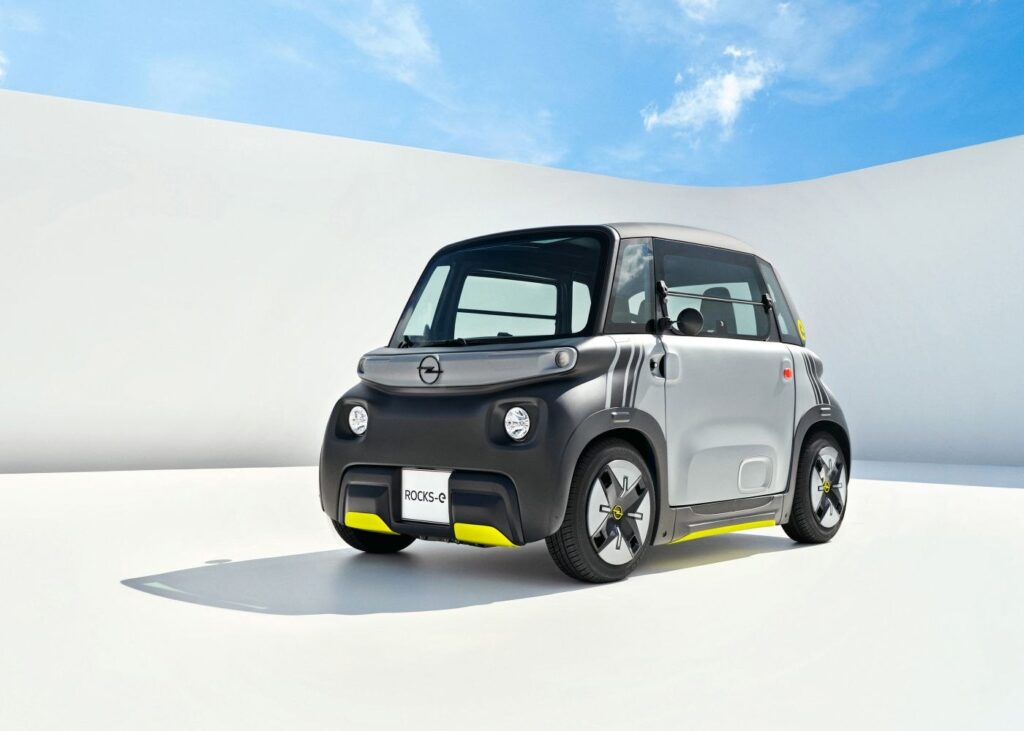
The Opel Rocks-e, introduced in 2022, represents a pivotal shift in urban mobility, particularly within the European market. As a Battery Electric Vehicle (BEV) classified as a quadricycle, it stands apart from conventional passenger cars, offering a unique solution for navigating congested cityscapes. This compact, two-seater vehicle is Opel’s answer to the growing demand for affordable, sustainable, and accessible personal transportation, especially for younger drivers. While not available in the United States, its innovative design and strategic market positioning make it a significant model in the global automotive landscape, showcasing how manufacturers are adapting to diverse mobility needs.
The Opel Rocks-e: Redefining Urban Mobility
Concept and Market Positioning
The fundamental concept behind the Opel Rocks-e is rooted in its classification as a light quadricycle (L6e category in Europe). This designation is crucial, as it dictates the vehicle’s technical specifications and, more importantly, its accessibility. In several European countries, light quadricycles can be driven by individuals as young as 14 or 16 years old with a specific type of driver’s license (e.g., AM license), which is less stringent than a full automobile license. This makes the Rocks-e an ideal first “vehicle” for teenagers, offering independence and protection from the elements, a significant advantage over two-wheeled alternatives.
For adult commuters, the Rocks-e serves as an ultra-compact, zero-emission solution for daily errands, short commutes, and navigating narrow city streets where parking is at a premium. Its diminutive size and electric powertrain contribute to reduced urban congestion and improved air quality, aligning with the sustainability goals of many European cities. The vehicle’s straightforward design and limited top speed of 27.96 mph are perfectly suited for urban environments, where higher speeds are rarely achievable or necessary. It competes not just with other quadricycles but also indirectly with public transport and ride-sharing services, offering a private, personal space for travel.
Design Philosophy and Practicality
The design of the Opel Rocks-e is a masterclass in functional minimalism. Its distinctive, almost symmetrical aesthetic is not merely a stylistic choice but a practical engineering decision. Both the front and rear body panels are identical, as are the left and right doors (though hinged differently, with the driver’s door opening conventionally and the passenger’s door opening rearward). This clever approach significantly reduces manufacturing complexity and costs, contributing to its affordability.
Despite its compact footprint, measuring just 94.88 inches in length and 54.65 inches in width, the Rocks-e maximizes interior space for its two occupants. The cabin is designed to be airy and offers surprisingly good visibility, crucial for urban driving. The focus is on core functionality, with a straightforward dashboard and essential controls. This design philosophy underscores its purpose: to be a practical, no-frills urban transporter that prioritizes ease of use and low running costs. Its robust appearance, with prominent lighting signatures and protective cladding, gives it a friendly yet resilient character, perfectly suited for the urban jungle.
Powertrain & Engine Architecture (5.5 kWh 12 Hp Electric)
The powertrain of the Opel Rocks-e 5.5 kWh (12 Hp) is a testament to efficiency and simplicity, perfectly tailored for its intended use as an urban quadricycle. It is a pure Battery Electric Vehicle (BEV), meaning it runs solely on electric power with zero tailpipe emissions.
At its heart is a single electric motor, strategically located on the front axle and mounted transversely. This motor delivers a modest yet entirely adequate 12 horsepower (Hp) and 32.45 lb.-ft. of torque. These figures, while seemingly low compared to conventional cars, are more than sufficient to propel the lightweight Rocks-e (with a curb weight of just 1038.38 lbs.) through city traffic. The immediate torque delivery characteristic of electric motors ensures brisk acceleration from a standstill, making it agile enough for urban cut-and-thrust driving.
Powering the electric motor is a 5.5 kWh gross capacity Lithium-ion (Li-Ion) battery. This battery pack is cleverly integrated below the floor, a common practice in electric vehicles to maintain a low center of gravity and optimize interior space. The energy density of the Li-Ion technology provides an official all-electric range (WLTP) of 46.6 miles, which is ample for the vast majority of urban commutes and daily errands. Given its primary use case, a typical user would likely recharge every few days, depending on their travel patterns.
The drivetrain architecture is straightforward: one electric motor drives the front wheels, providing a familiar and predictable front-wheel-drive experience. The transmission is a single-gear automatic, eliminating the need for gear changes and further simplifying the driving experience, which is particularly beneficial for novice drivers. Performance figures include a maximum speed limited to 27.96 mph (45 km/h), a regulatory requirement for light quadricycles in Europe, ensuring it remains suitable for its intended low-speed urban environment. Its weight-to-power ratio stands at 39.3 kg/Hp (25.5 Hp/tonne), and a weight-to-torque ratio of 10.7 kg/Nm (93.4 Nm/tonne), highlighting its efficient use of available power for its mass.
Driving Characteristics
The driving experience in the Opel Rocks-e is defined by its simplicity and agility. The 12 hp electric motor provides sufficient power for navigating city streets, with brisk acceleration from a standstill. The single-speed automatic transmission ensures smooth and effortless operation. While not designed for highway driving, the Rocks-e excels in urban environments, where its compact size and nimble handling are significant advantages. The limited top speed of 27.96 mph is a regulatory requirement and aligns with the vehicle’s intended use case. Compared to a conventional gasoline-powered car, the Rocks-e offers a quieter and more refined driving experience, with instant torque delivery and zero emissions.
Equipment & Trim Levels
The Opel Rocks-e is intentionally minimalist in terms of equipment and trim levels. It focuses on providing essential functionality at an affordable price point. Standard features include a digital instrument cluster, basic lighting, seatbelts, and a robust structure for a quadricycle. Optional extras are limited, but may include a panoramic glass roof and different exterior color options. The interior is designed for durability and ease of cleaning, with hard-wearing plastics and minimal ornamentation. The emphasis is on practicality and functionality rather than luxury or comfort.
Chassis & Braking
The chassis of the Opel Rocks-e is engineered for urban agility and comfort. It features an independent McPherson type front suspension, a common and effective setup for compact vehicles, providing a decent balance of ride comfort and handling precision. The rear suspension utilizes a torsion beam, a simple and space-efficient design well-suited for a vehicle of this size and weight.
Braking is handled by disc brakes at the front and drum brakes at the rear, a conventional and reliable combination for its performance capabilities. The steering system is a steering rack and pinion type, complemented by electric power steering. This electric assistance significantly reduces steering effort, making the Rocks-e exceptionally easy to maneuver in tight urban spaces and during parking, a critical feature for its target audience.
Market Reception & Comparison
The Opel Rocks-e has carved out a distinct niche in the European automotive market since its introduction. Its primary appeal lies in its affordability, low running costs, and accessibility, particularly for the younger demographic. In countries like Germany, France, and Italy, where quadricycles have a more established presence and a younger minimum driving age, the Rocks-e has been well-received as a safe, enclosed, and environmentally friendly alternative to mopeds or scooters. Its urban-centric design and limited range are not seen as drawbacks but as features perfectly aligned with its intended use.
Competitors in its segment primarily include its platform sibling, the Citroën Ami, which enjoys similar success. Other light quadricycles from manufacturers like Ligier and Microcar also operate in this space, but the Rocks-e (and Ami) stand out due to their modern electric powertrain, distinctive styling, and the backing of a major automotive group like Stellantis. This gives them a significant advantage in terms of brand recognition, dealership networks, and perceived reliability. The Rocks-e has helped Opel broaden its portfolio beyond traditional cars, tapping into a growing segment of urban personal mobility solutions.
Technical Specifications
| Category | Specification |
| General Information | |
| Brand | Opel |
| Model | Rocks-e |
| Generation | Rocks-e |
| Type (Engine) | 5.5 kWh (12 Hp) |
| Start of production | 2022 year |
| Powertrain Architecture | BEV (Electric Vehicle) |
| Body type | Quadricycle |
| Seats | 2 |
| Doors | 2 |
| Performance Specs | |
| Fuel Type | Electricity |
| Maximum speed | 27.96 mph |
| Weight-to-power ratio | 39.3 kg/Hp (25.5 Hp/tonne) |
| Weight-to-torque ratio | 10.7 kg/Nm (93.4 Nm/tonne) |
| Electric Cars and Hybrids Specs | |
| Gross battery capacity | 5.5 kWh |
| Battery technology | Lithium-ion (Li-Ion) |
| Battery location | Below the floor |
| All-electric range (WLTP) | 46.6 mi |
| Electric motor power | 12 Hp |
| Electric motor Torque | 32.45 lb.-ft. |
| Electric motor location | Front axle, Transverse |
| System power | 12 Hp |
| System torque | 32.45 lb.-ft. |
| Space, Volume and Weights | |
| Kerb Weight | 1038.38 lbs. |
| Trunk (boot) space – minimum | 2.22 cu. ft. |
| Dimensions | |
| Length | 94.88 in. |
| Width | 54.65 in. |
| Width including mirrors | 60.55 in. |
| Height | 60.04 in. |
| Minimum turning circle (turning diameter) | 23.62 ft. |
| Drivetrain, Brakes and Suspension Specs | |
| Drivetrain Architecture | One electric motor drives the front wheels. |
| Drive wheel | Front wheel drive |
| Number of gears and type of gearbox | 1 gear, automatic transmission |
| Front suspension | Independent type McPherson |
| Rear suspension | Torsion |
| Front brakes | Disc |
| Rear brakes | Drum |
| Steering type | Steering rack and pinion |
| Power steering | Electric Steering |
| Tires size | 155/65 R14 |
| Wheel rims size | 14 |
Legacy and Market Impact
The historical significance of the Opel Rocks-e extends beyond its immediate sales figures. It represents a tangible step towards more sustainable urban transportation. As a zero-emission BEV, it contributes to reducing local air pollution and noise levels in densely populated areas. Its compact size helps alleviate traffic congestion and parking challenges, which are endemic in many European cities. By offering a practical and affordable entry point into electric mobility, the Rocks-e plays a crucial role in normalizing EV adoption, particularly among younger generations who are increasingly environmentally conscious.
Furthermore, the Opel Rocks-e challenges the traditional notion of what a “car” should be. It highlights a future where personal transportation is diversified, with purpose-built vehicles tailored for specific needs and environments. This strategic move by Opel demonstrates foresight in adapting to evolving consumer preferences and regulatory pressures, particularly those pushing for decarbonization of urban transport.
Looking ahead, the Opel Rocks-e, along with similar micro-mobility solutions, is likely to influence the future landscape of urban transportation. Its success could encourage other manufacturers to explore similar segments, leading to more innovation in compact electric vehicles. As urban centers continue to grapple with environmental concerns and infrastructure limitations, vehicles like the Rocks-e offer a compelling vision for personal mobility: efficient, sustainable, and accessible. It underscores Opel’s commitment to electric vehicles and its adaptability in catering to a broader spectrum of mobility requirements, cementing its legacy as a pioneer in the evolving world of urban electric transport.