The Renault Clio Sport (Phase I) 3.0 V6, produced from 2000 to 2002, stands as one of the most audacious and unique creations in the history of the hot hatchback segment. Breaking decisively from the conventional front-engine, front-wheel-drive layout of its standard Clio brethren, this special edition was a radical re-engineering project by Renault Sport, transforming a humble subcompact into a rear-wheel-drive, mid-engined powerhouse. Conceived as a spiritual successor to the legendary Renault 5 Turbo, the Clio V6 was not merely a performance variant but a bespoke, hand-built machine that redefined expectations for what a small car could be, particularly within the European market where it gained significant notoriety. Its aggressive styling, intoxicating V6 soundtrack, and challenging handling characteristics cemented its legacy as a true driver’s car and a cult classic.
Engineering Extremism: The Renault Clio Sport (Phase I) 3.0 V6 Powertrain
Engine & Performance
At the heart of the Renault Clio Sport (Phase I) 3.0 V6 lies a transversely mounted 2.9-liter (2946 cm³, or 179.78 cu. in.) L7X 760 V6 engine, positioned directly behind the driver and passenger seats. This naturally aspirated, DOHC (Double Overhead Camshaft) unit, with 4 valves per cylinder and a robust 11.4:1 compression ratio, was a modified version of the engine found in larger Renault and PSA vehicles. In this application, it delivered a formidable 226 horsepower at 6000 rpm, translating to a specific output of 76.7 Hp per liter. Peak torque arrived at 3750 rpm, providing 221.27 lb.-ft. (300 Nm) to the rear wheels.
This unique powertrain architecture, where the engine drives the rear wheels, was paired exclusively with a precise 6-speed manual transmission, offering direct engagement for the driver. The performance figures were impressive for a car of its size and era: the Clio V6 could sprint from 0 to 60 mph in a swift 6.1 seconds (0-100 km/h in 6.4 seconds) and reach a top speed of 146.02 mph (235 km/h). Its weight-to-power ratio stood at 5.9 kg/Hp (169.3 Hp/tonne), underscoring its focused performance intent.
Given its high-performance V6 engine, fuel economy, while not a primary concern for its target audience, was predictably modest. The combined cycle fuel consumption was rated at 21 US mpg (11.2 l/100 km), with urban driving seeing figures drop to 15.8 US mpg (14.9 l/100 km) and extra-urban cruising improving to 26.4 US mpg (8.9 l/100 km).
Fuel Injection and Valvetrain
The L7X 760 engine utilized a multi-port fuel injection system, delivering fuel directly into the intake ports just before the intake valves. This system, while not as advanced as direct injection found in later engines, provided precise fuel metering and efficient combustion for the time. The DOHC valvetrain, with four valves per cylinder, maximized airflow into and out of the combustion chambers, contributing to the engine’s high specific output. The valve timing was carefully optimized to provide a broad torque curve and strong top-end power.
Design & Features
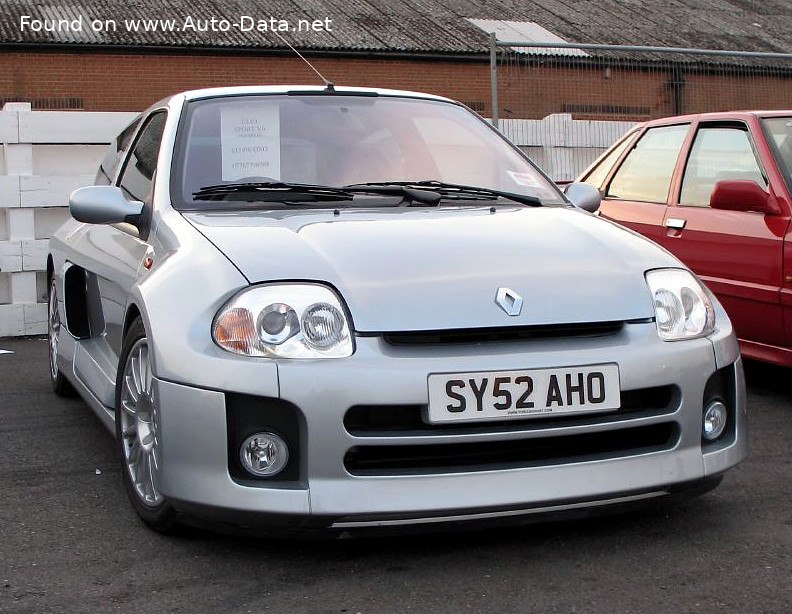
The exterior design of the Renault Clio Sport (Phase I) 3.0 V6 was a dramatic departure from the standard Clio hatchback, instantly signaling its specialized nature. While retaining the 3-door hatchback body type, the car’s dimensions were significantly altered. It was substantially wider at 71.26 inches (1810 mm), with massively flared wheel arches accommodating the wider track (59.06 inches front, 59.45 inches rear) and larger 17-inch wheels shod with 235/45 R17 tires. The overall length remained compact at 149.61 inches (3800 mm), and the height was 53.54 inches (1360 mm), giving it a squat, aggressive stance. The rear quarter panels featured distinctive air intakes to feed the mid-mounted engine, and the rear fascia incorporated dual exhaust outlets, completing its menacing look.
Inside, the transformation was equally radical. To accommodate the V6 engine, the rear seats were entirely removed, making the Clio V6 a strict 2-seater. This emphasized its role as a focused performance machine rather than a practical daily driver. The interior featured sporty bucket seats, specific instrumentation, and trim unique to the V6 model, enhancing the performance ambiance.
Chassis & Braking
Underneath, the chassis received extensive modifications. The front suspension utilized a spring strut setup, while the rear featured a torsion beam arrangement – a highly unusual choice for a rear-wheel-drive performance car, though likely heavily reinforced and tuned by Renault Sport for optimal handling. Braking was handled by ventilated discs at the front and solid discs at the rear, complemented by an Anti-lock Braking System (ABS) for enhanced stopping power and stability. Hydraulic power steering with a rack and pinion system provided direct feedback to the driver, crucial for controlling a short-wheelbase, mid-engined vehicle.
The use of a torsion beam rear suspension was a cost-saving measure, but Renault Sport engineers worked extensively to optimize its performance. The wider track and stiffer springs and dampers helped to mitigate the inherent limitations of the torsion beam design, providing acceptable handling characteristics for a car of this type. The front suspension geometry was also revised to improve cornering stability and reduce understeer.
Market Reception & Comparison
The Renault Clio Sport (Phase I) 3.0 V6 carved out a unique niche in the European automotive landscape, standing apart from its contemporaries. It was never intended for broad commercial success, nor was it ever officially imported into the United States due to its highly specialized nature, limited production volume, and the significant cost involved in adapting it for American regulations. Instead, it was a halo car, a testament to Renault Sport’s engineering prowess and a bold statement about performance.
In its primary European market, the Clio V6 was a direct competitor not necessarily to other hot hatches like the Ford Focus RS or Honda Civic Type R, but rather to more exotic sports cars. Its mid-engine, rear-wheel-drive layout and aggressive styling placed it in a unique category, often drawing comparisons to entry-level Porsche Boxsters or Lotus Exiges in terms of driving experience and pure performance focus, despite its humble Clio origins. While these competitors offered a more refined or traditional sports car experience, the Clio V6 presented a raw, visceral, and somewhat challenging drive that appealed to enthusiasts seeking something truly different.
Compared to other Clio variants, the V6 was in a completely different league. The standard Clio models focused on affordability and practicality, while the V6 prioritized performance above all else. Even the more potent Clio Renaultsport 172 and 182 models, with their front-wheel-drive layouts and smaller engines, couldn’t match the V6’s raw speed or unique driving experience. The V6 was significantly more expensive than any other Clio trim, reflecting its hand-built nature and exotic powertrain.
Technical Specifications: Renault Clio Sport (Phase I) 3.0 V6 (226 Hp)
| Category | Specification |
| General Information | |
| Brand | Renault |
| Model | Clio |
| Generation | Clio Sport (Phase I) |
| Type (Engine) | 3.0 V6 (226 Hp) |
| Production Start | 2000 |
| Production End | 2002 |
| Powertrain Architecture | Internal Combustion Engine |
| Body Type | Hatchback |
| Seats | 2 |
| Doors | 3 |
| Performance Specs | |
| Fuel Consumption (Urban) | 14.9 l/100 km |
| Fuel Consumption (Extra Urban) | 8.9 l/100 km |
| Fuel Consumption (Combined) | 11.2 l/100 km |
| Fuel Type | Petrol (Gasoline) |
| Acceleration 0-60 mph | 6.1 sec |
| Acceleration 0-100 km/h | 6.4 sec |
| Maximum Speed | 235 km/h |
| Weight-to-Power Ratio | 5.9 kg/Hp |
| Weight-to-Torque Ratio | 4.5 kg/Nm |
| Engine Specs | |
| Power | 226 Hp @ 6000 rpm |
| Power per Liter | 76.7 Hp/l |
| Torque | 300 Nm @ 3750 rpm |
| Engine Layout | Rear, Transverse |
| Engine Model/Code | L7X 760 |
| Engine Displacement | 2946 cm³ |
| Number of Cylinders | 6 |
| Engine Configuration | V-engine |
| Cylinder Bore | 87 mm |
| Piston Stroke | 82.6 mm |
| Compression Ratio | 11.4:1 |
| Valves per Cylinder | 4 |
| Fuel Injection System | Multi-port manifold injection |
| Engine Aspiration | Naturally aspirated |
| Valvetrain | DOHC |
| Engine Oil Capacity | 5.5 l |
| Coolant Capacity | 15 l |
| Space, Volume and Weights | |
| Kerb Weight | 1335 kg |
| Maximum Weight | 1545 kg |
| Maximum Load | 210 kg |
| Trunk (Boot) Space (Min) | 65 l |
| Trunk (Boot) Space (Max) | 110 l |
| Fuel Tank Capacity | 61 l |
| Dimensions | |
| Length | 3800 mm |
| Width | 1810 mm |
| Height | 1360 mm |
| Wheelbase | 2511 mm |
| Front Track | 1500 mm |
| Rear Track | 1510 mm |
| Drivetrain, Brakes and Suspension Specs | |
| Drivetrain Architecture | Internal Combustion engine (ICE) drives the rear wheels. |
| Drive Wheel | Rear-wheel drive |
| Gearbox | 6 gears, manual transmission |
| Front Suspension | Spring Strut |
| Rear Suspension | Torsion |
| Front Brakes | Ventilated discs |
| Rear Brakes | Disc |
| Assisting Systems | ABS (Anti-lock braking system) |
| Steering Type | Steering rack and pinion |
| Power Steering | Hydraulic Steering |
| Tires Size | 235/45 R17 |
| Wheel Rims Size | 17 inches |
Legacy
The Renault Clio Sport (Phase I) 3.0 V6 carved out a unique niche in the European automotive landscape, standing apart from its contemporaries. Its limited production run, combined with its extraordinary engineering and cult status, has ensured it a place as a modern classic. It represents an era when manufacturers dared to produce extreme, unconventional vehicles purely for the passion of driving.
Today, examples of the Clio V6 are highly sought after by collectors and enthusiasts, appreciating in value as a symbol of Renault’s daring spirit and a pinnacle of hot hatch extremism. The L7X engine, while not known for being particularly robust, has proven reasonably durable when properly maintained. Common issues include oil leaks and wear on the timing chain tensioners. The unique mid-engine layout requires specialized knowledge for servicing, making maintenance potentially expensive. However, the car’s rarity and desirability ensure that parts availability, while sometimes challenging, is generally adequate. It remains a vivid reminder that sometimes, the most impractical and outlandish engineering solutions can create the most memorable and beloved automobiles.