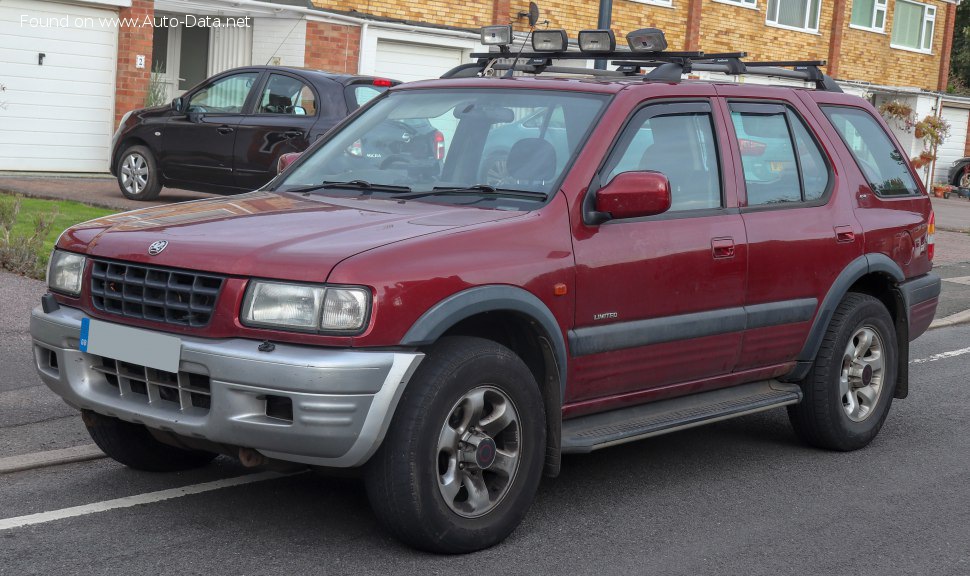
The Vauxhall Frontera Mk II 2.2 DTI (116 Hp) represents the second generation of a rugged and practical sport utility vehicle (SUV) that was a familiar sight on European roads from 1997 to 2000. While never officially sold in the United States under the Vauxhall badge, the Frontera was a rebadged version of the Isuzu MU (Mysterious Utility) or Isuzu Rodeo in other markets, highlighting its international origins and robust design philosophy. In the United Kingdom, where Vauxhall is a prominent brand, the Frontera Mk II carved out a niche as an affordable yet capable 4×4, appealing to families and individuals seeking a versatile vehicle for both daily commuting and light off-road adventures. This particular model, equipped with a diesel engine, aimed to offer a balance of power, torque, and fuel efficiency, a crucial factor in the European market.
Frontera Mk II 2.2 DTI: Positioning and Overview
Positioned in the increasingly competitive mid-size SUV segment, the Frontera Mk II faced off against a growing number of rivals. It was designed to offer more utility and genuine off-road capability than the emerging “soft-roaders” while being more accessible than traditional, larger luxury SUVs. Its five-door body style and five-seat configuration made it a practical choice for families, offering ample space for passengers and cargo. The 2.2 DTI engine provided a sensible powertrain option, emphasizing longevity and economy, which resonated well with its target demographic across Europe. This variant occupied a middle ground in the Frontera Mk II lineup, offering a step up in refinement and fuel efficiency compared to the base petrol models, but remaining more affordable and practical than the higher-specification trims.
Powertrain & Engine Architecture
At the heart of the Vauxhall Frontera Mk II 2.2 DTI is a robust 2.2-liter (2171 cm³ or 132.48 cu. in.) inline four-cylinder diesel engine, designated by the code X22DTH. This powerplant features a DOHC (Double Overhead Camshaft) valvetrain with four valves per cylinder, a configuration that was becoming standard for efficient combustion and improved performance in the late 1990s. The engine benefits from a direct injection fuel system and a turbocharger, which significantly boosts its output and torque characteristics. The direct injection system, utilizing a high-pressure common rail setup, allowed for precise fuel delivery and optimized combustion, contributing to both power and efficiency.
The engine produces a respectable 116 horsepower (Hp) at 3800 revolutions per minute (rpm), making it a capable performer for its size and era. More importantly for an SUV designed for hauling and off-road use, it delivers a substantial 260 Newton-meters (Nm) of torque, which translates to approximately 191.77 pound-feet (lb.-ft.), available at a low 1900 rpm. This low-end torque is crucial for strong acceleration from a standstill, effortless cruising, and tackling challenging terrain, providing the necessary grunt without having to constantly rev the engine. Power is channeled to all four wheels through a durable 5-speed manual transmission, offering the driver direct control over the vehicle’s dynamics. The all-wheel-drive (4×4) system, combined with the generous torque, ensures good traction and capability on various surfaces, from paved roads to unpaved tracks. The engine’s compression ratio of 18.5:1 is typical for a direct-injection diesel of its time, contributing to its efficiency.
Driving Characteristics
While not a speed demon, the Frontera Mk II 2.2 DTI was designed for utility rather than outright acceleration. It can accelerate from 0 to 60 miles per hour (mph) in approximately 13.3 seconds, and reach a maximum speed of around 97.56 mph (157 km/h). These figures are competitive for a mid-size diesel SUV from the late 1990s, reflecting its focus on practicality and robust performance for everyday tasks. The 5-speed manual transmission provides a reasonable spread of gears, allowing the driver to keep the engine in its optimal torque band for most driving situations. Compared to the petrol-powered Fronteras, the 2.2 DTI offered significantly more low-end grunt, making it more suitable for towing and off-road driving. However, it lacked the higher-revving character and quicker acceleration of the petrol engines. The gear ratios were tuned for practicality, prioritizing torque delivery over outright speed. The 4×4 system, typically selectable between 2H (rear-wheel drive), 4H (high-range four-wheel drive), and 4L (low-range four-wheel drive), provided versatility for different terrains and driving conditions.
Equipment & Trim Levels
The Frontera Mk II 2.2 DTI typically came equipped with a reasonable level of standard features for its price point. These included power steering, central locking, electric front windows, and an AM/FM radio. Interior upholstery was typically a durable cloth material, designed to withstand the rigors of family use. The dashboard layout was functional and straightforward, with clearly labeled controls. Optional extras available for this trim included air conditioning, alloy wheels, a sunroof, and upgraded audio systems. Higher-specification Fronteras offered additional features such as leather upholstery, wood trim, and more advanced audio systems. The 2.2 DTI trim often served as a base for adding these optional extras, allowing buyers to customize their vehicle to their specific needs and preferences.
Chassis & Braking
The Vauxhall Frontera Mk II utilized a traditional body-on-frame construction, providing a robust and durable platform for off-road use. The suspension system consisted of independent double wishbones at the front and a multi-link setup at the rear, offering a reasonable balance between ride comfort and off-road capability. The front suspension incorporated a stabilizer bar to reduce body roll during cornering. Rear brakes were typically drum brakes, while the front brakes were ventilated discs, providing adequate stopping power for the vehicle’s weight and intended use. The steering was rack and pinion with hydraulic power assistance, offering good feedback and maneuverability. The chassis was designed to handle the stresses of off-road driving, with reinforced components and a robust underbody protection system.
Market Reception & Comparison
Critics generally viewed the Frontera Mk II 2.2 DTI as a practical and capable SUV, offering good value for money. Its diesel engine was praised for its fuel efficiency and low-end torque, making it well-suited for long-distance travel and towing. However, some critics noted that the interior was somewhat basic and lacked the refinement of some of its rivals. Compared to the petrol-powered Fronteras, the 2.2 DTI offered superior fuel economy and torque, but at the expense of outright acceleration. Against competitors like the Land Rover Freelander, the Frontera offered a more affordable price point and a more robust 4×4 system, but lacked the Freelander’s more sophisticated interior and on-road manners. The Frontera’s reliability was generally considered good, benefiting from the Isuzu engineering heritage. Fuel economy was a key selling point, averaging around 22.4 US mpg in combined driving, which was competitive for a diesel SUV of that era.
Technical Specifications: Vauxhall Frontera Mk II 2.2 DTI (116 Hp)
| Specification | Value |
| General Information | |
| Brand | Vauxhall |
| Model | Frontera |
| Generation | Frontera Mk II |
| Type (Engine) | 2.2 DTI (116 Hp) |
| Production Start | 1997 |
| Production End | 2000 |
| Powertrain Architecture | Internal Combustion Engine |
| Body Type | SUV |
| Seats | 5 |
| Doors | 5 |
| Performance Specs | |
| Fuel Consumption (Urban) | 11.6 l/100 km (20.3 US mpg) |
| Fuel Consumption (Extra Urban) | 7.8 l/100 km (30.2 US mpg) |
| Fuel Consumption (Combined) | 10.5 l/100 km (22.4 US mpg) |
| Fuel Type | Diesel |
| Acceleration 0 – 60 mph | 13.3 sec |
| Acceleration 0 – 100 km/h | 14 sec |
| Maximum Speed | 97.56 mph (157 km/h) |
| Weight-to-Power Ratio | 15.3 kg/Hp (65.2 Hp/tonne) |
| Weight-to-Torque Ratio | 6.8 kg/Nm (146.1 Nm/tonne) |
| Engine Specs | |
| Power | 116 Hp @ 3800 rpm |
| Power per Liter | 53.4 Hp/l |
| Torque | 260 Nm (191.77 lb.-ft.) @ 1900 rpm |
| Engine Layout | Front, Longitudinal |
| Engine Model/Code | X22DTH |
| Engine Displacement | 2.2 Liters (2171 cm³, 132.48 cu. in.) |
| Number of Cylinders | 4 |
| Engine Configuration | Inline |
| Cylinder Bore | 3.31 in. (84 mm) |
| Piston Stroke | 3.86 in. (98 mm) |
| Compression Ratio | 18.5:1 |
| Valves per Cylinder | 4 |
| Fuel Injection System | Direct injection |
| Engine Aspiration | Turbocharger |
| Valvetrain | DOHC |
| Engine Oil Capacity | 6.1 Liters (6.45 US qt) |
| Coolant Capacity | 7.9 Liters (8.35 US qt) |
| Space, Volume and Weights | |
| Kerb Weight | 3924.23 lbs. (1780 kg) |
| Max. Weight (GVWR) | 5401.33 lbs. (2450 kg) |
| Max Load | 1477.1 lbs. (670 kg) |
| Trunk Space (Minimum) | 13.74 cu. ft. (389 l) |
| Trunk Space (Maximum) | 63.21 cu. ft. (1790 l) |
| Fuel Tank Capacity | 19.81 US gal (75 l) |
| Dimensions | |
| Length | 183.39 in. (4658 mm) |
| Width | 70.28 in. (1785 mm) |
| Height | 68.5 in. (1740 mm) |
| Wheelbase | 106.38 in. (2702 mm) |
| Front Track | 59.65 in. (1515 mm) |
| Rear (Back) Track | 59.84 in. (1520 mm) |
| Drivetrain, Brakes and Suspension | |
| Drive Wheel | All-wheel drive (4×4) |
| Gearbox Type | 5 gears, Manual Transmission |
| Front Brakes | Ventilated discs |
| Rear Brakes | Ventilated discs |
| Assisting Systems | ABS (Anti-lock braking system) |
| Steering Type | Steering rack and pinion |
| Power Steering | Hydraulic Steering |
| Tire Size | 245/75 R16 |
| Wheel Rims Size | 7J x 16 |
Legacy
The Vauxhall Frontera Mk II, particularly the 2.2 DTI variant, played a significant role in the European SUV landscape of the late 1990s. As a rebadged Isuzu model, it benefited from a reputation for robustness and reliability, traits that were highly valued by consumers seeking a durable vehicle. While it didn’t boast the premium feel of some European or Japanese rivals, its honest, no-frills approach to SUV motoring resonated with a segment of the market that prioritized utility and capability over luxury. Today, the Frontera Mk II 2.2 DTI can be found on the used car market, often at very affordable prices. Its diesel engine, while not the most refined, is known for its longevity if properly maintained. Common issues include wear and tear on suspension components and potential problems with the turbocharger. However, parts availability is generally good, and the vehicle’s relatively simple mechanicals make it a viable option for those seeking a rugged and capable SUV on a budget. It remains a testament to a period when SUVs were often more about utility and adventure than urban sophistication.