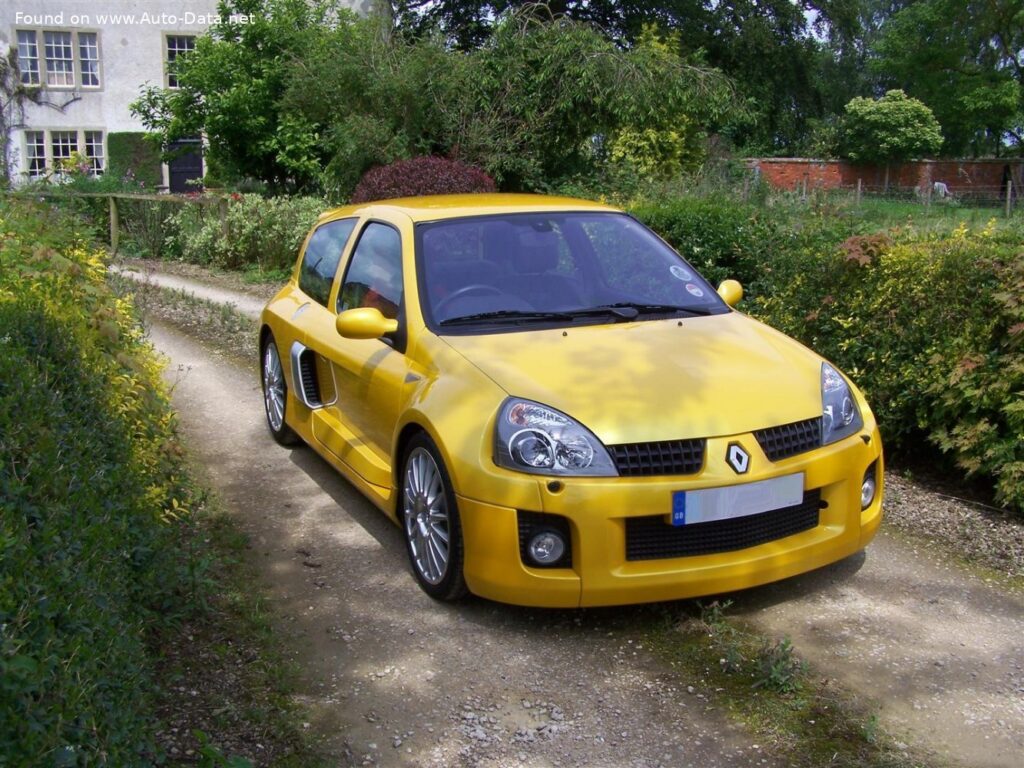
The Renault Clio Sport (Phase II) 3.0i V6 24V (254 Hp) represents a unique and unconventional approach to the hot hatchback segment. Introduced in June 2003 and produced until July 2005, this vehicle distinguished itself from typical front-wheel-drive competitors with a radical mid-engine, rear-wheel-drive layout. Developed by Renault Sport, the high-performance division of Renault, the Clio V6 was initially conceived as a homologation special for racing, evolving into a highly sought-after performance car. While never officially offered for sale in the United States, it gained a legendary reputation among enthusiasts worldwide for its distinctive engineering and exhilarating driving experience.
Development & History
The Renault Clio V6 originated from a desire within Renault Sport to create a truly engaging and dynamic performance car. The project began as a means to homologate a vehicle for racing purposes, but quickly evolved into a standalone model. The Clio V6 is based on a heavily modified version of the second-generation Clio (MkII) platform. The most significant alteration was the relocation of the engine behind the front seats, necessitating a complete redesign of the chassis and bodywork. The Phase II iteration addressed criticisms leveled at the original Phase I model, focusing on refining the handling characteristics and improving overall usability. It built upon the foundation laid by its predecessor, offering a more polished and accessible driving experience without sacrificing the core appeal of its unique configuration.
Powertrain & Performance
The heart of the Renault Clio Sport (Phase II) is a 3.0-liter (2946 cc or 179.78 cubic inches) naturally aspirated V6 engine, designated L7X 762. This engine was a substantial upgrade from the 230 horsepower unit found in the Phase I model. Renault Sport engineers meticulously retuned the engine, increasing its output to 254 horsepower at 7150 rpm. This high-revving nature is characteristic of Renault Sport engines, delivering a responsive and engaging power delivery. Torque was also increased to 221.27 lb-ft (300 Nm) at 4650 rpm, providing a broader and more usable powerband. The engine features four valves per cylinder and a Double Overhead Cam (DOHC) configuration, optimizing breathing and performance. Fuel is delivered via a multi-port fuel injection system, further enhancing responsiveness.
The defining feature of the Clio V6’s powertrain is its mid-engine placement, situated behind the front seats where the rear passenger compartment would typically reside. This configuration, coupled with a rear-wheel-drive system, dramatically alters the car’s dynamics. Power is transmitted to the rear wheels through a precise 6-speed manual transmission, providing the driver with direct control. This setup allows the Clio V6 Phase II to accelerate from 0 to 60 mph in 5.5 seconds (0-100 km/h in 5.8 seconds) and achieve a top speed of 155.34 mph (250 km/h). The car’s weight-to-power ratio is an impressive 5.5 kg/Hp (181.4 Hp/tonne), highlighting its performance capabilities.
Chassis & Handling
The Renault Clio Sport (Phase II) boasts a bespoke chassis designed to accommodate the mid-engine layout and rear-wheel-drive configuration. Both the front and rear suspensions utilize independent McPherson struts with hydraulic elements, meticulously tuned for optimal handling balance. The braking system is equally robust, featuring large 330 mm ventilated discs at the front and 300 mm ventilated discs at the rear, complemented by an Anti-lock Braking System (ABS) for enhanced stopping power. The car rides on staggered wheel and tire setups, with 205/45 R17 or 205/40 R18 tires on 7J x 17 or 7J x 18 rims at the front, and wider 225/45 R17 or 245/40 R18 tires on 8.5J x 17 or 8.5J x 18 rims at the rear. This configuration maximizes grip and stability, crucial for a rear-wheel-drive machine. The steering system is a rack and pinion type, providing direct and responsive feedback to the driver.
Design & Interior
The exterior design of the Renault Clio Sport (Phase II) visually communicates its performance intent. While retaining the basic silhouette of a standard Clio hatchback, it is significantly widened to accommodate the mid-mounted V6 engine and wider track. Flared wheel arches, aggressive front and rear bumpers, and large side air intakes (essential for engine cooling) contribute to its muscular stance. The Phase II received subtle refinements to the front fascia, headlights, and taillights, resulting in a more modern and cohesive aesthetic compared to the Phase I.
The interior reflects the car’s performance focus and unique layout. Due to the engine’s placement, the Clio V6 is strictly a two-seater. The space typically occupied by the rear seats is now home to the V6 engine, while a small trunk space, ranging from 1.59 to 2.37 cubic feet (45 to 67 liters), is available behind the engine. The cabin features sporty accents, including bolstered seats and specific instrumentation, reinforcing its performance pedigree.
Variants & Special Editions
The Renault Clio V6 was primarily offered in a single, well-equipped trim level. However, minor variations existed based on market-specific options and packages. The Phase II model represents the most refined and desirable version of the Clio V6, offering improvements in handling and usability over the original Phase I. Limited production numbers and the car’s unique character have made all Clio V6 models collectible, with the Phase II commanding a premium due to its enhanced refinement.
Technical Specifications
| Category | Specification |
| General Information | |
| Brand | Renault |
| Model | Clio |
| Generation | Clio Sport (Phase II) |
| Type (Engine) | 3.0i V6 24V (254 Hp) |
| Start of Production | June 2003 |
| End of Production | July 2005 |
| Powertrain Architecture | Internal Combustion engine |
| Body Type | Hatchback |
| Seats | 2 |
| Doors | 2 |
| Performance Specs | |
| Fuel Consumption (Urban) | 15.6 l/100 km |
| Fuel Consumption (Extra Urban) | 9.8 l/100 km |
| Fuel Consumption (Combined) | 11.9 l/100 km |
| CO2 Emissions | 285 g/km |
| Fuel Type | Petrol (Gasoline) |
| Acceleration 0 – 60 mph | 5.5 sec |
| Acceleration 0 – 100 km/h | 5.8 sec |
| Maximum Speed | 250 km/h (155.34 mph) |
| Emission Standard | Euro 3 D4 |
| Weight-to-Power Ratio | 5.5 kg/Hp (181.4 Hp/tonne) |
| Weight-to-Torque Ratio | 4.7 kg/Nm (214.3 Nm/tonne) |
| Engine Specs | |
| Power | 254 Hp @ 7150 rpm |
| Power per Liter | 86.2 Hp/l |
| Torque | 300 Nm @ 4650 rpm (221.27 lb.-ft. @ 4650 rpm) |
| Engine Layout | Rear, Transverse |
| Engine Model/Code | L7X 762 |
| Engine Displacement | 2946 cm3 (179.78 cu. in.) |
| Number of Cylinders | 6 |
| Engine Configuration | V-engine |
| Cylinder Bore | 87 mm (3.43 in.) |
| Piston Stroke | 82.6 mm (3.25 in.) |
| Compression Ratio | 11.4:1 |
| Valves per Cylinder | 4 |
| Fuel Injection System | Multi-port manifold injection |
| Engine Aspiration | Naturally aspirated |
| Valvetrain | DOHC |
| Engine Oil Capacity | 5.25 l (5.55 US qt) |
| Coolant Capacity | 15 l (15.85 US qt) |
| Space, Volume and Weights | |
| Kerb Weight | 1400 kg (3086.47 lbs.) |
| Max. Weight | 1610 kg (3549.44 lbs.) |
| Max Load | 210 kg (462.97 lbs.) |
| Trunk Space (Min) | 45 l (1.59 cu. ft.) |
| Trunk Space (Max) | 67 l (2.37 cu. ft.) |
| Fuel Tank Capacity | 61 l (16.11 US gal) |
| Dimensions | |
| Length | 3841 mm (151.22 in.) |
| Width | 1830 mm (72.05 in.) |
| Width (incl. mirrors) | 1940 mm (76.38 in.) |
| Height | 1351 mm (53.19 in.) |
| Wheelbase | 2532 mm (99.69 in.) |
| Front Track | 1518 mm (59.76 in.) |
| Rear Track | 1470 mm (57.87 in.) |
| Front Overhang | 753 mm (29.65 in.) |
| Rear Overhang | 556 mm (21.89 in.) |
| Minimum Turning Circle | 14.4 m (47.24 ft.) |
| Drivetrain, Brakes and Suspension Specs | |
| Drivetrain Architecture | Internal Combustion engine drives the rear wheels. |
| Drive Wheel | Rear-wheel drive |
| Number of Gears/Type | 6 gears, manual transmission |
| Front Suspension | Hydraulic elements, Independent McPherson |
| Rear Suspension | Hydraulic elements, McPherson |
| Front Brakes | Ventilated discs, 330 mm |
| Rear Brakes | Ventilated discs, 300 mm |
| Assisting Systems | ABS (Anti-lock braking system) |
| Steering Type | Steering rack and pinion |
| Front Wheel Tires | 205/45 R17; 205/40 R18 |
| Rear Wheel Tires | 225/45 R17; 245/40 R18 |
| Front Wheel Rims | 7J x 17; 7J x 18 |
| Rear Wheel Rims | 8.5J x 17; 8.5J x 18 |
Legacy & Reception
The Renault Clio Sport (Phase II) 3.0i V6 24V (254 Hp) is widely regarded as one of the most audacious and memorable hot hatches ever created. Its radical mid-engine, rear-wheel-drive configuration within a compact hatchback body set it apart from conventional competitors. While other performance hatchbacks offered impressive front-wheel-drive performance, none challenged the fundamental layout of the hot hatch in the same way. The Clio V6 was a halo product for Renault Sport, showcasing the division’s engineering capabilities and willingness to innovate. Limited production numbers and its unique character have made it a highly collectible vehicle. Today, the Clio V6, particularly the Phase II, commands significant attention in the collector car market. Its legacy lies in its bold engineering statement and its role in redefining the possibilities of a compact car. It represents a golden era of automotive experimentation, and a thrilling chapter in the history of European performance cars.