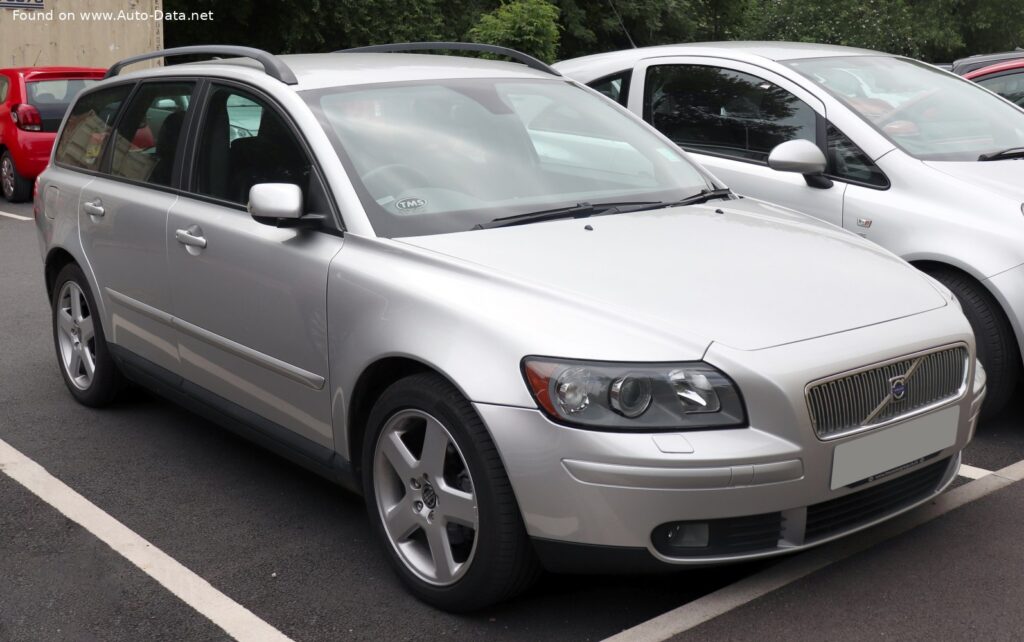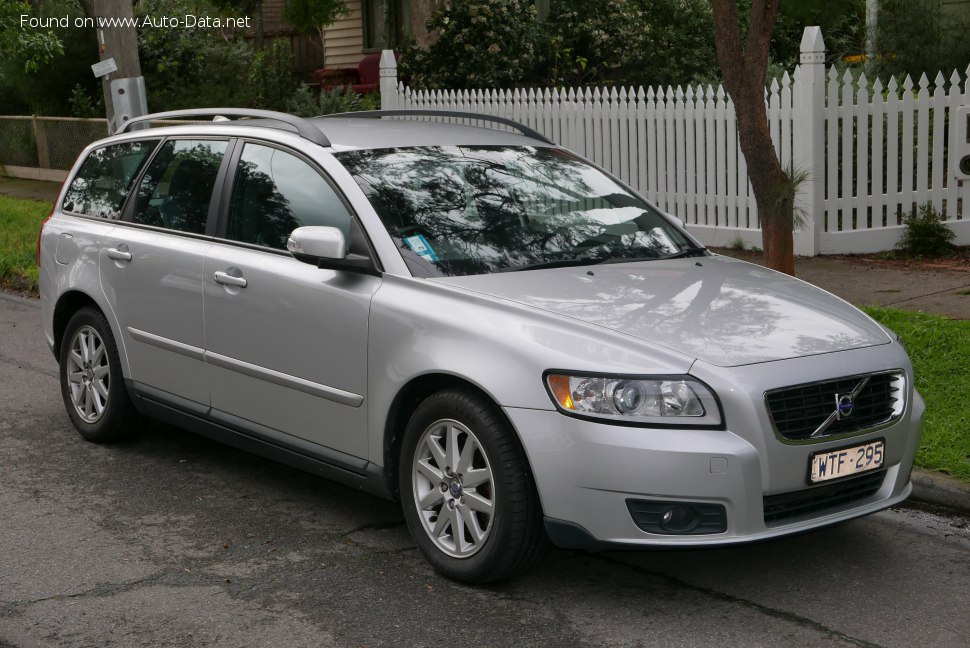
The Volvo V50, a compact executive wagon, represented Volvo’s entry into the competitive premium compact segment. Launched initially in 2004, the V50 shared its platform – Volvo’s P1 architecture – with the second-generation S40 sedan, as well as the Ford Focus and Mazda3, benefiting from a robust and well-regarded chassis. This article focuses on the enhanced variant introduced with the 2007 facelift, specifically the potent 2.5 T5 (230 Hp) Geartronic model. The facelift brought subtle yet significant aesthetic and functional improvements, reaffirming the V50’s position as a stylish, safe, and practical option for buyers seeking a more upscale compact wagon experience.
Volvo V50 (Facelift 2007) 2.5 T5 Geartronic: An Overview
Positioned as a versatile alternative to traditional sedans and larger wagons, the Volvo V50 (facelift 2007) catered to a demographic valuing Scandinavian design, advanced safety features, and dynamic driving characteristics in a compact package. The T5 variant, with its turbocharged five-cylinder engine, offered a compelling blend of performance and everyday usability, making it a standout choice in its class. Produced from 2007 until 2012, this iteration of the V50 continued Volvo’s tradition of combining elegance with utility, appealing to families and individuals alike who sought a premium vehicle without excessive bulk.
Development & History
The Volvo V50 is rooted in Volvo’s P1 platform, a collaborative effort shared with Ford and Mazda. This platform underpinned the second-generation S40 sedan and, notably, the Ford Focus and Mazda3. Utilizing this shared architecture allowed Volvo to leverage economies of scale while maintaining its distinct brand identity. The V50 was conceived as the wagon derivative of the S40, offering a more practical and versatile body style. The 2007 facelift represented a mid-cycle refresh, addressing both aesthetic and functional aspects of the vehicle. It was designed to enhance the V50’s appeal in a market increasingly focused on design and features. The V50 was eventually superseded by the V40 in 2012, marking a shift towards a more compact and technologically advanced offering in the premium compact segment.
Powertrain & Performance
The core of the Volvo V50 (facelift 2007) 2.5 T5 Geartronic is Volvo’s 2.5-liter inline-five turbocharged engine, designated B5254T7. This engine is renowned for its smooth power delivery and distinctive exhaust note. It produces 230 horsepower at 5000 rpm and 236 lb-ft of torque available from 1500 to 5000 rpm. This broad torque band provides responsive acceleration and effortless cruising. Power is transmitted to the front wheels via a 5-speed Geartronic automatic transmission, offering both automatic operation and manual gear selection. The combination allows for a 0 to 60 mph acceleration time of 6.9 seconds and a top speed electronically limited to 146 mph. The engine employs multi-port fuel injection, a turbocharger, and an intercooler to optimize air charge density. Fuel economy is rated at 24.8 mpg combined, with 36.2 mpg on the highway and 17.4 mpg in urban driving. CO2 emissions are rated at 227 g/km.
Chassis & Handling
The Volvo V50 (facelift 2007) utilizes an independent suspension system designed to balance comfort and handling. The front suspension features McPherson struts with coil springs and an anti-roll bar, while the rear employs an independent multi-link setup with a stabilizer bar. This configuration provides a stable and controlled ride, minimizing body roll during cornering. Braking is handled by ventilated discs at the front and solid discs at the rear, offering consistent stopping power. The electric power steering system, a rack and pinion type, provides precise control and good feedback. Volvo’s commitment to safety is evident in the inclusion of ABS (Anti-lock Braking System) as standard equipment. The chassis is designed to provide a secure and predictable driving experience, prioritizing stability and control in various driving conditions.
Design & Interior
The Volvo V50 (facelift 2007) retains the elegant lines of the pre-facelift model, with subtle enhancements to modernize its appearance. As a five-door station wagon, it combines sleek styling with practical utility. The facelift included a redesigned grille, revised headlights, and a more sculpted front bumper. At the rear, new LED taillights and a reshaped bumper further refined the design. The interior showcases Volvo’s commitment to ergonomic design and high-quality materials. The signature “floating” center console creates a sense of spaciousness and modern Scandinavian minimalism. The cabin comfortably seats five occupants and offers a minimum trunk capacity of 14.73 cubic feet, expanding to 46.16 cubic feet with the rear seats folded down. The maximum roof load capacity is 165 lbs, and the V50 T5 can tow up to 3307 lbs with brakes. Safety features include SIPS (Side Impact Protection System) and WHIPS (Whiplash Protection System).
Variants & Special Editions
The Volvo V50 was offered in several trim levels, each with varying levels of equipment and features. The T5 variant, discussed here, represented the performance-oriented option, featuring the more powerful turbocharged engine. Other variants included the 2.4i, which offered a more fuel-efficient, naturally aspirated engine. While Volvo did not produce dedicated “special editions” of the V50 in the same vein as some other manufacturers, various option packages were available, allowing buyers to customize their vehicles with features such as leather upholstery, premium audio systems, and advanced safety technologies. These packages allowed for a degree of personalization within the V50 lineup.
Technical Specifications
| Brand | Volvo |
| Model | V50 |
| Generation | V50 (facelift 2007) |
| Type (Engine) | 2.5 T5 (230 Hp) Geartronic |
| Start of Production | 2007 year |
| End of Production | 2012 year |
| Powertrain Architecture | Internal Combustion engine |
| Body type | Station wagon (estate) |
| Seats | 5 |
| Doors | 5 |
| Fuel consumption (economy) – urban | 13.5 l/100 km | 17.4 US mpg | 20.9 UK mpg |
| Fuel consumption (economy) – extra urban | 6.5 l/100 km | 36.2 US mpg | 43.5 UK mpg |
| Fuel consumption (economy) – combined | 9.5 l/100 km | 24.8 US mpg | 29.7 UK mpg |
| CO2 emissions | 227 g/km |
| Fuel Type | Petrol (Gasoline) |
| Acceleration 0 – 60 mph | 6.9 sec |
| Acceleration 0 – 100 km/h | 7.3 sec |
| Maximum speed | 235 km/h | 146.02 mph |
| Weight-to-power ratio | 6.2 kg/Hp, 160.8 Hp/tonne |
| Weight-to-torque ratio | 4.5 kg/Nm, 223.8 Nm/tonne |
| Power | 230 Hp @ 5000 rpm |
| Power per liter | 91.2 Hp/l |
| Torque | 320 Nm @ 1500-5000 rpm | 236.02 lb.-ft. @ 1500-5000 rpm |
| Engine layout | Front, Transverse |
| Engine Model/Code | B5254T7 |
| Engine displacement | 2521 cm3 | 153.84 cu. in. |
| Number of cylinders | 5 |
| Engine configuration | Inline |
| Cylinder Bore | 83 mm | 3.27 in. |
| Piston Stroke | 93.2 mm | 3.67 in. |
| Compression ratio | 9:1 |
| Number of valves per cylinder | 4 |
| Fuel injection system | Multi-port manifold injection |
| Engine aspiration | Turbocharger, Intercooler |
| Valvetrain | DOHC |
| Engine oil capacity | 5.8 l | 6.13 US qt | 5.1 UK qt |
| Coolant | 10 l | 10.57 US qt | 8.8 UK qt |
| Kerb Weight | 1430 kg | 3152.61 lbs. |
| Max. weight | 2000 kg | 4409.25 lbs. |
| Max load | 570 kg | 1256.63 lbs. |
| Trunk (boot) space – minimum | 417 l | 14.73 cu. ft. |
| Trunk (boot) space – maximum | 1307 l | 46.16 cu. ft. |
| Fuel tank capacity | 62 l | 16.38 US gal | 13.64 UK gal |
| Max. roof load | 75 kg | 165.35 lbs. |
| Permitted trailer load with brakes (12%) | 1500 kg | 3306.93 lbs. |
| Permitted trailer load without brakes | 700 kg | 1543.24 lbs. |
| Permitted towbar download | 75 kg | 165.35 lbs. |
| Length | 4522 mm | 178.03 in. |
| Width | 1770 mm | 69.69 in. |
| Width including mirrors | 2022 mm | 79.61 in. |
| Height | 1457 mm | 57.36 in. |
| Wheelbase | 2640 mm | 103.94 in. |
| Front track | 1535 mm | 60.43 in. |
| Rear (Back) track | 1531 mm | 60.28 in. |
| Minimum turning circle (turning diameter) | 10.6 m | 34.78 ft. |
| Drivetrain Architecture | The Internal combustion engine (ICE) drives the front wheels of the vehicle. |
| Drive wheel | Front wheel drive |
| Number of gears and type of gearbox | 5 gears, automatic transmission Geartronic |
| Front suspension | Independent, type McPherson with coil spring and anti-roll bar |
| Rear suspension | Independent multi-link spring suspension with stabilizer |
| Front brakes | Ventilated discs |
| Rear brakes | Disc |
| Assisting systems | ABS (Anti-lock braking system) |
| Steering type | Steering rack and pinion |
| Power steering | Electric Steering |
| Tires size | 205/55 R16; 205/50 R17; 215/45 R18 |
| Wheel rims size | 6.5J x 16; 7J x 17; 7.5J x 18 |
Legacy & Reception
The Volvo V50 (facelift 2007) 2.5 T5 Geartronic established a significant presence in the premium compact wagon segment. In an era increasingly dominated by SUVs, the V50 offered a compelling alternative for buyers who valued the driving dynamics of a car combined with the practicality of a wagon. Its compact dimensions made it well-suited for urban environments, while the T5 engine provided ample power for highway driving. While it may not have matched the outright sportiness of some German rivals, the V50 distinguished itself with its unique Scandinavian design, unwavering commitment to safety, and understated luxury. The T5 engine, in particular, garnered praise for its smooth power delivery and distinctive sound. The V50’s legacy is that of a well-rounded, sophisticated, and safe compact wagon that continues to be appreciated by enthusiasts and practical drivers alike.