
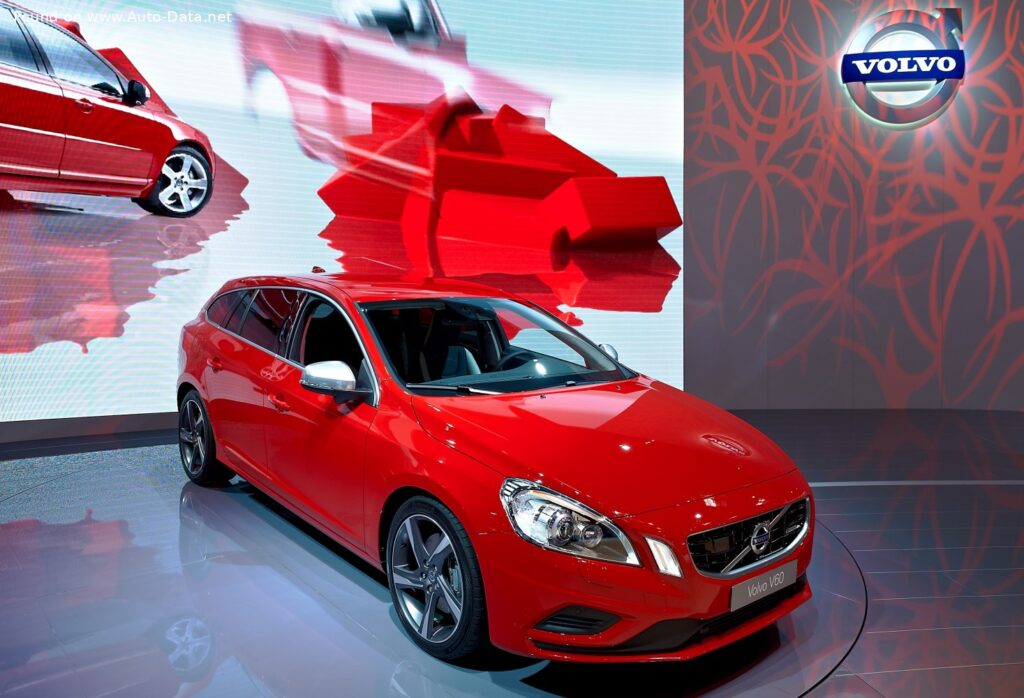
The Volvo V60 I 1.6 Drive (115 Hp) represents a significant offering within Volvo’s first generation V60 lineup, produced between 2011 and 2012. Positioned as a premium compact executive station wagon (or estate, as it’s known in Europe), this particular variant was engineered primarily for the European market, where diesel powertrains and the estate body style hold considerable popularity due to their blend of fuel efficiency, practicality, and long-distance comfort. The V60 I, introduced as a more dynamically styled alternative to the larger V70, aimed to combine Volvo’s renowned safety credentials with a sportier aesthetic and a more engaging driving experience. The 1.6 Drive model, specifically, underscored Volvo’s commitment to environmental responsibility and economical motoring, offering impressive fuel economy and lower CO2 emissions for its class. While not widely sold in the United States, its design and engineering principles influenced subsequent Volvo models globally, embodying the brand’s evolving identity in the early 2010s.
Engine & Performance of the Volvo V60 I
At the heart of the Volvo V60 I 1.6 Drive (115 Hp) is a 1.6-liter (1560 cm³, 95.2 cu. in.) inline-four diesel engine, designated with the internal code D4162T. This powertrain features a front, transverse engine layout, driving the front wheels through a 6-speed manual transmission. The engine is equipped with a common rail fuel injection system, a turbocharger, and an intercooler, technologies crucial for maximizing both power output and fuel efficiency from a relatively small displacement diesel unit.
This engine produces 115 horsepower at 3600 rpm, combined with 270 Nm (199.14 lb.-ft.) of torque available between 1750-2500 rpm. This provides adequate motivation for daily driving and highway cruising. The torque delivery is particularly notable, offering strong low-end pull typical of modern diesel engines, making the car responsive in city traffic and capable of effortless overtaking. The power-to-weight ratio is 74.9 Hp per tonne (13.3 kg/Hp), while the torque-to-weight ratio is 175.9 Nm per tonne (5.7 kg/Nm), indicating a well-balanced performance for its class.
The V60 I 1.6 Drive (115 Hp) can accelerate from 0 to 60 mph in approximately 10.7 seconds, or 0 to 100 km/h in 11.3 seconds. While not a performance-oriented vehicle, these figures are competitive for an economical family estate. Its fuel consumption figures are impressive: an urban rating of 45.2 US mpg, an extra-urban rating of 57.4 US mpg, and a combined cycle of 52.3 US mpg (4.5 l/100 km). With CO2 emissions of just 119 g/km, the vehicle met the stringent Euro 5 emission standard, making it an environmentally conscious choice. The inclusion of a particulate filter further enhanced its ecological credentials.
Design & Features
The Volvo V60 I generation marked a departure from Volvo’s traditionally boxy estate designs, embracing a more dynamic and coupe-like profile. Despite its sleeker appearance, the V60 I retained the practicality expected of a Volvo station wagon. Its five-door, five-seat configuration provided ample space for passengers and cargo, making it a versatile family vehicle. The exterior design featured Volvo’s signature “shoulders” and a distinctive rear light cluster, giving it a modern and sophisticated look.
Measuring 182.2 inches (4628 mm) in length, 73.43 inches (1865 mm) in width, and 58.43 inches (1484 mm) in height, with a 109.29-inch (2776 mm) wheelbase, the V60 I offered a comfortable and stable ride. The front track of 62.52 inches (1588 mm) and rear track of 62.4 inches (1585 mm) contributed to its composed handling. Inside, Volvo’s ergonomic design philosophy was evident, with a driver-focused cockpit and high-quality materials.
Safety is a key selling point for any Volvo, and the V60 I was no exception. It came equipped with standard safety features, including ABS (Anti-lock Braking System). The V60 platform was designed to accommodate innovations such as City Safety (automatic braking at low speeds), pedestrian detection, and various driver assistance systems, depending on market and trim level. The trunk space of 24.44 cu. ft. (692 liters) provided generous cargo capacity for a vehicle of its size, further enhancing its appeal as a practical family hauler.
Technical Specifications
| Category | Specification |
| General Information | |
| Brand | Volvo |
| Model | V60 |
| Generation | V60 I |
| Type (Engine) | 1.6 Drive (115 Hp) |
| Start of production | 2011 year |
| End of production | 2012 year |
| Powertrain Architecture | Internal Combustion engine |
| Body type | Station wagon (estate) |
| Seats | 5 |
| Doors | 5 |
| Performance Specs | |
| Fuel consumption (economy) – urban | 5.2 l/100 km |
| Fuel consumption (economy) – extra urban | 4.1 l/100 km |
| Fuel consumption (economy) – combined | 4.5 l/100 km |
| CO2 emissions | 119 g/km |
| Fuel Type | Diesel |
| Acceleration 0 – 100 km/h | 11.3 sec |
| Acceleration 0 – 62 mph | 11.3 sec |
| Acceleration 0 – 60 mph (Calculated) | 10.7 sec |
| Emission standard | Euro 5 |
| Weight-to-power ratio | 13.3 kg/Hp |
| Weight-to-torque ratio | 5.7 kg/Nm |
| Engine Specs | |
| Power | 115 Hp @ 3600 rpm |
| Power per liter | 73.7 Hp/l |
| Torque | 270 Nm @ 1750-2500 rpm |
| Engine layout | Front, Transverse |
| Engine Model/Code | D4162T |
| Engine displacement | 1560 cm³ |
| Number of cylinders | 4 |
| Engine configuration | Inline |
| Cylinder Bore | 75 mm |
| Piston Stroke | 88.3 mm |
| Fuel injection system | Diesel Commonrail |
| Engine aspiration | Turbocharger, Intercooler |
| Engine oil capacity | 3.8 l |
| Coolant | 10.5 l |
| Engine systems | Particulate filter |
| Space, Volume and Weights | |
| Kerb Weight | 1535 kg |
| Max. weight | 2110 kg |
| Max load | 575 kg |
| Trunk (boot) space – minimum | 692 l |
| Fuel tank capacity | 67.5 l |
| Dimensions | |
| Length | 4628 mm |
| Width | 1865 mm |
| Height | 1484 mm |
| Wheelbase | 2776 mm |
| Front track | 1588 mm |
| Rear (Back) track | 1585 mm |
| Minimum turning circle (turning diameter) | 11.5 m |
| Drivetrain, Brakes and Suspension Specs | |
| Drivetrain Architecture | The Internal combustion engine (ICE) drives the front wheels of the vehicle. |
| Drive wheel | Front wheel drive |
| Number of gears and type of gearbox | 6 gears, manual transmission |
| Assisting systems | ABS (Anti-lock braking system) |
Legacy and Market Impact of the Volvo V60 I
The Volvo V60 I, particularly in its 1.6 Drive (115 Hp) diesel configuration, carved out a significant niche in the highly competitive European compact executive segment. Its primary competitors included established players like the BMW 3 Series Touring, Audi A4 Avant, and Mercedes-Benz C-Class Estate. While German rivals often emphasized sportiness or outright luxury, the V60 distinguished itself by offering a unique blend of Scandinavian design, unparalleled safety features, and a strong emphasis on practical efficiency.
The “Drive” designation in Volvo’s nomenclature of this era specifically highlighted models optimized for maximum fuel economy and reduced emissions. For the European market, where fuel prices are consistently higher and environmental regulations are stricter than in the U.S., the 1.6-liter diesel engine was a compelling choice. Its excellent combined fuel economy of 52.3 US mpg and low CO2 emissions of 119 g/km meant lower running costs and reduced vehicle taxes in many European countries, making it an attractive proposition for both private buyers and fleet operators.
The V60 I’s impact was largely centered on reinforcing Volvo’s reputation for building safe, comfortable, and practical family vehicles, even as the brand ventured into more emotionally styled designs. It demonstrated that Volvo could offer a car that was both aesthetically pleasing and highly functional, without compromising on its core values. The success of the V60 I helped pave the way for subsequent generations and solidified Volvo’s position as a premium alternative in a segment often dominated by German marques. Its engineering, particularly the efficient diesel powertrains, showcased Volvo’s commitment to sustainable mobility well before electrification became mainstream, proving that internal combustion engines could also be highly optimized for environmental performance. The model remains a testament to Volvo’s strategic approach to market-specific needs, delivering a product perfectly tailored to the demands of its primary audience.
