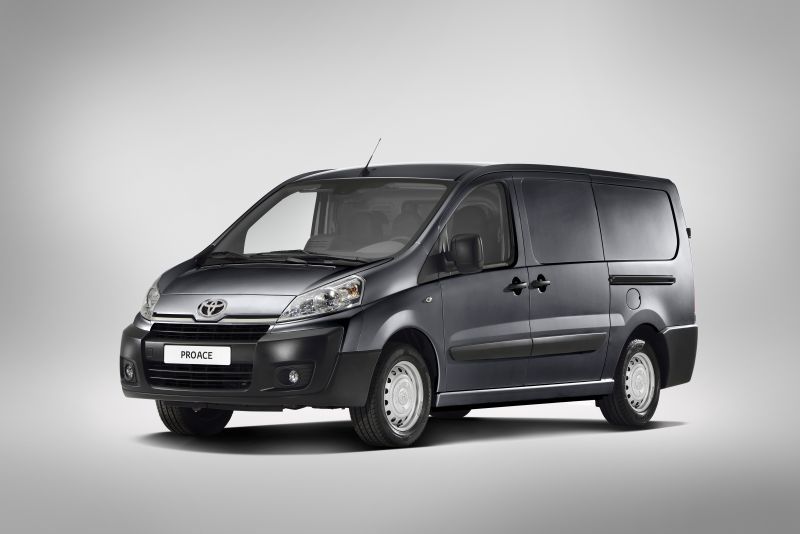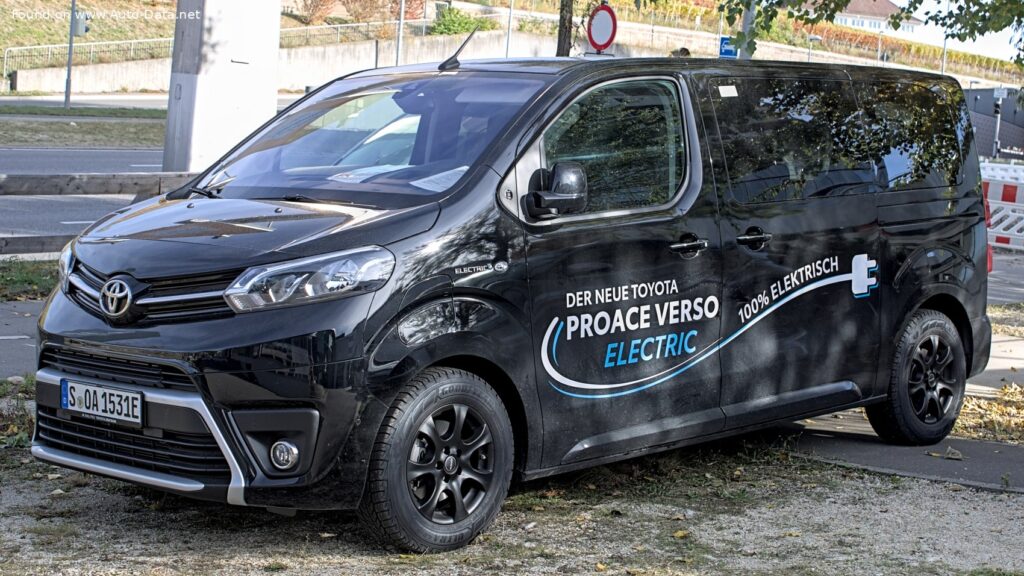
The Toyota Proace Verso II SWB 75 kWh (136 Hp) Electric represents a significant stride for Toyota into the burgeoning electric vehicle (EV) segment, particularly within the commercial and passenger minivan sectors in Europe. Launched in April 2021, this second-generation Proace Verso, in its short-wheelbase (SWB) electric guise, is a battery-electric vehicle (BEV) designed to offer zero-emission mobility for families, shuttle services, and businesses requiring substantial passenger and cargo capacity. While not sold in the United States, the Proace Verso Electric plays a crucial role in Toyota’s European electrification strategy, providing a practical, spacious, and environmentally conscious alternative to traditional internal combustion engine (ICE) vans and minivans.
As part of a strategic collaboration with Stellantis (formerly PSA Group), the Proace Verso shares its platform and electric powertrain technology with several European siblings, including the Peugeot e-Traveller, Citroën ë-Spacetourer, and Opel Zafira-e Life. This partnership allows Toyota to efficiently expand its EV offerings in markets where such multi-purpose vehicles are highly valued for their versatility and utility. The 75 kWh (136 Hp) Electric variant emphasizes efficiency and urban-friendly performance, catering to the growing demand for sustainable transport solutions across the continent.
Toyota Proace Verso II SWB 75 kWh: Powertrain and Performance
The Toyota Proace Verso II SWB 75 kWh (136 Hp) Electric is powered by a front-wheel-drive, battery-electric powertrain. A single synchronous electric motor, transversely mounted on the front axle, delivers a maximum power output of 136 horsepower. This is complemented by 260 Newton-meters (Nm) of torque, equivalent to approximately 191.77 pound-feet (lb.-ft.). The electric motor’s immediate torque delivery provides responsive acceleration and confident maneuvering, especially in urban environments and when carrying passengers or cargo.
Power is transmitted to the front wheels via a single-speed automatic transmission, simplifying the driving experience and ensuring smooth, linear power delivery. The vehicle’s top speed is electronically limited to 130 kilometers per hour (approximately 80.78 mph), which is suitable for its intended use cases. The power-to-weight ratio is 15.2 kg/Hp (or 65.9 Hp/tonne), balancing performance and efficiency.
Energy storage is provided by a 75 kWh gross capacity Lithium-ion (Li-Ion) battery pack, positioned under the vehicle floor to lower the center of gravity and maximize interior space. This configuration allows for an all-electric range of up to 314 kilometers (approximately 195.11 miles) on the WLTP cycle. Energy consumption averages 26.9-28 kWh per 100 kilometers (43.29-45.06 kWh per 100 miles), resulting in an impressive 78-75 MPGe (Miles Per Gallon equivalent).
Design and Features
The Toyota Proace Verso II SWB is a classic minivan, prioritizing practicality, space, and passenger comfort. It features five doors and seating for eight to nine occupants, making it suitable for large families, shuttle services, or corporate transport. The short-wheelbase variant offers maneuverability in urban areas while maintaining significant passenger and cargo capacity.
The vehicle measures 4,959 millimeters (approximately 195.24 inches) in length, 1,920 millimeters (75.59 inches) in width, and 1,890 millimeters (74.41 inches) in height. A 3,275 millimeter (128.94 inches) wheelbase contributes to a stable ride and spacious interior. Track widths are 1,627 millimeters (64.06 inches) at the front and 1,600 millimeters (62.99 inches) at the rear.
The interior is highly adaptable, offering a minimum trunk space of 603 liters (21.29 cubic feet) with all seats in use, expanding to 3,968 liters (140.13 cubic feet) with the rear seats folded or removed. The vehicle’s kerb weight is 2,065 kilograms (approximately 4,552.55 lbs.), with a maximum permissible weight of 2,965 kilograms (6,536.71 lbs.) and a payload capacity of 900 kilograms (1,984.16 lbs.). It can also tow a braked trailer of up to 1,000 kilograms (2,204.62 lbs.).
The Proace Verso utilizes an independent McPherson strut front suspension and a wishbone rear suspension for a comfortable ride, even when fully loaded. Disc brakes on all four wheels are augmented by an Anti-lock Braking System (ABS) for enhanced safety. The rack and pinion steering system with electric power steering provides light and precise control. The vehicle rides on 225/55 R17 tires mounted on 17-inch alloy wheels.
Safety and Technology
Beyond its electric powertrain, the Proace Verso II SWB incorporates modern safety features. ABS, Electronic Stability Control (ESC), and multiple airbags are standard. Depending on the trim level, features like lane departure warning, automatic emergency braking, and adaptive cruise control may be available. The infotainment system typically includes a touchscreen display with smartphone integration (Apple CarPlay and Android Auto) and navigation capabilities.
Technical Specifications
| Specification | Value |
| Brand | Toyota |
| Model | Proace |
| Generation | Proace Verso II SWB |
| Type (Engine) | 75 kWh (136 Hp) Electric |
| Start of Production | April, 2021 |
| Powertrain Architecture | BEV (Electric Vehicle) |
| Body Type | Minivan |
| Seats | 8-9 |
| Doors | 5 |
| Fuel Type | Electricity |
| Maximum Speed | 130 km/h (80.78 mph) |
| Weight-to-Power Ratio | 15.2 kg/Hp (65.9 Hp/tonne) |
| Weight-to-Torque Ratio | 7.9 kg/Nm (125.9 Nm/tonne) |
| Gross Battery Capacity | 75 kWh |
| Battery Technology | Lithium-ion (Li-Ion) |
| Battery Location | Below the floor |
| All-Electric Range (WLTP) | 314 km (195.11 mi) |
| Average Energy Consumption (WLTP) | 26.9-28 kWh/100 km (43.29-45.06 kWh/100 mi, 78-75 MPGe) |
| Electric Motor Power | 136 Hp |
| Electric Motor Torque | 260 Nm (191.77 lb.-ft.) |
| Electric Motor Model/Code | ZK01 |
| Electric Motor Location | Front axle, Transverse |
| Electric Motor Type | Synchronous |
| System Power | 136 Hp |
| System Torque | 260 Nm (191.77 lb.-ft.) |
| Kerb Weight | 2065 kg (4552.55 lbs.) |
| Max. Weight | 2965 kg (6536.71 lbs.) |
| Max Load | 900 kg (1984.16 lbs.) |
| Trunk (boot) space – minimum | 603 liters (21.29 cu. ft.) |
| Trunk (boot) space – maximum | 3968 liters (140.13 cu. ft.) |
| Permitted Trailer Load with Brakes (12%) | 1000 kg (2204.62 lbs.) |
| Permitted Towbar Download | 60 kg (132.28 lbs.) |
| Length | 4959 mm (195.24 in.) |
| Width | 1920 mm (75.59 in.) |
| Height | 1890 mm (74.41 in.) |
| Wheelbase | 3275 mm (128.94 in.) |
| Front Track | 1627 mm (64.06 in.) |
| Rear Track | 1600 mm (62.99 in.) |
| Drivetrain Architecture | One electric motor drives the front wheels. |
| Drive Wheel | Front-wheel drive |
| Number of Gears and Type of Gearbox | 1 gear, automatic transmission |
| Front Suspension | Independent type McPherson |
| Rear Suspension | Wishbone |
| Front Brakes | Disc |
| Rear Brakes | Disc |
| Assisting Systems | ABS (Anti-lock braking system) |
| Steering Type | Steering rack and pinion |
| Power Steering | Electric Steering |
| Tires Size | 225/55 R17 |
| Wheel Rims Size | 17 inches |
Legacy and Market Impact of the Toyota Proace Verso II SWB 75 kWh (136 Hp) Electric
The Toyota Proace Verso II SWB 75 kWh (136 Hp) Electric is a significant vehicle in the European automotive market, particularly within the growing segment of electric multi-purpose vehicles. Its introduction demonstrates Toyota’s commitment to offering a diverse range of electrified options, even in vehicle categories traditionally dominated by diesel engines. While Toyota is globally known for its hybrid technology, the Proace Verso Electric shows the brand’s adaptability and willingness to embrace full battery-electric solutions where market demands and regulations are strongest.
In its primary market, the Proace Verso Electric competes with its platform siblings from Stellantis, including the Peugeot e-Traveller, Citroën ë-Spacetourer, and Opel Zafira-e Life. Other competitors include the Mercedes-Benz EQV and smaller electric vans like the Nissan e-NV200 Combi. Its reputation is built on Toyota’s reliability and the practical, spacious design inherited from its ICE counterparts.
The historical significance of the Proace Verso Electric lies in its contribution to normalizing electric mobility in commercial and family transport. By offering a familiar, proven platform with an electric powertrain, Toyota and its partners make the transition to EVs less daunting for businesses and families. Its emission-free operation in urban centers, combined with a respectable range, makes it an attractive option for taxi companies, shuttle services, and families looking to reduce their carbon footprint without sacrificing space or utility. The Proace Verso Electric exemplifies a pragmatic approach to electrification, proving that even large, functional vehicles can successfully adopt battery-electric powertrains for a sustainable future.