
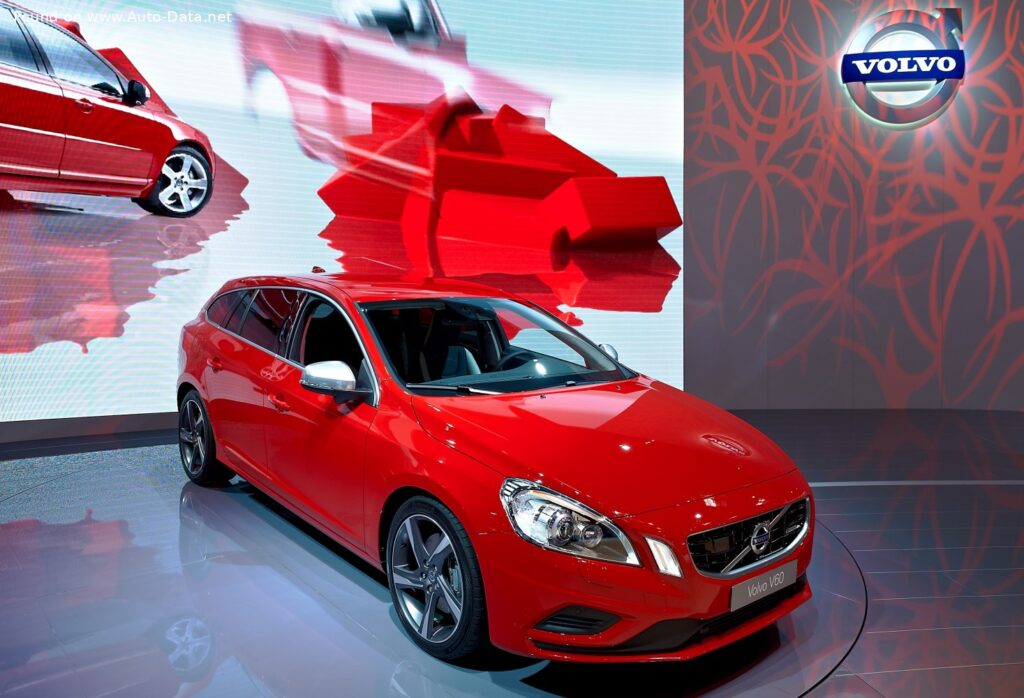
The Volvo V60 I 1.6 T4 (180 Hp) Automatic represents a key moment in Volvo’s evolution, transitioning the brand from a focus on pure functionality to a blend of Scandinavian practicality, dynamic driving, and contemporary design. Introduced in 2010 for the 2011 model year, the first-generation V60 (V60 I) was designed as a sport wagon, sharing its platform with the S60 sedan. This emphasized agility and driver engagement while retaining the versatility expected of a wagon. The 1.6 T4 Automatic variant, while primarily targeted at European markets, offered an efficient and spirited powertrain, aligning with regional fuel costs and taxation policies. Although the V60 was offered in North America, this specific engine configuration was less common, providing a compelling alternative to larger displacement engines favored in the United States.
Engine & Performance of the Volvo V60 I 1.6 T4 (180 Hp) Automatic
The Volvo V60 I 1.6 T4 (180 Hp) Automatic is powered by a 1.6-liter (1596 cm3) inline four-cylinder engine, internally designated by Volvo as the B4164T. This engine showcases modern design principles, incorporating direct fuel injection and a turbocharger with an intercooler to maximize efficiency and power output from its relatively small displacement. The engine produces 180 horsepower at 5700 rpm, a respectable figure for its size. Notably, it delivers 177.01 lb.-ft. (240 Nm) of torque across a broad rev range of 1600 to 5000 rpm. This wide torque band provides responsive acceleration and flexible driving characteristics, making the vehicle capable in various conditions, from urban commutes to highway travel.
Power is transmitted to the front wheels via a 6-speed automatic transmission. This drivetrain, combined with the engine’s characteristics, allows the V60 I 1.6 T4 to accelerate from 0 to 60 mph in 8.7 seconds. For a family-oriented station wagon, these performance figures demonstrate Volvo’s intention to imbue the V60 with a sporty character. Fuel efficiency is a significant strength, particularly in its primary markets. The combined fuel economy is rated at 31.8 US mpg (7.4 l/100 km), with up to 39.9 US mpg (5.9 l/100 km) on extra-urban roads. Urban fuel consumption is 23.8 US mpg (9.9 l/100 km). These figures, coupled with CO2 emissions of 176 g/km and Euro 5 emission compliance, positioned the 1.6 T4 as an environmentally conscious choice without sacrificing driving enjoyment.
Design & Features
The Volvo V60 I, produced from 2011 to 2015, features a sleek and athletic station wagon (estate) body style, deliberately moving away from the boxier designs of earlier Volvo wagons. Its design language is characterized by sweeping lines, a coupe-like roofline, and pronounced shoulders, creating a dynamic and contemporary aesthetic. The V60 I measures 182.2 inches (4628 mm) in length, 73.43 inches (1865 mm) in width, and 58.43 inches (1484 mm) in height, with a wheelbase of 109.29 inches (2776 mm). These dimensions provide a substantial road presence while maintaining maneuverability, as evidenced by a minimum turning circle of 37.73 feet.
The interior of the V60 I, consistent with Volvo’s “Designed Around You” philosophy, offers a minimalist yet elegant cabin focused on ergonomic comfort and intuitive controls. With five doors and seating for five, the V60 provides practical versatility. The trunk space, a key attribute of any wagon, offers 24.44 cubic feet (692 liters) of cargo capacity, making it well-suited for families and active lifestyles. While ABS (Anti-lock Braking System) is highlighted as an assisting system, it’s crucial to understand this within Volvo’s broader commitment to safety. As a modern Volvo, the V60 I would have included a comprehensive suite of passive and active safety features, such as multiple airbags, stability control, traction control, and potentially advanced driver-assistance systems like City Safety (Volvo’s low-speed collision mitigation system), depending on the trim level and optional packages. The curb weight of 3388.5 lbs (1537 kg) reflects its solid construction and the inclusion of these safety technologies, contributing to a secure and stable driving experience.
Legacy and Market Impact
The Volvo V60 I, and specifically the 1.6 T4 (180 Hp) Automatic, played a significant role in Volvo’s strategy to compete more effectively in the premium segment, particularly against German competitors. In its core European markets, the V60 I 1.6 T4 established a niche by combining Volvo’s renowned safety, distinctive Scandinavian design, and an engaging driving experience within a practical wagon body. Its smaller, turbocharged engine was particularly attractive in regions where fuel costs and vehicle taxation favored efficient powertrains, making it a sensible choice for both individual buyers and company fleets.
Competitors included the BMW 3 Series Touring, Audi A4 Avant, Mercedes-Benz C-Class Estate, and Volkswagen Passat Variant. The V60 differentiated itself with its unique styling, a focus on human-centric design, and a strong safety reputation. While German brands often prioritized sportier handling or luxurious features, Volvo offered a more understated, sophisticated, and safety-focused alternative that appealed to a specific customer base.
The historical importance of the V60 I lies in its contribution to modernizing Volvo’s image. It demonstrated that a Volvo wagon could be both practical and stylish, a departure from the utilitarian designs of the past. The 1.6 T4 engine highlighted Volvo’s commitment to downsizing and turbocharging for improved efficiency and reduced emissions, a trend that continues to shape the automotive industry. This generation of the V60 helped bridge the gap between Volvo’s traditional values and its ambition to become a contemporary, premium brand, paving the way for future models that would further solidify its global position. The Volvo V60 I 1.6 T4 (180 Hp) Automatic remains a testament to intelligent engineering and thoughtful design, embodying a practical yet spirited approach to premium motoring.
Technical Specifications
| Category | Specification |
| Brand | Volvo |
| Model | V60 |
| Generation | V60 I |
| Type (Engine) | 1.6 T4 (180 Hp) Automatic |
| Start of Production | 2011 year |
| End of Production | 2015 year |
| Powertrain Architecture | Internal Combustion engine |
| Body type | Station wagon (estate) |
| Seats | 5 |
| Doors | 5 |
| Fuel consumption (economy) – urban | 9.9 l/100 km (23.8 US mpg) |
| Fuel consumption (economy) – extra urban | 5.9 l/100 km (39.9 US mpg) |
| Fuel consumption (economy) – combined | 7.4 l/100 km (31.8 US mpg) |
| CO2 emissions | 176 g/km |
| Fuel Type | Petrol (Gasoline) |
| Acceleration 0 – 60 mph | 8.7 sec |
| Emission standard | Euro 5 |
| Weight-to-power ratio | 8.5 kg/HP, 117.1 HP/tonne |
| Weight-to-torque ratio | 6.4 kg/Nm, 156.1 Nm/tonne |
| Power | 180 HP @ 5700 rpm |
| Power per liter | 112.8 HP/l |
| Torque | 240 Nm (177.01 lb.-ft.) @ 1600-5000 rpm |
| Engine layout | Front, Transverse |
| Engine Model/Code | B4164T |
| Engine displacement | 1596 cm3 (1.6 liters / 97.39 cu. in.) |
| Number of cylinders | 4 |
| Engine configuration | Inline |
| Cylinder Bore | 79 mm (3.11 in.) |
| Piston Stroke | 81.4 mm (3.2 in.) |
| Fuel injection system | Direct injection |
| Engine aspiration | Turbocharger, Intercooler |
| Engine oil capacity | 4.1 l (4.33 US qt) |
| Coolant | 9.8 l (10.36 US qt) |
| Kerb Weight | 1537 kg (3388.5 lbs.) |
| Max. weight | 2100 kg (4629.71 lbs.) |
| Max load | 563 kg (1241.2 lbs.) |
| Trunk (boot) space – minimum | 692 l (24.44 cu. ft.) |
| Fuel tank capacity | 67.5 l (17.83 US gal) |
| Length | 4628 mm (182.2 in.) |
| Width | 1865 mm (73.43 in.) |
| Height | 1484 mm (58.43 in.) |
| Wheelbase | 2776 mm (109.29 in.) |
| Front track | 1588 mm (62.52 in.) |
| Rear (Back) track | 1585 mm (62.4 in.) |
| Minimum turning circle (turning diameter) | 11.5 m (37.73 ft.) |
| Drivetrain Architecture | The Internal combustion engine (ICE) drives the front wheels of the vehicle. |
| Drive wheel | Front wheel drive |
| Number of gears and type of gearbox | 6 gears, automatic transmission |
| Assisting systems | ABS (Anti-lock braking system) |
