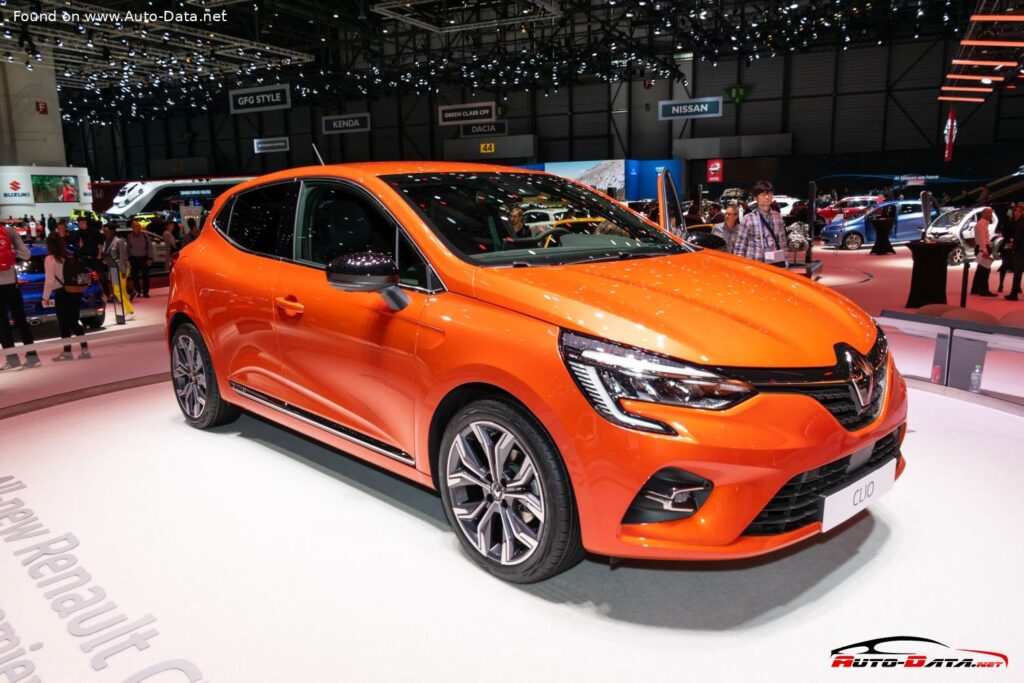
The Renault Clio V (Phase I) 1.0 TCe (100 Hp) CVT represents a significant iteration of one of Europe’s most beloved and enduring subcompact hatchbacks. Launched in September 2019 as the fifth generation of the Clio lineage, this specific variant, produced until August 2020, encapsulates Renault’s commitment to efficiency, modern design, and urban practicality. While the Renault Clio has never been officially sold in the United States, it holds a pivotal position in the European market, consistently ranking among the best-selling models due to its blend of affordability, style, and dynamic driving characteristics. The ‘Phase I’ designation refers to the initial production run of the fifth generation before any significant mid-cycle refreshes.
The Clio V arrived with a refreshed design language, borrowing cues from its larger sibling, the Mégane, while retaining the Clio’s signature charm. Underneath its stylish exterior, it was built on the CMF-B platform, shared with other models within the Renault-Nissan-Mitsubishi Alliance, allowing for improved structural rigidity, enhanced safety features, and the integration of advanced technologies. This particular model, equipped with the 1.0-liter TCe engine and a Continuously Variable Transmission (CVT), was specifically tailored to meet the demands of European drivers seeking a fuel-efficient and easy-to-drive vehicle for daily commutes and city life, all while adhering to stringent Euro 6 emission standards.
Engine & Performance: The Heart of the Renault Clio V (Phase I) 1.0 TCe (100 Hp) CVT
Powering the Renault Clio V (Phase I) 1.0 TCe (100 Hp) CVT is a compact yet capable 1.0-liter (999 cm³ or 60.96 cubic inches) inline three-cylinder gasoline engine, designated by the code H4D 460. This engine features a multi-port manifold injection system, augmented by a turbocharger and intercooler, ensuring both responsive power delivery and impressive fuel efficiency. It generates a respectable 100 horsepower at 5000 revolutions per minute (rpm), making it well-suited for the urban jungle and comfortable enough for highway cruising. The power output translates to 100.1 horsepower per liter, indicating a highly optimized engine design for its displacement.
Torque delivery is equally important for a small car, and the Clio’s 1.0 TCe unit provides 118.01 lb.-ft. (160 Nm) of torque, peaking at a relatively low 2750 rpm. This low-end torque is crucial for quick acceleration from a standstill and flexible driving in city traffic, reducing the need for constant downshifting. The engine’s front, transverse layout, combined with front-wheel drive, is a classic and efficient configuration for subcompact vehicles, maximizing interior space and simplifying the drivetrain.
The power is channeled through an automatic Continuously Variable Transmission (CVT), which is designed to provide smooth, seamless acceleration and optimize fuel economy by keeping the engine in its most efficient operating range. While some enthusiasts might prefer a manual transmission for engagement, the CVT significantly enhances driving comfort, particularly in congested traffic, and contributes to the Clio’s impressive fuel consumption figures.
In terms of raw performance, the Renault Clio V (Phase I) 1.0 TCe (100 Hp) CVT accelerates from 0 to 60 mph in a calculated 10.9 seconds (0-100 km/h in 11.5 seconds) and can reach a maximum speed of 113.09 mph (182 km/h). These figures position it as a competent performer within its segment, prioritizing everyday usability and efficiency over outright speed. The vehicle’s weight-to-power ratio stands at 12 kg/Hp (83.3 Hp/tonne), reflecting its lightweight construction and efficient powertrain.
Fuel efficiency is a strong suit for this Clio variant. According to the WLTP (Worldwide Harmonized Light Vehicles Test Procedure) cycle, it achieves a combined fuel consumption of 40.6 US mpg (5.8 liters per 100 km). This, combined with CO2 emissions of 131 g/km (WLTP), underscores its commitment to environmental responsibility and compliance with the Euro 6 emission standard, a critical factor for European vehicle sales.
Design & Features: Modern European Hatchback Appeal
The Renault Clio V (Phase I) presented a sophisticated and dynamic aesthetic that set it apart in the competitive subcompact segment. As a 5-door hatchback with seating for five occupants, it perfectly balances compact exterior dimensions with a surprisingly spacious and practical interior. The design language, characterized by C-shaped LED daytime running lights, a prominent grille, and sculpted body lines, gave the Clio a premium feel, defying its segment.
Dimensionally, the Clio V measures 159.45 inches (4050 mm) in length, 72.28 inches (1836 mm) in width (with mirrors folded), and 56.69 inches (1440 mm) in height. Its wheelbase of 101.69 inches (2583 mm) contributes to a stable ride and maximized interior volume for its class. The relatively short front and rear overhangs (32.68 inches and 25.08 inches, respectively) enhance its maneuverability, particularly in tight urban environments, further aided by a minimum turning circle of 34.12 feet (10.4 meters).
Inside, the Clio V introduced a significant upgrade in material quality and technological integration. A modern car of this era and segment typically includes a touchscreen infotainment system, digital instrument cluster options, and connectivity features like Apple CarPlay and Android Auto. The focus on driver ergonomics and intuitive controls was paramount.
Practicality is a key strength, with a generous trunk space ranging from 13.81 cubic feet (391 liters) with the rear seats up, expanding to a substantial 37.75 cubic feet (1069 liters) when the rear seats are folded down. This flexibility makes the Clio a versatile choice for everything from grocery runs to weekend trips. The fuel tank capacity of 11.1 US gallons (42 liters) provides a respectable cruising range given its fuel efficiency.
Safety and driving dynamics are well-addressed. The car features an independent McPherson strut setup for the front suspension and a semi-independent elastic beam with coil springs at the rear, a common and effective arrangement for compact cars, balancing comfort and handling. Braking is handled by ventilated discs at the front (280×24 mm) and solid discs at the rear (260×8 mm), complemented by an Anti-lock Braking System (ABS) for enhanced stopping power and stability. The electric power steering system, with a rack and pinion setup, provides light and precise control, making city driving effortless. Tire options include 195/55 R16 87H or 205/45 R17 88H, mounted on 16-inch or 17-inch wheel rims, influencing both ride comfort and handling characteristics. The kerb weight of 2647.75 lbs (1201 kg) contributes to its agility and efficiency.
Technical Specifications
| Category | Specification |
| General Information | |
| Brand | Renault |
| Model | Clio |
| Generation | Clio V (Phase I) |
| Engine Type | 1.0 TCe (100 Hp) CVT |
| Start of Production | September, 2019 |
| End of Production | August, 2020 |
| Powertrain Architecture | Internal Combustion engine |
| Body Type | Hatchback |
| Seats | 5 |
| Doors | 5 |
| Performance Specs | |
| Combined Fuel Consumption (WLTP) | 5.8 l/100 km |
| CO2 Emissions (WLTP) | 131 g/km |
| CO2 Emissions (NEDC) | 113 g/km |
| Fuel Type | Petrol (Gasoline) |
| Acceleration 0 – 60 mph | 10.9 sec |
| Maximum Speed | 182 km/h |
| Emission Standard | Euro 6 |
| Weight-to-Power Ratio | 12 kg/Hp |
| Weight-to-Torque Ratio | 7.5 kg/Nm |
| Engine Specs | |
| Power | 100 Hp @ 5000 rpm |
| Power per Liter | 100.1 Hp/l |
| Torque | 160 Nm @ 2750 rpm |
| Engine Layout | Front, Transverse |
| Engine Model/Code | H4D 460 |
| Engine Displacement | 999 cm³ |
| Number of Cylinders | 3 |
| Engine Configuration | Inline |
| Cylinder Bore | 72.2 mm |
| Piston Stroke | 81.3 mm |
| Number of Valves per Cylinder | 4 |
| Fuel Injection System | Multi-port manifold injection |
| Engine Aspiration | Turbocharger, Intercooler |
| Space, Volume and Weights | |
| Kerb Weight | 1201 kg |
| Max. Weight (GVWR) | 1626 kg |
| Trunk (boot) Space – Minimum | 391 l |
| Trunk (boot) Space – Maximum | 1069 l |
| Fuel Tank Capacity | 42 l |
| Dimensions | |
| Length | 4050 mm |
| Width with Mirrors Folded | 1836 mm |
| Height | 1440 mm |
| Wheelbase | 2583 mm |
The Renault Clio V (Phase I) 1.0 TCe (100 Hp) CVT, despite its relatively short production run for this specific powertrain variant (September 2019 to August 2020), played a crucial role in maintaining the Clio’s status as a perennial bestseller in the European supermini segment. The Clio lineage itself boasts a rich heritage, consistently evolving to meet changing market demands and regulatory pressures. The fifth generation, and particularly this efficient 1.0-liter turbo-CVT combination, underscored Renault’s strategy to offer compelling value in a highly competitive class.
In its primary European market, the Clio V faced formidable rivals, including segment stalwarts like the Ford Fiesta, Volkswagen Polo, Peugeot 208, and Opel Corsa (Vauxhall Corsa in the UK). To stand out, Renault focused on a distinctive blend of dynamic styling, a high-quality interior for its class, and a strong emphasis on modern technology and connectivity features. The availability of efficient powertrains like the 1.0 TCe (100 Hp) with a smooth CVT was key to attracting a broad spectrum of buyers, from young professionals to small families, who valued low running costs and ease of driving.
The 1.0 TCe engine itself is a testament to the industry’s move towards downsizing and turbocharging to achieve better fuel economy and lower emissions without sacrificing too much performance. This three-cylinder unit, paired with the CVT, made the Clio an ideal urban commuter, offering a relaxed driving experience and excellent maneuverability. Its adherence to Euro 6 emission standards was vital for its marketability across the continent, especially in cities with increasingly strict environmental zones.
Historically, the Clio has been a trendsetter in its segment, often introducing features and design elements that would later become commonplace. The Clio V continued this tradition by offering a more mature and refined package than its predecessors. Its impact lies in its ability to combine practicality with a desirable aesthetic, proving that a compact car can still feel premium and sophisticated. The specific 1.0 TCe (100 Hp) CVT model, while not the most powerful or enthusiast-focused variant, was instrumental in broadening the Clio’s appeal, offering a balanced proposition of performance, comfort, and efficiency that resonated deeply with the core European supermini buyer. Its legacy is one of smart engineering and market-savvy positioning, reinforcing the Clio’s enduring charm and commercial success.