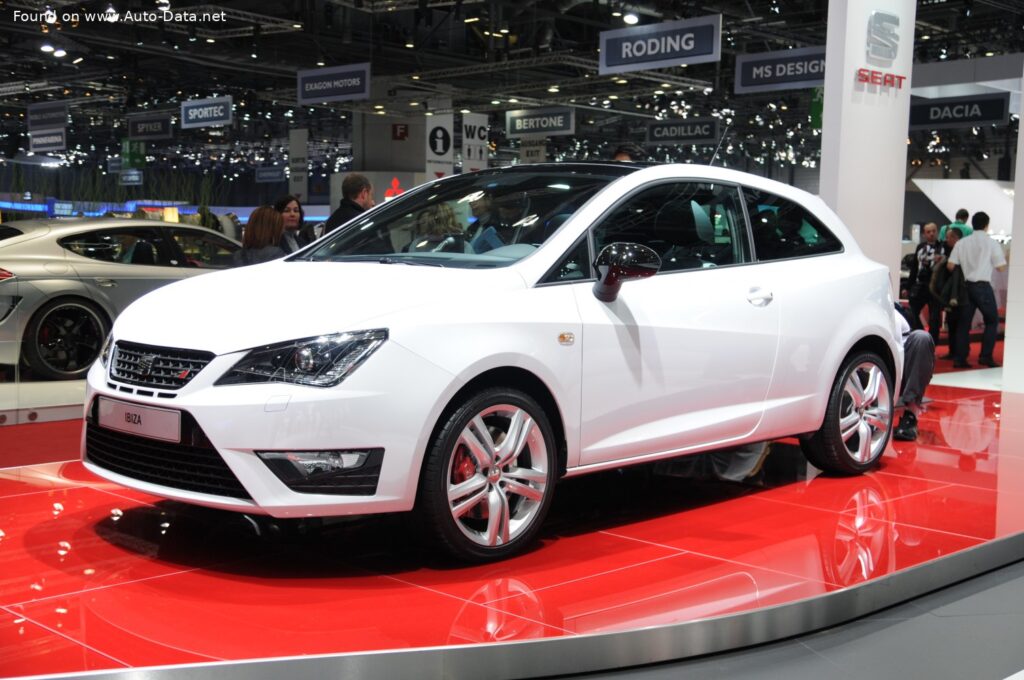
The Seat Ibiza IV SC (facelift 2012) 1.6 TDI (90 Hp) DSG represents a significant iteration of one of Europe’s most popular and enduring subcompact vehicles. Manufactured by the Spanish automaker SEAT, a member of the Volkswagen Group, the Ibiza has consistently served as a cornerstone of the brand’s lineup since its inception in 1984. The fourth generation, introduced in 2008 and subsequently updated with a facelift in 2012, solidified the Ibiza’s reputation as a stylish, practical, and efficient contender in the fiercely competitive European B-segment, often referred to as the supermini class. This specific variant, the SC (SportCoupé) with its three-door body style, paired with the economical 1.6 TDI (Turbocharged Direct Injection) diesel engine producing 90 horsepower and the advanced 7-speed DSG (Direct Shift Gearbox) automatic transmission, was a compelling option for European consumers seeking a blend of sporty aesthetics, fuel efficiency, and modern technology between 2012 and 2015.
While never officially sold in the United States, the Ibiza’s influence and design philosophy resonated within the global automotive landscape, showcasing SEAT’s distinct “Auto Emoción” design language – a blend of sharp lines, dynamic proportions, and a youthful appeal. The 2012 facelift brought subtle yet impactful enhancements, primarily to the exterior styling and interior refinement, ensuring the Ibiza remained fresh and competitive against rivals like the Volkswagen Polo, Ford Fiesta, and Renault Clio in its primary markets. The combination of its compact dimensions, spirited yet frugal powertrain, and advanced transmission made the Seat Ibiza IV SC (facelift 2012) a highly relevant and successful model in its segment.
Engine & Performance of the Seat Ibiza IV SC (facelift 2012)
At the heart of this particular Seat Ibiza IV SC (facelift 2012) model is a robust and highly efficient 1.6-liter TDI diesel engine, identified by the engine code CAYB. This inline four-cylinder powerplant, mounted transversely at the front, features a sophisticated common rail fuel injection system, a turbocharger, and an intercooler to optimize performance and fuel economy. With an engine displacement of 1598 cubic centimeters (97.52 cubic inches), it delivers a respectable 90 horsepower at 4200 RPM, providing a power-per-liter ratio of 56.3 horsepower per liter.
More impressively for a vehicle of its size and intended use, the engine generates a substantial 230 Newton-meters (169.64 lb.-ft.) of torque, available across a broad and usable range from 1500 to 2500 RPM. This low-end torque is crucial for responsive acceleration in urban driving and effortless cruising on highways, making the Ibiza feel more potent than its horsepower figure might suggest. The engine’s architecture includes a bore of 79.5 mm (3.13 in.) and a piston stroke of 80.5 mm (3.17 in.), with a high compression ratio of 16.5:1, typical for a modern diesel engine designed for efficiency. Each cylinder features four valves, contributing to efficient breathing and combustion, and the engine is equipped with a particulate filter to meet Euro 5 emission standards, reflecting its commitment to environmental responsibility.
Power is seamlessly delivered to the front wheels via SEAT’s advanced 7-speed DSG automatic transmission. This dual-clutch gearbox is renowned for its rapid, smooth shifts and its ability to significantly enhance both performance and fuel efficiency compared to traditional automatic transmissions. The DSG’s precise gear selection ensures the engine operates within its optimal torque band, contributing to the car’s impressive economy figures. The Ibiza SC 1.6 TDI (90 Hp) DSG accelerates from 0 to 60 mph in a brisk 11 seconds (0-100 km/h in 11.6 seconds) and can reach a maximum speed of 110.6 mph (178 km/h).
Fuel economy is a standout feature of this diesel variant. The official combined fuel consumption rating is an excellent 4.3 liters per 100 kilometers, translating to an impressive 54.7 US mpg (65.7 UK mpg). Urban driving yields 45.2 US mpg (5.2 l/100 km), while extra-urban cruising can achieve an astounding 63.6 US mpg (3.7 l/100 km). With CO2 emissions of just 112 g/km, the Ibiza 1.6 TDI DSG was a highly economical and environmentally conscious choice for European motorists, offering a practical solution for daily commuting and longer journeys alike. The fuel tank capacity of 45 liters (11.89 US gallons) further extends its range between fill-ups.
Design & Features
The Seat Ibiza IV SC (facelift 2012) adopts a “Coupe” body type, characterized by its three-door configuration and a more dynamic, sportier profile compared to its five-door hatchback sibling. This SportCoupé (SC) designation emphasizes its youthful appeal and sleeker aesthetics. The facelift introduced a revised front fascia, featuring sharper headlights, a redesigned grille, and updated bumper, giving the car a more aggressive and contemporary look that aligned with SEAT’s evolving design language. Its compact dimensions – 159.17 inches (4043 mm) in length, 66.65 inches (1693 mm) in width, and 56.22 inches (1428 mm) in height – make it highly maneuverable in congested European city environments, while its 97.2-inch (2469 mm) wheelbase ensures a stable ride.
Despite its coupe designation, the Ibiza SC offers seating for five occupants, though the rear seats are naturally more suited for shorter journeys or children. The interior, refreshed during the 2012 facelift, featured improved materials and revised trim options, enhancing the cabin’s perceived quality. Practicality is maintained with a respectable minimum trunk space of 284 liters (10.03 cubic feet), sufficient for daily errands or weekend trips.
Key features for this generation included essential safety and driving aids. The vehicle is equipped with an Anti-lock Braking System (ABS) for enhanced stopping power and control. Steering is handled by a rack and pinion system with electric power steering, providing light and precise control, particularly beneficial for parking and low-speed maneuvers. The suspension setup is typical for a front-wheel-drive subcompact, featuring an independent McPherson strut system with coil springs and an anti-roll bar at the front, paired with a more compact trailing arm setup at the rear. This configuration offers a good balance of ride comfort and agile handling, characteristic of European hatchbacks. Braking performance is ensured by ventilated discs at the front and disc brakes at the rear.
The Ibiza SC was available with various wheel and tire options, allowing for personalization and different levels of grip and ride comfort. Standard fitments often included 185/60 R15 tires on 6J x 15 rims, with optional upgrades to larger 215/45 R16 tires on 7J x 16 rims or even sportier 215/40 R17 tires on 7J x 17 rims, further enhancing its visual appeal and handling dynamics.
Technical Specifications
| Category | Specification |
| Brand | Seat |
| Model | Ibiza |
| Generation | Ibiza IV SC (facelift 2012) |
| Type (Engine) | 1.6 TDI (90 Hp) DSG |
| Start of Production | 2012 year |
| End of Production | 2015 year |
| Powertrain Architecture | Internal Combustion engine |
| Body type | Coupe |
| Seats | 5 |
| Doors | 3 |
| Fuel consumption (economy) – urban | 5.2 l/100 km (45.2 US mpg) |
| Fuel consumption (economy) – extra urban | 3.7 l/100 km (63.6 US mpg) |
| Fuel consumption (economy) – combined | 4.3 l/100 km (54.7 US mpg) |
| CO2 emissions | 112 g/km |
| Fuel Type | Diesel |
| Acceleration 0 – 60 mph | 11 sec |
| Acceleration 0 – 100 km/h | 11.6 sec |
| Maximum speed | 178 km/h (110.6 mph) |
| Emission standard | Euro 5 |
| Weight-to-power ratio | 13.2 kg/Hp (75.7 Hp/tonne) |
| Weight-to-torque ratio | 5.2 kg/Nm (193.4 Nm/tonne) |
| Power | 90 Hp @ 4200 rpm |
| Power per liter | 56.3 Hp/l |
| Torque | 230 Nm (169.64 lb.-ft.) @ 1500-2500 rpm |
| Engine layout | Front, Transverse |
| Engine Model/Code | CAYB |
| Engine displacement | 1598 cm3 (97.52 cu. in.) |
| Number of cylinders | 4 |
| Engine configuration | Inline |
| Cylinder Bore | 79.5 mm (3.13 in.) |
| Piston Stroke | 80.5 mm (3.17 in.) |
| Compression ratio | 16.5:1 |
| Number of valves per cylinder | 4 |
| Fuel injection system | Diesel Commonrail |
| Engine aspiration | Turbocharger, Intercooler |
| Engine oil capacity | 4.3 l (4.54 US qt) |
| Coolant | 8 l (8.45 US qt) |
| Engine systems | Particulate filter |
| Kerb Weight | 1189 kg (2621.3 lbs.) |
| Max. weight | 1690 kg (3725.81 lbs.) |
| Max load | 501 kg (1104.52 lbs.) |
| Trunk (boot) space – minimum | 284 l (10.03 cu. ft.) |
| Fuel tank capacity | 45 l (11.89 US gal) |
| Length | 4043 mm (159.17 in.) |
| Width | 1693 mm (66.65 in.) |
| Height | 1428 mm (56.22 in.) |
| Wheelbase | 2469 mm (97.2 in.) |
| Front track | 1465 mm (57.68 in.) |
| Rear (Back) track | 1457 mm (57.36 in.) |
| Minimum turning circle (turning diameter) | 10.48 m (34.38 ft.) |
| Drivetrain Architecture | The Internal combustion engine (ICE) drives the front wheels of the vehicle. |
| Drive wheel | Front wheel drive |
| Number of gears and type of gearbox | 7 gears, automatic transmission DSG |
| Front suspension | Independent, type McPherson with coil spring and anti-roll bar |
| Rear suspension | Trailing arm |
| Front brakes | Ventilated discs |
| Rear brakes | Disc |
| Assisting systems | ABS (Anti-lock braking system) |
| Steering type | Steering rack and pinion |
| Power steering | Electric Steering |
| Tires size | 185/60 R15; 215/45 R16; 215/40 R17 |
| Wheel rims size | 6J x 15; 7J x 16; 7J x 17 |
Legacy and Market Impact
The Seat Ibiza, particularly the fourth generation and its facelifted 2012 iteration, holds a significant place in the European automotive landscape. As a core model for SEAT, it consistently ranked among the best-selling cars in Spain and was a strong performer across other European markets. Its competitive edge was sharpened by its position within the Volkswagen Group, allowing it to share platforms, engines, and technologies with segment leaders like the Volkswagen Polo and Audi A1, yet offering a distinct “Spanish flair” and a generally more aggressive, youthful design at a compelling price point.
The 1.6 TDI (90 Hp) DSG variant specifically underscored the European market’s preference for efficient diesel powertrains in the subcompact segment during the early 2010s. For many consumers, diesel engines offered an unbeatable combination of fuel economy, robust torque for daily driving, and lower running costs, especially given European fuel pricing structures. The inclusion of the advanced 7-speed DSG transmission further elevated the driving experience, providing a level of refinement and efficiency often associated with larger, more expensive vehicles. This combination made the Ibiza an ideal choice for urban commuters, young families, and those who frequently traveled longer distances, offering comfort and economy without sacrificing style or a modicum of driving enjoyment.
Competitors for the Ibiza in its primary markets were numerous and formidable. Key rivals included the aforementioned Volkswagen Polo, Ford Fiesta, Renault Clio, Peugeot 208, Opel/Vauxhall Corsa, and Skoda Fabia. The Ibiza differentiated itself through its expressive design, often perceived as sportier and more passionate than its VW Group stablemates, aligning with SEAT’s brand ethos of “Auto Emoción.” Its three-door SC variant, in particular, appealed to buyers looking for a more coupe-like aesthetic in a practical small car.
The legacy of the Ibiza IV SC (facelift 2012) lies in its successful blend of practicality, efficiency, and style, cementing SEAT’s position as a significant player in the European automotive market. It represents a pivotal moment in the brand’s evolution, showcasing its ability to deliver compelling vehicles that resonate with a diverse range of consumers.