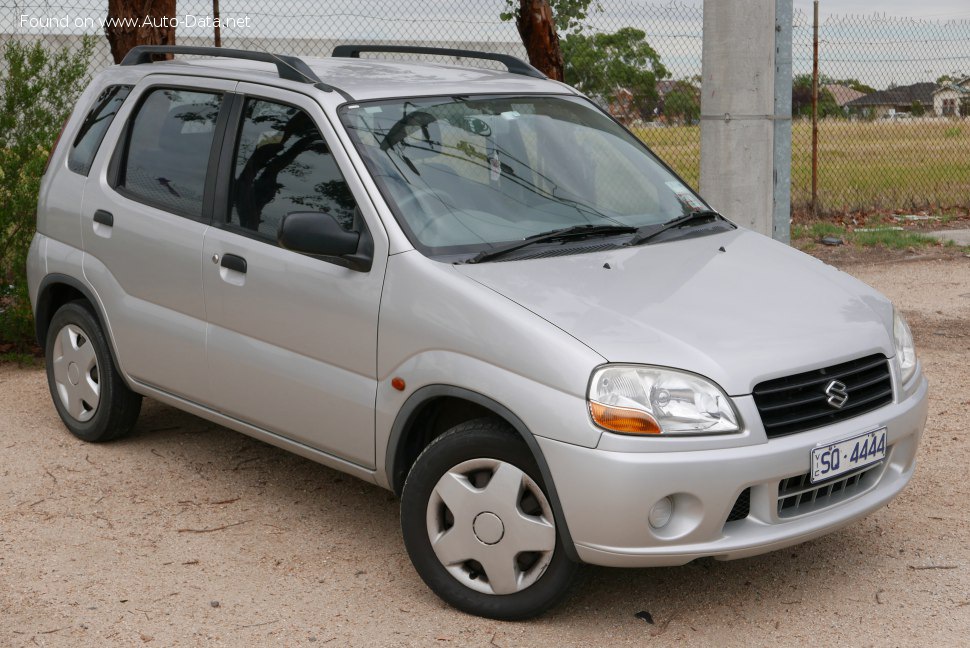
The Suzuki Ignis Hatchback I FH 1.3 i (85 Hp) represents the first generation of Suzuki’s foray into the compact car segment with a distinctive, somewhat crossover-inspired design. Produced from 2000 to 2003, this iteration of the Ignis was a pivotal model for Suzuki, particularly in European and Asian markets where demand for versatile, fuel-efficient, and compact vehicles was strong. While not a mainstream offering in the United States, the Ignis I FH showcased Suzuki’s engineering prowess in creating a small car that maximized interior space and offered a robust driving experience for its class. It carved out a niche for itself as a practical urban vehicle with a hint of ruggedness, appealing to buyers seeking an alternative to conventional hatchbacks.
Engine & Performance of the Suzuki Ignis
At the heart of the Suzuki Ignis Hatchback I FH 1.3 i (85 Hp) was the M13A engine, a naturally aspirated 1.3-liter (1299 cubic centimeters, or 79.27 cubic inches) inline-four gasoline powerplant. This engine featured a modern Double Overhead Camshaft (DOHC) valvetrain with four valves per cylinder, a configuration that was becoming standard for efficiency and performance in compact engines of the era. Fuel delivery was handled by a multi-port manifold injection system, ensuring precise fuel metering and combustion. With a compression ratio of 9.5:1, the engine was designed for reliable operation on standard gasoline.
The M13A unit generated a respectable 85 horsepower at 6000 revolutions per minute (rpm), providing a power-to-liter ratio of 65.4 horsepower per liter. Torque output stood at 78.18 pound-feet (106 Newton-meters) at a relatively low 3500 rpm, indicating a flexible powerband suitable for city driving and highway cruising alike. Power was sent to the front wheels via a smooth-shifting 5-speed manual transmission, a common and efficient setup for compact cars of this period.
In terms of acceleration, the Ignis 1.3 i was capable of reaching 60 miles per hour from a standstill in an estimated 12.4 seconds, with a maximum speed of approximately 102.53 miles per hour (165 km/h). These figures positioned it as a competent performer within its segment, offering adequate power for daily commutes and occasional longer journeys. Fuel economy was a strong suit, with a combined rating of 42 US miles per gallon (5.6 liters per 100 km). Urban driving yielded around 32.2 US mpg (7.3 l/100 km), while extra-urban conditions could see it achieve an impressive 50 US mpg (4.7 l/100 km), highlighting its efficiency for a gasoline-powered vehicle of its time. The car’s low curb weight of 1664.49 pounds (755 kg) contributed significantly to both its lively performance and excellent fuel economy.
Design & Features
The Suzuki Ignis Hatchback I FH adopted a distinctive 5-door, 5-seat hatchback body type, but with a taller stance and more upright styling that hinted at its later evolution into a mini-SUV or crossover. Its compact dimensions were key to its urban appeal: a length of 151.38 inches (3845 mm), a width of 62.6 inches (1590 mm), and a height of 54.33 inches (1380 mm). This relatively high roofline, combined with a wheelbase of 93.11 inches (2365 mm), allowed for a surprisingly spacious interior for its exterior footprint, offering comfortable seating for five passengers, albeit snugly in the rear.
The design emphasized practicality and functionality. The interior provided a decent cargo capacity, ranging from 9.89 cubic feet (280 liters) with all seats in place, expanding to a more substantial 21.9 cubic feet (620 liters) with the rear seats folded down. This flexibility made the Ignis a versatile companion for shopping, family errands, or weekend trips. The fuel tank capacity of 10.57 US gallons (40 liters) provided a good cruising range given its excellent fuel efficiency.
Underneath, the Ignis featured a drivetrain architecture where the internal combustion engine drove the front wheels. The suspension system consisted of wishbones at the front, providing a robust and comfortable ride, while the rear utilized a coil spring setup, common for compact hatchbacks. Braking duties were handled by disc brakes at the front and drum brakes at the rear, a typical configuration for economy cars of its class, offering reliable stopping power. Steering was managed by a hydraulic rack and pinion system, providing direct feedback and ease of maneuverability, especially with a tight minimum turning circle of 31.5 feet (9.6 meters). The car rode on 165/70 R13 tires, mounted on 13-inch wheel rims, which contributed to its nimble handling and cost-effective tire replacement.
Technical Specifications
| Category | Specification |
| General Information | |
| Brand | Suzuki |
| Model | Ignis Hatchback I FH |
| Engine Type | 1.3 i (85 Hp) |
| Production Start | 2000 |
| Production End | 2003 |
| Powertrain Architecture | Internal Combustion Engine |
| Body Type | Hatchback |
| Seats | 5 |
| Doors | 5 |
| Performance Specs | |
| Fuel Consumption (Urban) | 7.3 l/100 km (32.2 US mpg) |
| Fuel Consumption (Extra Urban) | 4.7 l/100 km (50 US mpg) |
| Fuel Consumption (Combined) | 5.6 l/100 km (42 US mpg) |
| Fuel Type | Petrol (Gasoline) |
| Acceleration 0-60 mph | 12.4 sec |
| Maximum Speed | 165 km/h (102.53 mph) |
| Weight-to-Power Ratio | 8.9 kg/Hp (112.6 Hp/tonne) |
| Weight-to-Torque Ratio | 7.1 kg/Nm (140.4 Nm/tonne) |
| Engine Specs | |
| Power | 85 Hp @ 6000 rpm |
| Power per liter | 65.4 Hp/l |
| Torque | 106 Nm @ 3500 rpm (78.18 lb-ft @ 3500 rpm) |
| Engine Layout | Front, Transverse |
| Engine Model/Code | M13A |
| Engine Displacement | 1299 cm3 (79.27 cu. in.) |
| Number of Cylinders | 4 |
| Engine Configuration | Inline |
| Cylinder Bore | 74 mm (2.91 in.) |
| Piston Stroke | 75.5 mm (2.97 in.) |
| Compression Ratio | 9.5:1 |
| Valves per Cylinder | 4 |
| Fuel Injection System | Multi-port manifold injection |
| Engine Aspiration | Naturally aspirated |
| Valvetrain | DOHC |
| Engine Oil Capacity | 3.8 l (4.02 US qt) |
| Coolant Capacity | 5.6 l (5.92 US qt) |
| Space, Volume & Weights | |
| Kerb Weight | 755 kg (1664.49 lbs.) |
| Max. Weight (Gross) | 1290 kg (2843.96 lbs.) |
| Max Load | 535 kg (1179.47 lbs.) |
| Trunk Space (Minimum) | 280 l (9.89 cu. ft.) |
| Trunk Space (Maximum) | 620 l (21.9 cu. ft.) |
| Fuel Tank Capacity | 40 l (10.57 US gal) |
| Dimensions | |
| Length | 3845 mm (151.38 in.) |
| Width | 1590 mm (62.6 in.) |
| Height | 1380 mm (54.33 in.) |
| Wheelbase | 2365 mm (93.11 in.) |
| Front Track | 1365 mm (53.74 in.) |
| Rear Track | 1340 mm (52.76 in.) |
| Minimum Turning Circle | 9.6 m (31.5 ft.) |
| Drivetrain, Brakes & Suspension | |
| Drivetrain Architecture | Front-wheel drive (ICE drives front wheels) |
| Drive Wheel | Front wheel drive |
| Gearbox Type | 5 gears, manual transmission |
| Front Suspension | Wishbone |
| Rear Suspension | Coil spring |
| Front Brakes | Disc |
| Rear Brakes | Drum |
| Steering Type | Steering rack and pinion |
| Power Steering | Hydraulic Steering |
| Tires Size | 165/70 R13 |
| Wheel Rims Size | 13 inches |
Legacy and Market Impact of the Suzuki Ignis
The Suzuki Ignis Hatchback I FH 1.3 i (85 Hp) played a significant role in Suzuki’s global strategy during the early 2000s, particularly in markets outside of North America. It was positioned as an affordable, reliable, and highly practical compact car that offered more versatility than traditional hatchbacks due to its slightly elevated ride height and boxier, more utilitarian styling. This design philosophy, which blurred the lines between a conventional hatchback and a compact SUV, was quite forward-thinking for its time and foreshadowed the later boom in crossover vehicles.
In Europe and Asia, the Ignis I FH competed against a diverse array of subcompact and supermini vehicles. Its rivals included established players like the Toyota Yaris (known as Vitz in some markets), Honda Jazz (Fit), Nissan Micra, and various European models such as the Fiat Panda and Renault Twingo. What set the Ignis apart was its reputation for robust engineering, low running costs, and Suzuki’s inherent expertise in building small, durable vehicles. While it might not have offered the same level of refinement as some European competitors, its straightforward mechanics and proven reliability made it a popular choice for budget-conscious buyers and those who valued dependability over luxury.
The Ignis’s slightly elevated driving position and practical interior made it well-suited for congested urban environments, where its compact size and tight turning radius were significant advantages. Its fuel-efficient engine also resonated with consumers facing rising fuel prices. The first-generation Ignis laid the groundwork for future Suzuki compacts and crossovers, demonstrating the brand’s ability to innovate within the small car segment. Its legacy is one of a dependable, unpretentious, and surprisingly capable vehicle that delivered excellent value and played a crucial role in Suzuki’s international market presence, proving that a small car could offer big utility and a distinctive personality.