
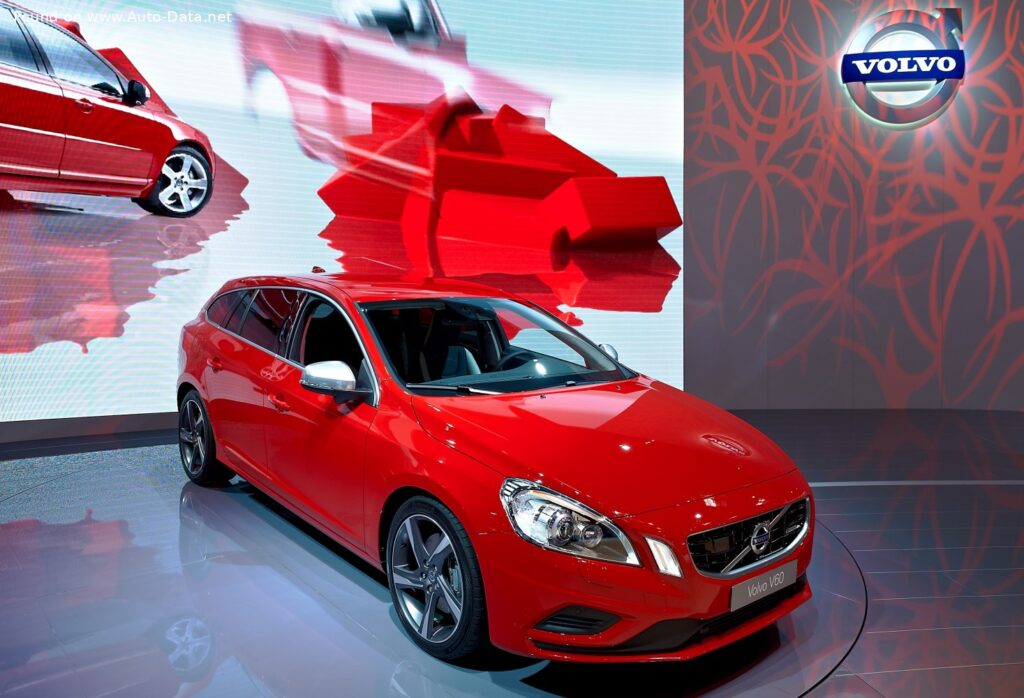
The Volvo V60 I 2.0 D3 (163 Hp) S/S represents a compelling chapter in Volvo’s modern history, marking the brand’s continued evolution from its traditionally boxy, safety-first image to one that also embraced dynamic styling and advanced technology. Introduced as part of the first-generation V60 lineup, this specific variant, produced between 2012 and 2013, highlighted Volvo’s commitment to efficiency and performance within the premium compact executive segment. Primarily targeted at the European market, where diesel powertrains and station wagons (or “estates” as they are known across the Atlantic) enjoyed significant popularity, the V60 I 2.0 D3 skillfully blended practicality with a sporty aesthetic, offering a refined driving experience coupled with Volvo’s renowned safety credentials.
The V60 I generation, launched in 2010, was designed to compete with established German rivals such as the BMW 3 Series Touring and the Audi A4 Avant. While sharing its platform with the S60 sedan, the V60 distinguished itself with its sleek wagon silhouette, providing enhanced versatility without compromising on its athletic stance. The 2.0 D3 (163 Hp) S/S variant, with its efficient five-cylinder diesel engine and intelligent Start/Stop technology, showcased Volvo’s engineering prowess in delivering a balanced package of power, fuel economy, and environmental responsibility, adhering to the Euro 5 emission standard prevalent at the time.
Engine & Performance of the Volvo V60 I 2.0 D3 (163 Hp) S/S
At the heart of the Volvo V60 I 2.0 D3 (163 Hp) S/S lies a sophisticated 2.0-liter (1984 cm3 or 121.07 cu. in.) inline five-cylinder turbo-diesel engine, internally designated as D5204T3. This powerplant was a hallmark of Volvo’s engineering, offering a unique blend of smoothness and torque delivery that set it apart from many four-cylinder competitors. The engine produced a robust 163 horsepower at 3500 rpm, which, while not segment-leading in raw numbers, was impressively complemented by a substantial 295.02 lb.-ft. (400 Nm) of torque, available across a broad rev range from 1500 to 2750 rpm. This wide torque band ensured excellent drivability and effortless acceleration in various driving conditions, from city commutes to highway cruising.
Power was efficiently transmitted to the front wheels via a 6-speed automatic transmission, providing seamless gear changes and contributing to the car’s refined character. The V60 I 2.0 D3 was also equipped with a Start/Stop (S/S) system, a pioneering feature for its time, which automatically shut off the engine when the vehicle was stationary and restarted it when the driver released the brake pedal. This technology played a crucial role in improving fuel efficiency and reducing CO2 emissions, particularly in urban environments.
Performance figures for this variant were respectable, with the V60 I 2.0 D3 capable of accelerating from 0 to 60 mph in a calculated 8.9 seconds (0-100 km/h in 9.4 seconds). Its weight-to-power ratio stood at 9.9 kg/Hp (100.9 Hp/tonne), underscoring its solid, if not overtly sporty, performance profile. Fuel economy was a significant strong suit for the diesel V60. The combined cycle consumption was rated at an impressive 41.3 US mpg (5.7 l/100 km), with extra-urban driving yielding up to 49 US mpg (4.8 l/100 km). These figures, combined with CO2 emissions of 149 g/km, highlighted the vehicle’s commitment to efficiency and lower environmental impact, meeting the Euro 5 emission standard.
Design & Features
The design of the Volvo V60 I marked a distinct shift for the Swedish automaker, moving away from its more utilitarian, angular past towards a sleeker, more dynamic aesthetic. As a five-door station wagon (estate), the V60 I 2.0 D3 combined the practicality inherent to the body style with a coupe-like profile, featuring a sloping roofline and muscular shoulder lines. This design language aimed to attract a younger, more design-conscious demographic without sacrificing the core values of space and functionality that Volvo owners had come to expect.
Inside, the V60 offered a typically Scandinavian cabin – minimalist yet highly functional, with high-quality materials and excellent ergonomics. The five-seat layout provided comfortable accommodation for all occupants, with supportive seating and ample legroom for a vehicle in its class. The trunk space was generous for its segment, offering a minimum of 692 liters (24.44 cu. ft.) of cargo volume, making it highly practical for families and those requiring versatile load-carrying capability. Key features for the era included a common rail diesel fuel injection system, a turbocharger with an intercooler for optimal engine performance, and a particulate filter to reduce emissions. Safety, as always with Volvo, was paramount, with the vehicle featuring an Anti-lock Braking System (ABS) as standard, a foundational element of its comprehensive safety suite.
The V60’s dimensions – 182.2 inches (4628 mm) in length, 73.43 inches (1865 mm) in width, and 58.43 inches (1484 mm) in height – contributed to its stable road presence and agile handling. A wheelbase of 109.29 inches (2776 mm) ensured a comfortable ride, while a minimum turning circle of 37.73 feet (11.5 meters) made it maneuverable in urban settings. The integration of the Start/Stop system was a significant technological feature, showcasing Volvo’s early adoption of efficiency-enhancing technologies in its mainstream models.
Technical Specifications: Volvo V60 I 2.0 D3 (163 Hp) S/S (2012-2013)
| Category | Specification |
| Brand | Volvo |
| Model | V60 |
| Generation | V60 I |
| Type (Engine) | 2.0 D3 (163 Hp) S/S |
| Production Start | 2012 |
| Production End | 2013 |
| Powertrain Architecture | Internal Combustion Engine |
| Body type | Station wagon (estate) |
| Seats | 5 |
| Doors | 5 |
| Fuel Consumption (Urban) | 7.1 l/100 km (33.1 US mpg) |
| Fuel Consumption (Extra Urban) | 4.8 l/100 km (49 US mpg) |
| Fuel Consumption (Combined) | 5.7 l/100 km (41.3 US mpg) |
| CO2 Emissions | 149 g/km |
| Fuel Type | Diesel |
| Acceleration 0 – 60 mph | 8.9 sec |
| Acceleration 0 – 100 km/h | 9.4 sec |
| Emission Standard | Euro 5 |
| Weight-to-power ratio | 9.9 kg/Hp (100.9 Hp/tonne) |
| Weight-to-torque ratio | 4 kg/Nm (247.5 Nm/tonne) |
| Power | 163 Hp @ 3500 rpm |
| Power per liter | 82.2 Hp/l |
| Torque | 400 Nm (295.02 lb.-ft.) @ 1500-2750 rpm |
| Engine Layout | Front, Transverse |
| Engine Model/Code | D5204T3 |
| Engine Displacement | 1984 cm3 (2.0 Liters / 121.07 cu. in.) |
| Number of Cylinders | 5 |
| Engine Configuration | Inline |
| Cylinder Bore | 81 mm (3.19 in.) |
| Piston Stroke | 77 mm (3.03 in.) |
| Fuel Injection System | Diesel Commonrail |
| Engine Aspiration | Turbocharger, Intercooler |
| Engine Oil Capacity | 5.9 l (6.23 US qt) |
| Coolant Capacity | 8.9 l (9.4 US qt) |
| Engine Systems | Particulate filter |
| Kerb Weight | 1616 kg (3562.67 lbs.) |
| Max. Weight | 2200 kg (4850.17 lbs.) |
| Max Load | 584 kg (1287.5 lbs.) |
| Trunk (boot) Space – Minimum | 692 l (24.44 cu. ft.) |
| Fuel Tank Capacity | 67.5 l (17.83 US gal) |
| Length | 4628 mm (182.2 in.) |
| Width | 1865 mm (73.43 in.) |
| Height | 1484 mm (58.43 in.) |
| Wheelbase | 2776 mm (109.29 in.) |
| Front Track | 1588 mm (62.52 in.) |
| Rear Track | 1585 mm (62.4 in.) |
| Minimum Turning Circle | 11.5 m (37.73 ft.) |
| Drivetrain Architecture | Front-wheel drive |
| Drive Wheel | Front wheel drive |
| Number of Gears | 6 |
| Type of Gearbox | Automatic transmission |
| Assisting Systems | ABS (Anti-lock braking system) |
Legacy and Market Impact
The Volvo V60 I, and particularly efficient diesel variants like the 2.0 D3 (163 Hp) S/S, played a crucial role in Volvo’s strategy to redefine its brand image in the early 2010s. It successfully demonstrated that Volvo could produce vehicles that were not only exceptionally safe and practical but also stylish, engaging to drive, and technologically advanced. In its primary market of Europe, the V60 faced fierce competition from premium rivals. Its main competitors included the BMW 3 Series Touring, known for its driving dynamics; the Audi A4 Avant, praised for its sophisticated design and quattro all-wheel drive options; and the Mercedes-Benz C-Class Estate, which offered a blend of luxury and comfort.
Against these formidable opponents, the V60 I 2.0 D3 carved out its niche by offering a distinctive Scandinavian design, a unique five-cylinder diesel engine with a strong torque output, and a clear focus on real-world safety and environmental responsibility through features like its Start/Stop system and Euro 5 compliance. While the specific 2.0 D3 (163 Hp) S/S variant had a relatively short production run from 2012 to 2013, it was an integral part of the broader V60 I generation, which continued to be produced until 2018, evolving with further engine updates and technological enhancements.
The V60 I’s legacy is one of successful transformation. It helped Volvo appeal to a broader, more youthful demographic while retaining the loyalty of its traditional customer base. Its blend of a sporty aesthetic with the inherent practicality of a station wagon proved to be a winning formula in markets where such vehicles are highly valued. For regions like the United States, where diesel wagons were (and largely remain) niche products, this specific variant of the V60 was not widely available. However, its existence underscores the diverse powertrain strategies employed by global automakers to cater to distinct market demands, showcasing Volvo’s engineering depth and its commitment to efficiency in a competitive European landscape.
