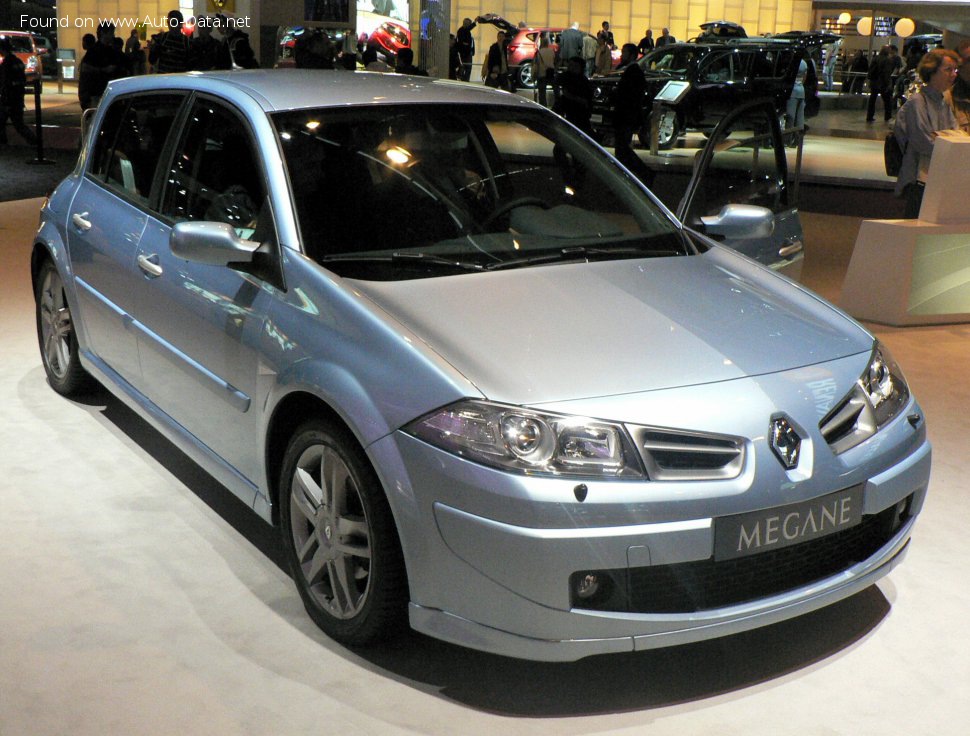
The Renault Megane II (Phase II, 2006) represents a significant iteration of Renault’s popular C-segment (compact car) offering, a vehicle primarily designed and sold for the European market. Launched in 2002, the second generation Megane quickly garnered attention for its unconventional and avant-garde styling, particularly its prominent “bustle-back” rear design for the hatchback variant. The Phase II refresh, introduced in 2006, brought subtle but meaningful updates to refine its aesthetics, enhance its technology, and improve its overall appeal in a fiercely competitive segment. This particular variant, equipped with the 1.4 16V engine producing 98 horsepower, served as an accessible and efficient entry point into the Megane lineup, catering to a broad base of European consumers seeking a practical, safe, and stylish compact car. While never officially imported to the United States, the Megane II’s design language and engineering principles profoundly influenced the global automotive landscape, showcasing Renault’s commitment to innovation and distinctive identity.
Engine & Performance of the Renault Megane II (Phase II, 2006)
Under the hood, the Renault Megane II (Phase II, 2006) 1.4 16V model featured a well-engineered 1.4-liter (1390 cm³) naturally aspirated inline-four gasoline engine, internally designated as the K4J. This powerplant was designed for a balance of urban maneuverability and highway efficiency, a common requirement for European drivers. With a power output of 98 horsepower at 6000 rpm and a peak torque of 93.67 lb.-ft. (127 Nm) delivered at 3750 rpm, the engine provided adequate motivation for the compact hatchback. Its dual overhead camshaft (DOHC) valvetrain with 16 valves (four per cylinder) and multi-port manifold injection system ensured smooth power delivery and reasonable fuel economy for its class and era.
Power was sent to the front wheels via a precise 5-speed manual transmission, a setup that maximized driver engagement and efficiency. The performance figures reflected its role as an economical family car rather than a performance-oriented hot hatch. The Renault Megane II (Phase II, 2006) 1.4 16V could accelerate from 0 to 60 mph in approximately 11.9 seconds, reaching a top speed of 113.71 mph (183 km/h). These figures were competitive for its segment, allowing for comfortable cruising on European highways and nimble navigation through city traffic.
Fuel efficiency was a key consideration, with combined consumption rated at 34.1 US mpg (6.9 l/100 km), making it an economical choice for daily commuting. In urban settings, it achieved 25.6 US mpg (9.2 l/100 km), while extra-urban driving could yield up to 42 US mpg (5.6 l/100 km). With CO2 emissions of 165 g/km, the vehicle met the Euro 4 emission standard, demonstrating Renault’s commitment to environmental regulations prevalent in Europe at the time. The engine’s modest 10:1 compression ratio and 4.8-liter oil capacity further highlighted its design for reliable and cost-effective operation.
Design & Features
The design of the Renault Megane II (Phase II, 2006) hatchback remained largely true to its groundbreaking predecessor, which famously broke away from conventional compact car styling. The 5-door hatchback body type offered a unique profile, characterized by its distinctive, almost vertical rear window and a prominent, sculptured trunk lid, often referred to as the “bustle-back” design. The Phase II update introduced subtle refinements, including revised headlights, taillights, and bumpers, giving it a slightly more modern and cohesive look without abandoning its original bold identity. Its dimensions—165.71 inches in length, 69.96 inches in width, and 57.4 inches in height—positioned it squarely within the compact segment, ideal for navigating European city streets and parking spaces.
Inside, the Megane II offered a spacious and practical cabin for five occupants. The interior design was contemporary for its time, featuring quality materials and a user-friendly layout. The trunk space was versatile, offering a minimum of 11.65 cubic feet (330 liters) with the rear seats up, expandable to a generous 42.02 cubic feet (1190 liters) when the rear seats were folded down, making it highly practical for families or those needing extra cargo capacity.
Key features for the 2006 model year included a focus on safety and comfort. Standard safety systems comprised ABS (Anti-lock Braking System), a crucial feature for maintaining control during emergency braking. The vehicle utilized ventilated disc brakes at the front and disc brakes at the rear, providing confident stopping power. The steering system featured an electric power steering rack and pinion setup, offering light and precise control, particularly beneficial for urban driving and parking. The front suspension employed an independent McPherson strut design, while the rear featured a torsion beam setup, a common and cost-effective configuration for compact cars that provides a good balance of ride comfort and handling stability. The car rode on 195/65 R15 tires mounted on 6J x 15-inch wheels, contributing to a comfortable ride quality and predictable handling characteristics.
Technical Specifications
| Category | Specification |
| General Information | |
| Brand | Renault |
| Model | Megane |
| Generation | Megane II (Phase II, 2006) |
| Type (Engine) | 1.4 16V (98 Hp) |
| Start of Production | 2006 |
| End of Production | 2008 |
| Powertrain Architecture | Internal Combustion engine |
| Body Type | Hatchback |
| Seats | 5 |
| Doors | 5 |
| Performance Specs | |
| Fuel Consumption (Economy) – Urban | 25.6 US mpg (9.2 l/100 km) |
| Fuel Consumption (Economy) – Extra Urban | 42 US mpg (5.6 l/100 km) |
| Fuel Consumption (Economy) – Combined | 34.1 US mpg (6.9 l/100 km) |
| CO2 Emissions | 165 g/km |
| Fuel Type | Petrol (Gasoline) |
| Acceleration 0 – 60 mph | 11.9 sec |
| Maximum Speed | 113.71 mph (183 km/h) |
| Emission Standard | Euro 4 |
| Weight-to-Power Ratio | 11.9 kg/Hp, 84.1 Hp/tonne |
| Weight-to-Torque Ratio | 9.2 kg/Nm, 109 Nm/tonne |
| Engine Specs | |
| Power | 98 Hp @ 6000 rpm |
| Power per liter | 70.5 Hp/l |
| Torque | 93.67 lb.-ft. @ 3750 rpm (127 Nm) |
| Engine Layout | Front, Transverse |
| Engine Model/Code | K4J |
| Engine Displacement | 84.82 cu. in. (1390 cm³) |
| Number of Cylinders | 4 |
| Engine Configuration | Inline |
| Cylinder Bore | 3.13 in. (79.5 mm) |
| Piston Stroke | 2.76 in. (70 mm) |
| Compression Ratio | 10:1 |
| Number of Valves per Cylinder | 4 |
| Fuel Injection System | Multi-port manifold injection |
| Engine Aspiration | Naturally aspirated engine |
| Valvetrain | DOHC |
| Engine Oil Capacity | 5.07 US qt (4.8 l) |
| Coolant Capacity | 6.34 US qt (6 l) |
| Space, Volume and Weights | |
| Kerb Weight | 2568.39 lbs. (1165 kg) |
| Max. Weight | 3780.93 lbs. (1715 kg) |
| Max Load | 1212.54 lbs. (550 kg) |
| Trunk (Boot) Space – Minimum | 11.65 cu. ft. (330 l) |
| Trunk (Boot) Space – Maximum | 42.02 cu. ft. (1190 l) |
| Fuel Tank Capacity | 15.85 US gal (60 l) |
| Max. Roof Load | 176.37 lbs. (80 kg) |
| Permitted Trailer Load with Brakes (12%) | 2866.01 lbs. (1300 kg) |
| Permitted Trailer Load without Brakes | 1433 lbs. (650 kg) |
| Permitted Towbar Download | 165.35 lbs. (75 kg) |
| Dimensions | |
| Length | 165.71 in. (4209 mm) |
| Width | 69.96 in. (1777 mm) |
| Width including mirrors | 79.76 in. (2026 mm) |
| Height | 57.4 in. (1458 mm) |
| Wheelbase | 103.35 in. (2625 mm) |
| Front Track | 59.76 in. (1518 mm) |
| Rear (Back) Track | 59.61 in. (1514 mm) |
| Front Overhang | 33.15 in. (842 mm) |
| Rear Overhang | 29.21 in. (742 mm) |
| Minimum Turning Circle (Turning Diameter) | 34.45 ft. (10.5 m) |
| Drivetrain, Brakes and Suspension Specs | |
| Drivetrain Architecture | The Internal combustion engine (ICE) drives the front wheels of the vehicle. |
| Drive Wheel | Front wheel drive |
| Number of Gears and Type of Gearbox | 5 gears, manual transmission |
| Front Suspension | Independent type McPherson |
| Rear Suspension | Torsion |
| Front Brakes | Ventilated discs |
| Rear Brakes | Disc |
| Assisting Systems | ABS (Anti-lock braking system) |
| Steering Type | Steering rack and pinion |
| Power Steering | Electric Steering |
| Tires Size | 195/65 R15 |
| Wheel Rims Size | 6J x 15 |
Legacy and Market Impact of the Renault Megane II (Phase II, 2006)
The Renault Megane II, including its Phase II refresh and the 1.4 16V variant, carved out a significant niche in the highly competitive European compact car market. Its daring design, a stark departure from the more conservative styling of its rivals, made it an instant conversation starter and a visual statement on the road. This bold aesthetic helped Renault differentiate itself in a segment dominated by established players like the Volkswagen Golf, Ford Focus, Opel Astra (Vauxhall Astra in the UK), and Peugeot 307. While its styling was polarizing for some, it undeniably contributed to its widespread recognition and appeal among those seeking something distinct.
Beyond its looks, the Megane II gained a strong reputation for its safety credentials. It was one of the first cars in its class to achieve a full five-star rating in Euro NCAP crash tests, a significant selling point that resonated with safety-conscious families across Europe. This emphasis on safety, combined with features like multiple airbags and ABS, set a new benchmark for compact vehicles and underscored Renault’s commitment to occupant protection. The 1.4 16V model, while not the most powerful, offered a reliable and economical package that appealed to a broad demographic, from young professionals to small families.
The Megane II’s impact extended to its driving dynamics, offering a comfortable ride quality and predictable handling, well-suited to diverse European road conditions. Its electric power steering, a relatively advanced feature for the time, contributed to ease of use in urban environments. The overall package of distinctive design, strong safety, practical interior, and efficient powertrains ensured its commercial success throughout its production run from 2002 to 2008, with the Phase II models continuing this legacy.
For the American market, the Renault Megane II remains an intriguing example of European automotive design and engineering prowess from the early 21st century. It serves as a reminder of the stylistic risks and technological advancements that characterized the compact segment outside of North America. Its legacy is one of a car that dared to be different, successfully combining unique aesthetics with practical functionality and leading-edge safety, thereby cementing its place as an iconic vehicle in Renault’s history and a significant chapter in the evolution of the European compact car.