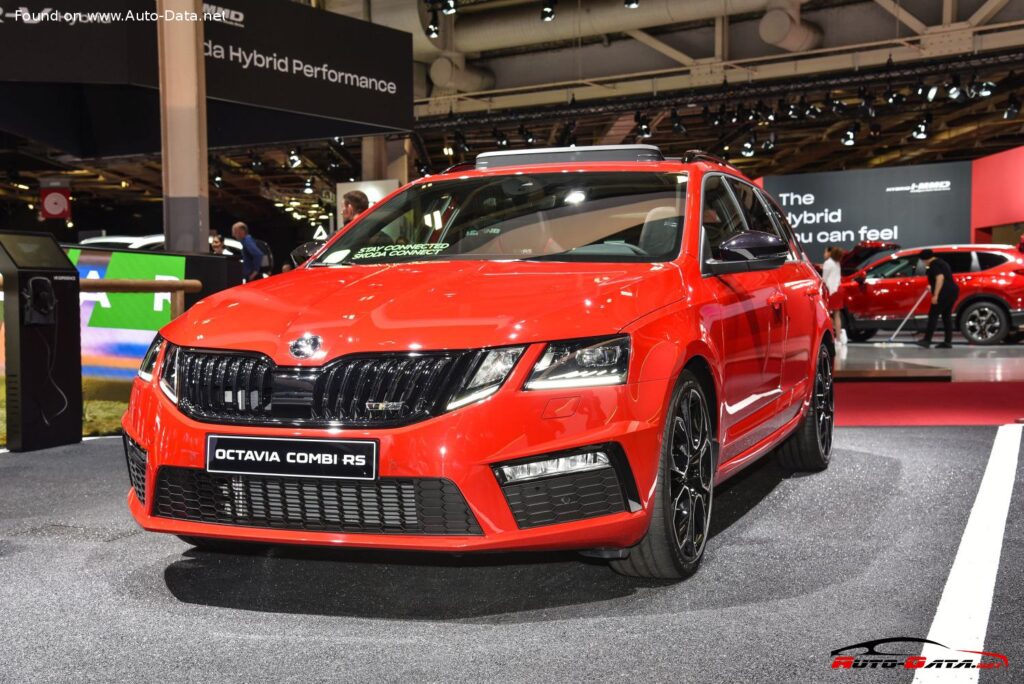
The Skoda Octavia has long been a cornerstone of the Czech automaker’s lineup, representing a formidable blend of practicality, value, and sophisticated engineering derived from its Volkswagen Group parentage. The third generation of the Octavia, introduced in 2012, received a significant facelift in 2017, further refining its aesthetics and technology. Among the most compelling variants of this generation was the Skoda Octavia III Combi (facelift 2017) RS 2.0 TDI (184 Hp) 6 DSG. This particular model, a high-performance diesel station wagon, carved out a unique niche in the European market, offering a compelling mix of everyday usability, impressive fuel efficiency, and genuine sporting credentials.
While Skoda vehicles are not officially sold in the United States, the Octavia RS models hold a significant reputation in their primary markets, particularly across Europe. The “Combi” designation signifies its station wagon body style, a highly popular and versatile choice for families and professionals alike on the continent. The RS badge, standing for “Rally Sport,” denotes a performance-oriented variant, bringing a sharper driving experience to the practical Octavia platform. This 2017 facelifted model, produced until 2018, embodied the brand’s commitment to delivering accessible performance without sacrificing the pragmatism expected of a Skoda.
Engine & Performance: The Heart of the Skoda Octavia III Combi RS 2.0 TDI
At the core of the Skoda Octavia III Combi RS 2.0 TDI’s appeal was its robust and efficient powertrain. Power came from Volkswagen Group’s widely acclaimed EA288 2.0-liter (1968 cm³ or 120.09 cu. in.) inline four-cylinder TDI (Turbocharged Direct Injection) diesel engine. This unit was specifically tuned to deliver 184 horsepower (Hp) at a flexible range of 3500-4000 rpm, providing ample thrust for both spirited driving and comfortable highway cruising. More impressively, the engine generated a substantial 280.27 lb.-ft. (380 Nm) of torque, available from a low 1750 rpm and sustained up to 3250 rpm. This broad torque band was crucial for the car’s responsive acceleration and effortless overtaking capabilities, a hallmark of modern performance diesels.
The engine featured a DOHC (Double Overhead Camshaft) valvetrain with four valves per cylinder, a common-rail fuel injection system, and was augmented by a turbocharger and intercooler. This setup ensured efficient combustion and optimal power delivery. Power was channeled to the front wheels via a sophisticated 6-speed DSG (Direct Shift Gearbox) automatic transmission. This dual-clutch unit was celebrated for its lightning-fast shifts, contributing to both the car’s sporty character and its impressive fuel economy.
Performance figures were quite respectable for a family-oriented station wagon. The Octavia RS 2.0 TDI could accelerate from 0 to 60 mph in a brisk 7.6 seconds (0-100 km/h in 8 seconds) and achieve a top speed of 141.67 mph (228 km/h). Despite these performance credentials, fuel efficiency remained a strong suit, a key advantage of the diesel powertrain. The combined fuel economy (NEDC) was rated at an impressive 48 US mpg (4.9 l/100 km), with extra-urban figures reaching 53.5 US mpg (4.4 l/100 km). This efficiency was further enhanced by a standard Start & Stop System and a particulate filter, helping the vehicle meet stringent Euro 6 emission standards with CO2 emissions of 129 g/km. With a 13.21 US gallon (50 l) fuel tank, the Octavia RS TDI offered an excellent cruising range, making it an ideal choice for long European road trips.
Design & Features: Practicality Meets Sportiness
The 2017 facelift brought subtle yet effective design updates to the Skoda Octavia III Combi, giving it a sharper and more modern appearance. The most distinctive change was the split headlight design, which, while initially polarizing, gave the car a unique visual signature. The grille was subtly revised, and the bumpers were redesigned to incorporate more aggressive styling cues, particularly on the RS variant. The Combi body style itself was inherently practical, offering generous proportions and a sophisticated, understated aesthetic.
As a station wagon, the Octavia Combi excelled in cargo capacity. It offered a massive 21.54 cu. ft. (610 l) of trunk space with the rear seats up, expanding to an enormous 61.45 cu. ft. (1740 l) when the rear seats were folded down. This made it one of the most capacious vehicles in its class, easily accommodating luggage, sports equipment, or even small furniture. The interior maintained Skoda’s reputation for ergonomic design and robust build quality. While not luxurious in the premium sense, the cabin was well-appointed, with quality materials and a logical layout. The RS model typically featured sport seats, a unique steering wheel, and subtle red stitching or carbon-fiber-effect trim to enhance its sporty ambiance.
Technology was a focus for the facelifted model. While specific infotainment details are not provided in the technical data, a 2017 vehicle would typically include an updated touchscreen infotainment system with smartphone integration (Apple CarPlay and Android Auto were becoming standard by this time), navigation, and various connectivity options. Driver-assist systems, such as adaptive cruise control, lane-keeping assist, and blind-spot monitoring, would likely have been available as options or standard on higher trims.
Underneath, the Octavia RS benefited from a well-engineered chassis designed for both comfort and dynamic handling. It featured an independent McPherson strut front suspension with a coil spring and anti-roll bar, paired with an independent multi-link rear suspension with a stabilizer. This setup provided a balanced ride and confident handling. Braking was handled by ventilated discs at the front and solid discs at the rear, supported by ABS (Anti-lock Braking System). Electric power steering offered precise control. The RS models typically came with larger alloy wheels, with options up to 19 inches (225/35 R19 tires), further enhancing its aggressive stance and road holding.
Technical Specifications: Skoda Octavia III Combi (facelift 2017) RS 2.0 TDI (184 Hp) 6 DSG
| Category | Specification |
| General Information | |
| Brand | Skoda |
| Model | Octavia |
| Generation | Octavia III Combi (facelift 2017) |
| Type (Engine) | RS 2.0 TDI (184 Hp) 6 DSG |
| Start of Production | 2017 year |
| End of Production | 2018 year |
| Powertrain Architecture | Internal Combustion engine |
| Body type | Station wagon (estate) |
| Seats | 5 |
| Doors | 5 |
| Performance Specs | |
| Fuel Consumption (economy) – Urban (NEDC) | 5.8 l/100 km (40.6 US mpg) |
| Fuel Consumption (economy) – Extra Urban (NEDC) | 4.4 l/100 km (53.5 US mpg) |
| Fuel Consumption (economy) – Combined (NEDC) | 4.9 l/100 km (48 US mpg) |
| CO2 emissions (NEDC) | 129 g/km |
| Fuel Type | Diesel |
| Acceleration 0 – 60 mph | 7.6 sec |
| Acceleration 0 – 100 km/h | 8 sec |
| Maximum Speed | 141.67 mph (228 km/h) |
| Emission standard | Euro 6 |
| Weight-to-power ratio | 7.7 kg/Hp, 130.3 Hp/tonne |
| Weight-to-torque ratio | 3.7 kg/Nm, 269.1 Nm/tonne |
| Engine Specs | |
| Power | 184 Hp @ 3500-4000 rpm |
| Power per liter | 93.5 Hp/l |
| Torque | 280.27 lb.-ft. (380 Nm) @ 1750-3250 rpm |
| Engine layout | Front, Transverse |
| Engine Model/Code | EA288 / CUNA, CUPA, DJGA |
| Engine displacement | 120.09 cu. in. (1968 cm³) |
| Number of cylinders | 4 |
| Engine configuration | Inline |
| Cylinder Bore | 3.19 in. (81 mm) |
| Piston Stroke | 3.76 in. (95.5 mm) |
| Compression ratio | 15.8:1 |
| Number of valves per cylinder | 4 |
| Fuel injection system | Diesel Commonrail |
| Engine aspiration | Turbocharger, Intercooler |
| Valvetrain | DOHC |
| Engine oil capacity | 4.86 US qt (4.6 l) |
| Engine oil specification | Specific requirements in owner’s manual |
| Engine systems | Start & Stop System, Particulate filter |
| Space, Volume and Weights | |
| Kerb Weight | 3112.93 lbs. (1412 kg) |
| Max. weight | 4360.74 lbs. (1978 kg) |
| Max load | 1247.82 lbs. (566 kg) |
| Trunk (boot) space – minimum | 21.54 cu. ft. (610 l) |
| Trunk (boot) space – maximum | 61.45 cu. ft. (1740 l) |
| Fuel tank capacity | 13.21 US gal (50 l) |
| Max. roof load | 165.35 lbs. (75 kg) |
| Permitted trailer load with brakes (8%) | 3968.32 lbs. (1800 kg) |
| Permitted trailer load with brakes (12%) | 3527.4 lbs. (1600 kg) |
| Permitted trailer load without brakes | 1631.42 lbs. (740 kg) |
| Permitted towbar download | 165.35 lbs. (75 kg) |
| Dimensions | |
| Length | 184.61 in. (4689 mm) |
| Width | 71.42 in. (1814 mm) |
| Width including mirrors | 79.41 in. (2017 mm) |
| Height | 57.17 in. (1452 mm) |
| Wheelbase | 105.51 in. (2680 mm) |
| Front track | 60.43 in. (1535 mm) |
| Rear (Back) track | 60.79 in. (1544 mm) |
| Front overhang | 35.55 in. (903 mm) |
| Rear overhang | 43.54 in. (1106 mm) |
| Ride height (ground clearance) | 5 in. (127 mm) |
| Drag coefficient (Cd) | 0.307 |
| Minimum turning circle (turning diameter) | 34.74 ft. (10.59 m) |
| Approach angle | 12.8° |
| Departure angle | 12.5° |
| Drivetrain, Brakes and Suspension Specs | |
| Drivetrain Architecture | The Internal combustion engine (ICE) drives the front wheels of the vehicle. |
| Drive wheel | Front wheel drive |
| Number of gears and type of gearbox | 6 gears, automatic transmission DSG |
| Front suspension | Independent, type McPherson with coil spring and anti-roll bar |
| Rear suspension | Independent multi-link spring suspension with stabilizer |
| Front brakes | Ventilated discs |
| Rear brakes | Disc |
| Assisting systems | ABS (Anti-lock braking system) |
| Steering type | Steering rack and pinion |
| Power steering | Electric Steering |
| Tires size | 225/45 R17; 225/40 R18; 225/35 R19 |
| Wheel rims size | 7.5J x 17; 7.5J x 18; 7.5J x 19 |
Legacy and Market Impact of the Skoda Octavia III Combi RS 2.0 TDI
The Skoda Octavia has been instrumental in transforming Skoda’s image from a budget brand to a respected and desirable marque within the competitive European automotive landscape. The third-generation Octavia, and particularly its RS variants, cemented this reputation by offering a compelling package of performance, practicality, and value that few rivals could match. The Skoda Octavia III Combi RS 2.0 TDI was a prime example of this strategy, appealing to a specific segment of buyers who desired sporty performance and engaging driving dynamics without compromising on the everyday usability and low running costs of a diesel station wagon.
In its primary European market, the Octavia RS 2.0 TDI Combi faced competition from a variety of vehicles, though its unique blend of attributes made direct comparisons challenging. Rivals included performance-oriented wagons like the Volkswagen Golf GTD Variant (sharing many underlying components), the Ford Focus ST Wagon Diesel (where available), and even some entry-level premium wagons from brands like BMW or Audi.