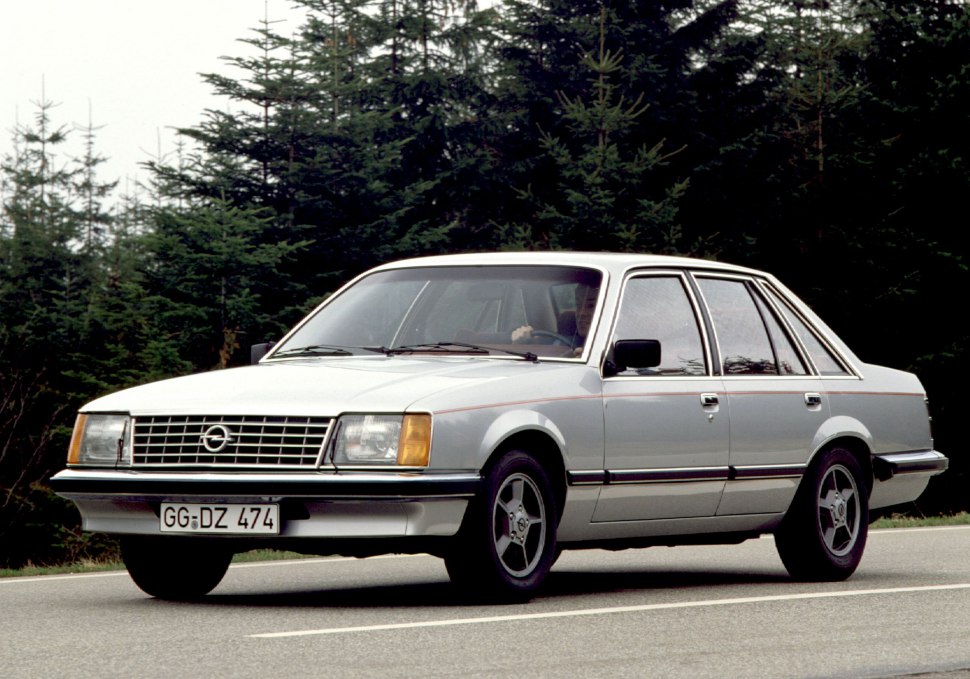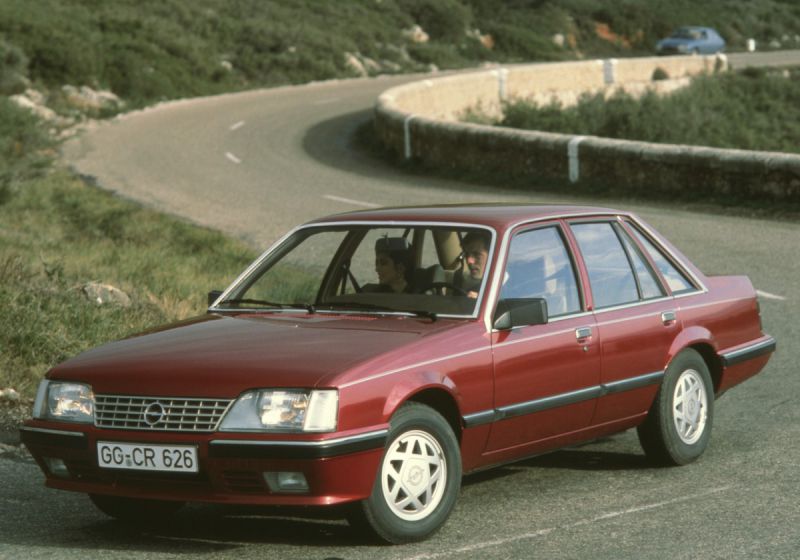
The Opel Senator A (facelift 1982) 3.0i CAT (156 Hp) Automatic represents a significant chapter in the history of European executive sedans. As Opel’s flagship model, the Senator was designed to compete in a highly contested segment, offering a blend of comfort, performance, and practicality. The A-generation, introduced in 1978, received a substantial refresh in 1982, bringing updated styling and technological improvements. The specific variant under review, the 3.0i CAT with its 156 horsepower engine and automatic transmission, was produced between 1985 and 1986, positioning itself as a refined, mid-range offering within the Senator lineup during the latter half of the A-generation’s production run. While never officially sold in the United States, the Senator played a crucial role in Opel’s strategy to challenge established premium brands in its primary European markets, particularly Germany and the UK, where it was also sold as the Vauxhall Senator.
Opel Senator A (facelift 1982): A Detailed Overview
The Opel Senator A was conceived as a larger, more luxurious alternative to the Opel Rekord, aiming to provide a vehicle capable of competing with the likes of BMW and Mercedes-Benz. The 1982 facelift brought significant improvements to the vehicle’s aesthetics and incorporated updated technology, enhancing its appeal in a competitive market. The Senator, in its various iterations, served as a statement of Opel’s engineering capabilities and design aspirations.
Engine & Performance
The 3.0i CAT variant of the Opel Senator A is powered by a 3.0-liter (2969 cm³) inline-six engine, internally designated as the C30LE. This naturally aspirated engine utilizes multi-port fuel injection and incorporates a catalytic converter, reflecting the growing emphasis on emissions regulations during the mid-1980s. The engine produces 156 horsepower at 5600 rpm and 226 Nm (166.69 lb.-ft.) of torque at 4200 rpm. This configuration delivers a smooth and responsive driving experience, well-suited for long-distance cruising.
Power is transmitted to the rear wheels through a four-speed automatic transmission, prioritizing ease of use and comfort over sporty driving dynamics. The Senator 3.0i CAT achieves a 0 to 60 mph acceleration time of 10.5 seconds and a top speed of 118.68 mph (191 km/h). Fuel economy figures for the era are estimated at 21 US mpg combined, 28.7 US mpg on extra-urban cycles, and 15.6 US mpg in city driving. These figures were typical for a large, executive sedan of the time.
Design & Features
The Opel Senator A (facelift 1982) features a traditional four-door sedan body style with a five-seat configuration. The 1982 refresh brought a more streamlined appearance, with revised front and rear fascias, updated lighting elements, and subtle aerodynamic enhancements. The vehicle’s dimensions – 190.51 inches in length, 67.8 inches in width, and 55.71 inches in height – contribute to a substantial and imposing road presence. A 105.63-inch wheelbase provides a stable and comfortable ride.
The interior of the Senator A is designed with passenger comfort in mind. The trunk offers a generous 25.25 cubic feet (715 liters) of cargo space, making it practical for family trips or business travel. The vehicle’s suspension system consists of an independent front suspension with McPherson struts, coil springs, and an anti-roll bar, coupled with an independent coil spring rear suspension featuring trailing arms and a transverse stabilizer. This setup aims to deliver a smooth and controlled ride. Braking is provided by ventilated discs at the front and solid discs at the rear, with an Anti-lock Braking System (ABS) available as a premium safety feature. Hydraulic power steering, utilizing a cone worm and recirculation balls, ensures effortless maneuverability.
Technical Specifications: Opel Senator A (facelift 1982) 3.0i CAT (156 Hp) Automatic
| Category | Specification |
| General Information | |
| Brand | Opel |
| Model | Senator |
| Generation | Senator A (facelift 1982) |
| Type (Engine) | 3.0i CAT (156 Hp) Automatic |
| Start of Production | 1985 |
| End of Production | 1986 |
| Powertrain Architecture | Internal Combustion Engine |
| Body Type | Sedan |
| Seats | 5 |
| Doors | 4 |
| Performance Specs | |
| Fuel Consumption (Urban) | 15.1 l/100 km (15.6 US mpg) |
| Fuel Consumption (Extra Urban) | 8.2 l/100 km (28.7 US mpg) |
| Fuel Consumption (Combined) | 11.2 l/100 km (21 US mpg) |
| Fuel Type | Petrol (Gasoline) |
| Acceleration 0 – 60 mph | 10.5 sec |
| Maximum Speed | 191 km/h (118.68 mph) |
| Weight-to-Power Ratio | 9 kg/Hp (111 Hp/tonne) |
| Weight-to-Torque Ratio | 6.2 kg/Nm (160.9 Nm/tonne) |
| Engine Specs | |
| Power | 156 Hp @ 5600 rpm |
| Power per Liter | 52.5 Hp/l |
| Torque | 226 Nm (166.69 lb.-ft.) @ 4200 rpm |
| Engine Layout | Front, Longitudinal |
| Engine Model/Code | C30LE |
| Engine Displacement | 2969 cm³ (181.18 cu. in.) |
| Number of Cylinders | 6 |
| Engine Configuration | Inline |
| Cylinder Bore | 95 mm (3.74 in.) |
| Piston Stroke | 69.8 mm (2.75 in.) |
| Compression Ratio | 8.5:1 |
| Number of Valves per Cylinder | 2 |
| Fuel Injection System | Multi-port manifold injection |
| Engine Aspiration | Naturally aspirated |
| Valvetrain | CIH (Cam-in-Head) |
| Engine Oil Capacity | 5.5 l (5.81 US qt) |
| Coolant Capacity | 10.1 l (10.67 US qt) |
| Space, Volume and Weights | |
| Kerb Weight | 1405 kg (3097.49 lbs.) |
| Max. Weight | 1935 kg (4265.94 lbs.) |
| Max Load | 530 kg (1168.45 lbs.) |
| Trunk (Boot) Space – Minimum | 715 l (25.25 cu. ft.) |
| Fuel Tank Capacity | 75 l (19.81 US gal) |
| Dimensions | |
| Length | 4839 mm (190.51 in.) |
| Width | 1722 mm (67.8 in.) |
| Height | 1415 mm (55.71 in.) |
| Wheelbase | 2683 mm (105.63 in.) |
Legacy and Market Impact
The Opel Senator A, particularly its facelifted version, occupied a significant niche in the European executive car market. It was positioned as a comfortable, well-equipped, and reliable alternative to more expensive German premium brands like Mercedes-Benz and BMW, as well as competitors from Ford. While it may not have carried the same prestige as its Bavarian rivals, the Senator offered a compelling value proposition, boasting strong engines, a spacious interior, and commendable ride comfort.
Opel’s strategy with the Senator was to provide a solid, no-nonsense executive car that appealed to a broad range of buyers. Its robust build quality and straightforward mechanicals contributed to a reputation for durability and ease of maintenance. The inline-six engine was particularly praised for its smoothness and longevity. The inclusion of features like ABS highlighted its aspirations to offer modern conveniences and safety. Although the Opel Senator A’s production ended in 1987, making way for the Senator B, its impact as a capable and often overlooked executive sedan from the 1980s is undeniable. It cemented Opel’s presence in the upper echelons of the European car market, demonstrating its ability to produce vehicles that combined traditional engineering with evolving consumer demands.