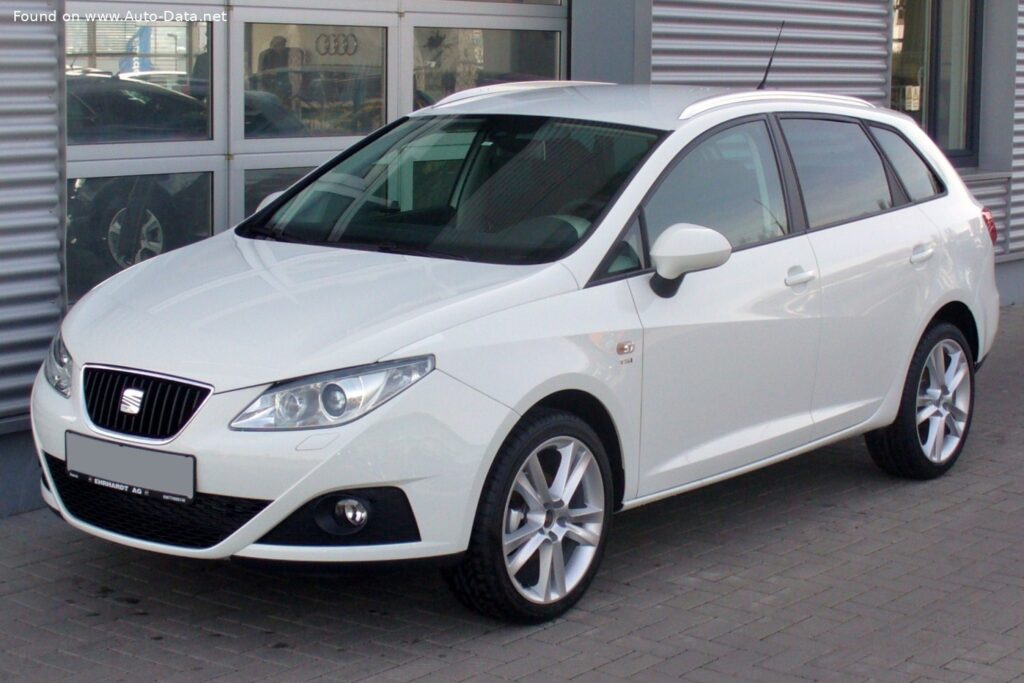
The SEAT Ibiza IV ST 1.2 (70 Hp), produced between 2010 and 2012, represents a significant offering from the Spanish automaker SEAT, a brand within the Volkswagen Group primarily targeting European and select international markets. While SEAT vehicles are not officially sold in the United States, the Ibiza is a cornerstone of the brand’s lineup, serving as a compact workhorse alongside its larger sibling, the Leon. The “IV” denotes the fourth generation of the Ibiza, a model that has consistently provided an accessible entry point into the supermini segment since its inception in 1984. The “ST” designation, signifying “Sport Tourer” or station wagon, broadened the Ibiza’s appeal by adding a practical, family-friendly dimension to an otherwise city-focused hatchback. This particular variant, equipped with a modest 1.2-liter engine, was designed with economy and urban efficiency in mind, catering to European consumers prioritizing low running costs and versatility in a compact footprint.
Evolution of the Ibiza and the SEAT Ibiza IV ST 1.2 (70 Hp)
The fourth generation of the SEAT Ibiza, internally coded 6J, was first introduced in 2008, initially as a three-door “SportCoupé” and a five-door hatchback. The addition of the ST (Station Wagon) body style in 2010 marked a strategic move by SEAT to compete in the burgeoning compact estate segment in Europe, a niche that offered the practicality of a larger car without the associated costs or dimensions. The Ibiza IV ST leveraged the Volkswagen Group’s PQ25 platform, shared with contemporaries like the Volkswagen Polo V and Skoda Fabia II, ensuring a solid foundation of engineering and componentry. This platform allowed for a more rigid body structure and improved driving dynamics compared to its predecessors. The 1.2 (70 Hp) engine option was positioned as the entry-level gasoline unit, designed to offer maximum fuel efficiency and minimal emissions for urban commuters and small families. Its role was to provide an affordable, reliable, and surprisingly spacious option for those needing more cargo capacity than a typical hatchback.
Engine & Performance: The SEAT Ibiza IV ST 1.2 (70 Hp) Powertrain
Under the hood, the SEAT Ibiza IV ST 1.2 (70 Hp) featured a transversely mounted, naturally aspirated 1.2-liter (1198 cm3 or 73.11 cu. in.) inline three-cylinder gasoline engine. This compact powerplant, often identified by engine codes like BZG, CGPA, or CJLB, was a testament to efficient engineering within the Volkswagen Group. It produced 70 horsepower at 5400 rpm and a modest 82.61 lb.-ft. of torque at 3000 rpm. While these figures might seem modest by American standards, they were entirely appropriate for the vehicle’s intended purpose and market segment in Europe.
The engine utilized a Multi-port manifold injection system and a Double Overhead Camshaft (DOHC) valvetrain with four valves per cylinder, optimizing fuel delivery and exhaust scavenging for its size. With a compression ratio of 10.5:1, it ran on petrol (gasoline) and met the Euro 5 emission standard, reflecting the increasingly stringent environmental regulations in Europe at the time. Power was exclusively sent to the front wheels via a 5-speed manual transmission, a common and reliable setup for this class of vehicle.
In terms of performance, the Ibiza IV ST 1.2 (70 Hp) was not built for speed. It achieved 0 to 60 mph in a leisurely 13.9 seconds, with a top speed of 101.28 mph (163 km/h). Its true strength lay in its fuel economy. The NEDC (New European Driving Cycle) figures indicated an impressive combined fuel consumption of 42.8 US mpg (5.5 l/100 km), with even better figures on the extra-urban cycle at 52.3 US mpg (4.5 l/100 km). Urban consumption was rated at 32.2 US mpg (7.3 l/100 km). These figures, coupled with CO2 emissions of 128 g/km, made it an economical choice for drivers looking to minimize their environmental footprint and fuel costs. The light curb weight of 2281.78 lbs (1035 kg) contributed significantly to its agility and efficiency.
Design & Features: Practicality Meets Compact Form
The SEAT Ibiza IV ST adopted a five-door station wagon (estate) body type, offering a practical solution for those who needed more cargo space than the standard hatchback. Measuring 166.42 inches (4227 mm) in length, 66.65 inches (1693 mm) in width, and 56.89 inches (1445 mm) in height, the Ibiza ST remained a compact vehicle, well-suited for navigating narrow European city streets and parking in tight spots. Its wheelbase of 97.2 inches (2469 mm) provided a stable ride for its size.
Despite its compact exterior, the Ibiza ST surprised with its interior volume. It comfortably seated five occupants, and the primary advantage of the ST variant was its generous trunk space, offering a minimum of 15.19 cu. ft. (430 liters) of cargo capacity. This was a substantial increase over the hatchback and a key selling point for families or individuals requiring extra utility. The design language of the Ibiza IV was sharp and angular, reflecting SEAT’s “auto emoción” philosophy, even in its more practical form. The distinctive “arrow design” front end, with its angular headlights and prominent grille, gave it a sporty appearance despite its modest engine.
Standard features for the 1.2 (70 Hp) model, while basic, focused on essential functionality and safety for the era. The vehicle was equipped with an independent McPherson strut front suspension with coil springs and an anti-roll bar, paired with a semi-dependent beam rear suspension with a stabilizer for lateral stability. Braking was handled by ventilated discs at the front (256×22 mm) and drum brakes at the rear (200×40 mm), complemented by an Anti-lock Braking System (ABS) for enhanced safety during emergency stops. Electric power steering, a rack and pinion system, offered light and precise control, particularly useful for urban maneuvering. Tire options included 175/70 R14 or 185/60 R15, fitted on 5J x 14 or 6J x 15 wheel rims, respectively. The 11.89 US gallon (45 liter) fuel tank provided a decent cruising range given the car’s fuel efficiency.
Technical Specifications
| Category | Specification |
| Brand | SEAT |
| Model | Ibiza |
| Generation | Ibiza IV ST |
| Type (Engine) | 1.2 (70 Hp) |
| Production Years | 2010 – 2012 |
| Powertrain Architecture | Internal Combustion Engine |
| Body Type | Station Wagon (Estate) |
| Seats | 5 |
| Doors | 5 |
| Performance Specs | |
| Fuel Consumption (Urban) | 7.3 l/100 km (32.2 US mpg) |
| Fuel Consumption (Extra Urban) | 4.5 l/100 km (52.3 US mpg) |
| Fuel Consumption (Combined) | 5.5 l/100 km (42.8 US mpg) |
| CO2 Emissions (NEDC) | 128 g/km |
| Fuel Type | Petrol (Gasoline) |
| Acceleration 0 – 60 mph | 13.9 sec |
| Maximum Speed | 101.28 mph (163 km/h) |
| Emission Standard | Euro 5 |
| Weight-to-Power Ratio | 14.8 kg/Hp (67.6 Hp/tonne) |
| Weight-to-Torque Ratio | 9.2 kg/Nm (108.2 Nm/tonne) |
| Engine Specs | |
| Power | 70 Hp @ 5400 rpm |
| Power per Liter | 58.4 Hp/l |
| Torque | 112 Nm (82.61 lb.-ft.) @ 3000 rpm |
| Engine Layout | Front, Transverse |
| Engine Model/Code | BZG, CGPA, CJLB |
| Engine Displacement | 1198 cm3 (1.2 Liters, 73.11 cu. in.) |
| Number of Cylinders | 3 |
| Engine Configuration | Inline |
| Cylinder Bore | 76.5 mm (3.01 in.) |
| Piston Stroke | 86.9 mm (3.42 in.) |
| Compression Ratio | 10.5:1 |
| Valves per Cylinder | 4 |
| Fuel Injection System | Multi-port manifold injection |
| Engine Aspiration | Naturally aspirated engine |
| Valvetrain | DOHC |
| Engine Oil Capacity | 3 l (3.17 US qt) |
| Coolant Capacity | 5.6 l (5.92 US qt) |
| Space, Volume and Weights | |
| Kerb Weight | 1035 kg (2281.78 lbs.) |
| Max. Weight | 1550 kg (3417.17 lbs.) |
| Max Load | 515 kg (1135.38 lbs.) |
| Trunk (boot) Space – Minimum | 430 l (15.19 cu. ft.) |
| Fuel Tank Capacity | 45 l (11.89 US gal) |
| Permitted Trailer Load with Brakes (12%) | 800 kg (1763.7 lbs.) |
| Dimensions | |
| Length | 4227 mm (166.42 in.) |
| Width | 1693 mm (66.65 in.) |
| Height | 1445 mm (56.89 in.) |
| Wheelbase | 2469 mm (97.2 in.) |
| Front Track | 1465 mm (57.68 in.) |
| Rear Track | 1457 mm (57.36 in.) |
| Minimum Turning Circle (Turning Diameter) | 10.48 m (34.38 ft.) |
| Drivetrain, Brakes and Suspension Specs | |
| Drivetrain Architecture | Front-wheel drive, Internal Combustion Engine |
| Drive Wheel | Front wheel drive |
| Number of Gears and Gearbox Type | 5 gears, manual transmission |
| Front Suspension | Independent, McPherson with coil spring and anti-roll bar |
| Rear Suspension | Semi-dependent beam with stabilizer lateral stability |
| Front Brakes | Ventilated discs, 256×22 mm |
| Rear Brakes | Drum, 200×40 mm |
| Assisting Systems | ABS (Anti-lock braking system) |
| Steering Type | Steering rack and pinion |
| Power Steering | Electric Steering |
| Tires Size | 175/70 R14; 185/60 R15 |
| Wheel Rims Size | 5J x 14; 6J x 15 |
Legacy & Market Impact: A European Mainstay
The SEAT Ibiza IV ST 1.2 (70 Hp) carved out a niche in the highly competitive European compact car market by offering a compelling blend of practicality, affordability, and efficiency. Its legacy is rooted in the broader success of the Ibiza line, which has consistently been SEAT’s best-selling model and a key driver of the brand’s identity within the Volkswagen Group. SEAT aims to be the sportier, more design-focused, and youthful brand compared to its VW and Skoda siblings, and the Ibiza, even in its utilitarian ST form, carried some of that flair.
In its primary European market, the Ibiza ST competed against a diverse array of compact estates, often referred to as “supermini estates” or “B-segment wagons.” Key rivals included the Skoda Fabia Combi (sharing the same platform), the Renault Clio Estate, the Peugeot 207 SW, and in some markets, smaller versions of the Ford Fiesta Van (though not a full estate). The Ibiza ST differentiated itself with its slightly more dynamic styling and SEAT’s reputation for a more engaging driving experience, even with the entry-level engine.
The 1.2 (70 Hp) variant, specifically, played a crucial role in making the Ibiza ST accessible to a wider demographic. Its low purchase price, frugal fuel consumption, and relatively low insurance and road tax costs (thanks to the Euro 5 emissions rating) made it an attractive option for first-time car buyers, small families on a budget, or as a second family vehicle. It demonstrated that practicality didn’t necessarily require a large, expensive vehicle, nor did it have to be devoid of character. The robust engineering from the Volkswagen Group ensured reliability and durability, contributing to its strong resale value in many European countries.
While never reaching American shores, the SEAT Ibiza IV ST 1.2 (70 Hp) remains a significant example of European automotive design and engineering principles: maximizing interior space and utility within compact dimensions, prioritizing fuel efficiency and low emissions, and offering a distinct brand identity within a larger automotive conglomerate. It successfully fulfilled its mission as a versatile, economical, and stylish compact estate, cementing the Ibiza’s status as a true European mainstay.