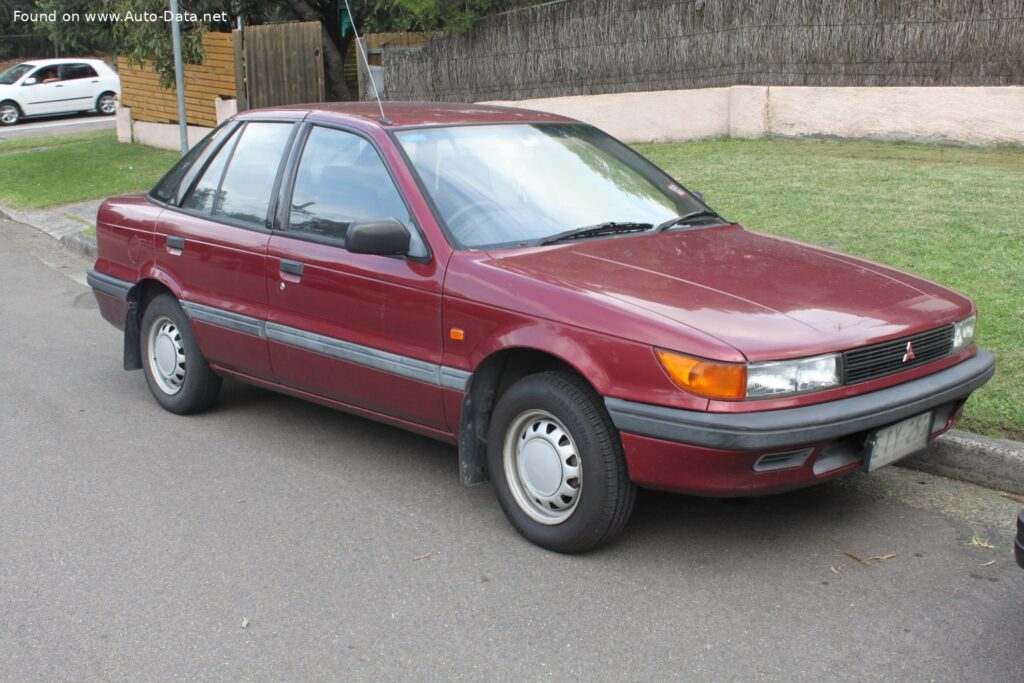
The Mitsubishi Lancer IV Hatchback 1.8 (136 Hp) represents a significant chapter in the history of compact performance vehicles, produced between 1988 and 1992. This fourth-generation Lancer, particularly in its hatchback guise with the potent 1.8-liter engine, carved out a niche in various international markets, primarily in Europe, Asia, and Australia, where its blend of practicality, reliability, and spirited performance resonated with a broad audience. While the Lancer nameplate was well-known in the United States, this specific 5-door hatchback variant with its higher-output engine was less common domestically, making its mark as a ‘warm hatch’ contender in regions more accustomed to such versatile vehicles. It emerged during an era when Japanese automakers were pushing the boundaries of engineering, offering advanced features and robust powertrains in accessible packages.
The Lancer IV generation, known internally as the C60 series, built upon Mitsubishi’s growing reputation for producing capable and durable vehicles. The hatchback body style offered enhanced utility compared to its sedan counterpart, appealing to buyers who needed more cargo flexibility without sacrificing a dynamic driving experience. The 1.8-liter engine variant was positioned as a performance-oriented model within the Lancer lineup, bridging the gap between standard commuter cars and dedicated high-performance machines. This article delves into the technical prowess, design philosophy, and lasting legacy of this often-overlooked yet impactful vehicle.
Engine & Performance of the Mitsubishi Lancer IV Hatchback
At the heart of the Mitsubishi Lancer IV Hatchback 1.8 (136 Hp) was a technologically advanced powertrain for its time. The vehicle was equipped with a 1.8-liter (1836 cm³ or 112.04 cu. in.) naturally aspirated inline-four engine, featuring a Double Overhead Camshaft (DOHC) valvetrain and four valves per cylinder. This DOHC setup was a key differentiator, allowing for more efficient airflow and higher engine speeds compared to simpler SOHC designs, directly contributing to its impressive power output. The engine delivered a robust 136 horsepower at 6500 rpm, which was a considerable figure for a compact car weighing in at just 2336.9 lbs (1060 kg). This resulted in a favorable weight-to-power ratio of 7.8 kg/Hp, or approximately 128.3 Hp per tonne, indicating its agile nature.
Torque figures further underscored the engine’s capability, producing 119.49 lb.-ft. (162 Nm) at 4500 rpm. This torque, combined with a precise 5-speed manual transmission, allowed the Lancer IV Hatchback to accelerate from 0 to 60 mph in a brisk 7.5 seconds, a performance metric that put it squarely in contention with many of its European hot hatch rivals. The top speed was rated at 124.27 mph (200 km/h), demonstrating its highway cruising ability and overall dynamic potential.
Fuel delivery was handled by a multi-port manifold injection system, ensuring precise fuel metering and improved efficiency over carbureted systems. With a compression ratio of 10.5:1, the engine was designed for optimal combustion, running on readily available petrol (gasoline). While performance was a highlight, the Lancer also offered reasonable fuel economy for its class, with a combined rating of approximately 29 US mpg (8.1 l/100 km), balancing spirited driving with everyday usability. The front, transverse engine layout, coupled with front-wheel drive, was typical for compact cars of this era, optimizing interior space and manufacturing efficiency while providing predictable handling characteristics.
Design & Features
The design of the Mitsubishi Lancer IV Hatchback reflected the automotive aesthetics of the late 1980s and early 1990s, characterized by clean lines, a relatively low beltline, and a focus on aerodynamic efficiency. As a 5-door hatchback, it offered a practical and versatile body type, seating five occupants comfortably. The overall dimensions – 166.73 inches (4235 mm) in length, 65.75 inches (1670 mm) in width, and 55.31 inches (1405 mm) in height – ensured a compact footprint ideal for urban environments, yet with enough interior volume for small families or active individuals. The wheelbase of 96.65 inches (2455 mm) contributed to stable handling and a comfortable ride.
Inside, the Lancer IV Hatchback prioritized functionality and ergonomics. While specific interior features varied by market and trim level, the focus was on durable materials and a straightforward layout. The hatchback configuration was a key selling point, offering a minimum trunk space of 11.3 cu. ft. (320 liters) which could expand significantly to 33.55 cu. ft. (950 liters) with the rear seats folded down, providing impressive cargo flexibility.
Underneath, the Lancer featured a robust chassis with coil spring suspension at both the front and rear, providing a balanced ride and handling. Braking duties were handled by ventilated discs at the front and solid discs at the rear, a competent setup for a car of its performance level. Notably, the inclusion of ABS (Anti-lock Braking System) was a significant safety feature for a compact vehicle in this period, offering improved control during emergency braking situations. Steering was managed by a rack and pinion system with hydraulic power steering, providing direct feedback and ease of maneuverability. The car rode on 175/70 R13 tires, a common size for compacts, offering a good balance of grip and ride comfort.
Mitsubishi Lancer IV Hatchback 1.8 (136 Hp) – Technical Specifications
| Category | Specification |
| Brand | Mitsubishi |
| Model | Lancer |
| Generation | Lancer IV Hatchback |
| Type (Engine) | 1.8 (136 Hp) |
| Production Start | 1988 |
| Production End | 1992 |
| Body Type | Hatchback |
| Seats | 5 |
| Doors | 5 |
| Performance Specifications | |
| Fuel Consumption (Urban) | 11.1 l/100 km (21.2 US mpg) |
| Fuel Consumption (Extra Urban) | 6.4 l/100 km (36.8 US mpg) |
| Fuel Consumption (Combined) | 8.1 l/100 km (29 US mpg) |
| Fuel Type | Petrol (Gasoline) |
| Acceleration 0-60 mph | 7.5 seconds |
| Maximum Speed | 124.27 mph (200 km/h) |
| Weight-to-Power Ratio | 7.8 kg/Hp (128.3 Hp/tonne) |
| Weight-to-Torque Ratio | 6.5 kg/Nm (152.8 Nm/tonne) |
| Engine Specifications | |
| Power | 136 Hp @ 6500 rpm |
| Torque | 119.49 lb.-ft. (162 Nm) @ 4500 rpm |
| Engine Layout | Front, Transverse |
| Engine Displacement | 1.8 liters (1836 cm³ / 112.04 cu. in.) |
| Number of Cylinders | 4 |
| Engine Configuration | Inline |
| Cylinder Bore | 3.21 inches (81.5 mm) |
| Piston Stroke | 3.46 inches (88 mm) |
| Compression Ratio | 10.5:1 |
| Valves per Cylinder | 4 |
| Fuel Injection System | Multi-port manifold injection |
| Engine Aspiration | Naturally aspirated |
| Valvetrain | DOHC |
| Dimensions, Volume, and Weights | |
| Kerb Weight | 2336.9 lbs (1060 kg) |
| Trunk (boot) Space (min) | 11.3 cu. ft. (320 liters) |
| Trunk (boot) Space (max) | 33.55 cu. ft. (950 liters) |
| Fuel Tank Capacity | 13.21 US gallons (50 liters) |
| Length | 166.73 inches (4235 mm) |
| Width | 65.75 inches (1670 mm) |
| Height | 55.31 inches (1405 mm) |
| Wheelbase | 96.65 inches (2455 mm) |
| Front Track | 56.3 inches (1430 mm) |
| Rear Track | 56.3 inches (1430 mm) |
| Drivetrain, Brakes, and Suspension | |
| Drivetrain Architecture | Front-wheel drive (ICE drives front wheels) |
| Drive Wheel | Front wheel drive |
| Gearbox Type | 5-speed manual transmission |
| Front Suspension | Coil spring |
| Rear Suspension | Coil spring |
| Front Brakes | Ventilated discs |
| Rear Brakes | Disc |
| Assisting Systems | ABS (Anti-lock braking system) |
| Steering Type | Steering rack and pinion |
| Power Steering | Hydraulic Steering |
| Tire Size | 175/70 R13 |
Legacy and Market Impact
The Mitsubishi Lancer IV Hatchback 1.8 (136 Hp) played a crucial role in Mitsubishi’s global strategy during the late 1980s and early 1990s. While not a household name in the performance segment in the United States, its impact was more pronounced in markets like Europe, Japan, and Australia, where compact, sporty hatchbacks were highly celebrated. It competed against a formidable lineup of rivals, including the Honda Civic Si, the Volkswagen Golf GTI Mk2, and various models from Mazda and Nissan. What set the Lancer apart was its reputation for robust engineering, reliability, and a somewhat understated yet potent performance package.
This generation of Lancer, particularly with its DOHC engine, was a testament to Mitsubishi’s commitment to advanced engine technology, a legacy that would pave the way for its globally renowned Lancer Evolution series. The 1.8-liter hatchback proved that Mitsubishi could deliver engaging driving dynamics alongside practical utility, offering a compelling alternative to more established European and domestic competitors. Its strong mechanical foundation and respectable performance figures contributed to the Lancer’s overall image as a capable and durable vehicle, influencing buyer perceptions and reinforcing Mitsubishi’s brand identity.
The Lancer IV Hatchback’s success in various markets helped cement the Lancer nameplate as a versatile platform, capable of catering to diverse automotive needs, from economical daily transport to spirited driving. Its combination of a powerful, free-revving engine, precise manual transmission, and a practical hatchback body made it a popular choice for those seeking a “do-it-all” vehicle that didn’t compromise on driving enjoyment. Today, these cars are appreciated by enthusiasts for their classic Japanese engineering, relative simplicity, and the foundational role they played in the evolution of performance compacts, demonstrating Mitsubishi’s engineering prowess during a golden age of automotive innovation. Its heritage continues to resonate with collectors and fans of classic Japanese sports compacts, highlighting its enduring significance.