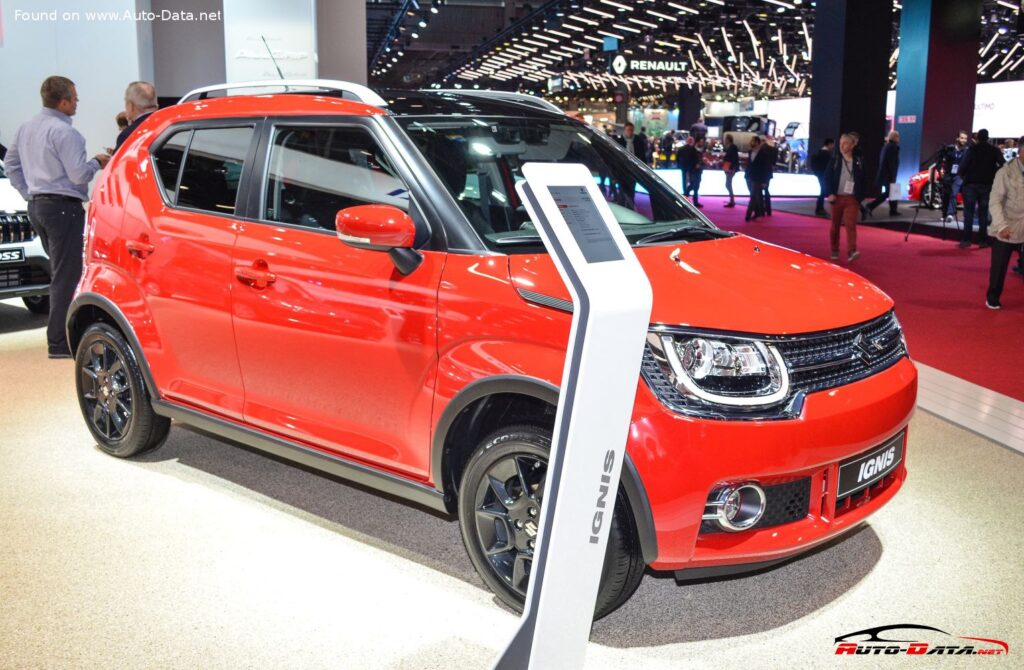
The Suzuki Ignis II 1.2 DualJet (90 Hp) 5 Seat represents the second generation of Suzuki’s subcompact crossover, a vehicle designed to blend the practicality of a small hatchback with the rugged aesthetic and higher driving position of an SUV. Launched in 2016 and produced until 2019, this iteration of the Ignis quickly carved out a niche in its primary markets across Europe, Japan, Australia, and India. While not officially sold in the United States, the Ignis II is a prime example of a global automotive trend towards smaller, more efficient, and versatile urban utility vehicles. It capitalized on Suzuki’s expertise in compact car engineering, offering a distinctive style, commendable fuel efficiency, and a surprisingly spacious interior for its diminutive footprint. The 1.2 DualJet variant, with its 90 horsepower engine, was a popular choice, emphasizing economical operation and nimble performance tailored for congested city environments and varied road conditions.
Engine & Performance of the Suzuki Ignis II 1.2 DualJet
At the heart of the Suzuki Ignis II 1.2 DualJet (90 Hp) 5 Seat is the K12C 1.2-liter (1242 cm³, or 75.79 cu. in.) DualJet inline-four-cylinder engine. This naturally aspirated gasoline engine is a testament to Suzuki’s commitment to efficiency and compact power delivery. With a power output of 90 horsepower at 6000 rpm and a peak torque of 88.51 lb.-ft. (120 Nm) at 4400 rpm, the engine is optimized for everyday driving dynamics. The “DualJet” designation refers to Suzuki’s advanced fuel injection system, which employs two injectors per cylinder. This design enhances fuel atomization and combustion efficiency, leading to better fuel economy and reduced emissions.
Paired with a 5-speed manual transmission, the front-wheel-drive Ignis II delivers a sprightly performance for its class. It can accelerate from 0 to 60 mph in a respectable 11.6 seconds, with a top speed of 105.63 mph (170 km/h). However, where the Ignis truly shines is in its fuel efficiency. With a combined fuel economy rating of 51.1 US mpg (4.6 l/100 km), it stands out as a highly economical choice. Urban driving returns an impressive 42.8 US mpg (5.5 l/100 km), while highway cruising extends to 57.4 US mpg (4.1 l/100 km). These figures, coupled with CO2 emissions of just 104 g/km and compliance with the Euro 6 emission standard, underscore its eco-friendly credentials, making it an attractive option for environmentally conscious drivers in its target markets.
Design & Features: The Distinctive Styling of the Ignis II
The Suzuki Ignis II breaks from conventional subcompact design with its unique and somewhat quirky aesthetic, often described as a “micro-SUV” or “mini crossover.” It features a distinctive, upright stance and a boxy silhouette that maximizes interior space within a very compact footprint. Measuring just 145.67 inches (3700 mm) in length, 65.35-66.54 inches (1660-1690 mm) in width, and 62.8 inches (1595 mm) in height, the Ignis is exceptionally maneuverable, boasting a tight minimum turning circle of just 30.84 feet (9.4 m), ideal for navigating crowded urban streets and tight parking spaces.
Despite its small exterior dimensions, the Ignis II offers a surprisingly practical five-seat interior. The elevated seating position provides excellent visibility, contributing to a sense of security and ease of driving. Cargo capacity is also noteworthy for its class, with a minimum trunk space of 9.43 cu. ft. (267 liters), which expands significantly to 38.74 cu. ft. (1097 liters) with the rear seats folded down. This flexibility makes it suitable for anything from daily errands to weekend getaways. The SUV-inspired design cues, such as the high ground clearance of 7.09 inches (180 mm) and pronounced wheel arches, give it a robust appearance, hinting at its capability to handle light off-road excursions, though its primary drivetrain is front-wheel drive.
Safety features for the era include an Anti-lock Braking System (ABS), standard on this model. The vehicle’s suspension setup, featuring an independent McPherson type in the front and a semi-independent coil spring system in the rear, provides a comfortable ride quality while maintaining agility. Ventilated disc brakes up front and drum brakes at the rear ensure adequate stopping power. Electric power steering makes low-speed maneuvers effortless. The Ignis II rode on either 175/65 R15 or 175/60 R16 tires, depending on the trim, contributing to its stable road manners and efficiency.
Technical Specifications: Suzuki Ignis II 1.2 DualJet (90 Hp) 5 Seat
| Specification | Value |
| Brand | Suzuki |
| Model | Ignis |
| Generation | Ignis II |
| Type (Engine) | 1.2 DualJet (90 Hp) 5 Seat |
| Production Start | 2016 year |
| Production End | 2019 year |
| Powertrain Architecture | Internal Combustion Engine |
| Body Type | SUV |
| Seats | 5 |
| Doors | 5 |
| Fuel Consumption (Urban) | 5.5 l/100 km (42.8 US mpg) |
| Fuel Consumption (Extra Urban) | 4.1 l/100 km (57.4 US mpg) |
| Fuel Consumption (Combined) | 4.6 l/100 km (51.1 US mpg) |
| CO2 Emissions | 104 g/km |
| Fuel Type | Petrol (Gasoline) |
| Acceleration 0 – 60 mph | 11.6 seconds |
| Acceleration 0 – 100 km/h | 12.2 seconds |
| Maximum Speed | 170 km/h (105.63 mph) |
| Emission Standard | Euro 6 |
| Weight-to-Power Ratio | 9 kg/Hp (111.1 Hp/tonne) |
| Weight-to-Torque Ratio | 6.8 kg/Nm (148.1 Nm/tonne) |
| Power | 90 Hp @ 6000 rpm |
| Power per liter | 72.5 Hp/l |
| Torque | 120 Nm @ 4400 rpm (88.51 lb.-ft. @ 4400 rpm) |
| Engine Layout | Front, Transverse |
| Engine Model/Code | K12C |
| Engine Displacement | 1242 cm³ (75.79 cu. in.) |
| Number of Cylinders | 4 |
| Engine Configuration | Inline |
| Cylinder Bore | 73 mm (2.87 in.) |
| Piston Stroke | 74.2 mm (2.92 in.) |
| Compression Ratio | 12.5:1 |
| Number of Valves per Cylinder | 4 |
| Fuel Injection System | Multi-port manifold injection |
| Engine Aspiration | Naturally aspirated engine |
| Kerb Weight | 810-855 kg (1785.74 – 1884.95 lbs.) |
| Trunk (Boot) Space – Minimum | 267 l (9.43 cu. ft.) |
| Trunk (Boot) Space – Maximum | 1097 l (38.74 cu. ft.) |
| Length | 3700 mm (145.67 in.) |
| Width | 1660-1690 mm (65.35 – 66.54 in.) |
| Height | 1595 mm (62.8 in.) |
| Minimum Turning Circle (Turning Diameter) | 9.4 m (30.84 ft.) |
Legacy and Market Impact
The Suzuki Ignis II 1.2 DualJet (90 Hp) 5 Seat, despite its absence from the North American market, made a significant impact in the compact and subcompact segments globally. It successfully revived the Ignis nameplate, which had been dormant since the early 2000s, by adapting it to the contemporary demand for crossovers and SUVs. In markets like Europe and Japan, where space and fuel efficiency are paramount, the Ignis became a popular choice for urban dwellers seeking a vehicle that combined the practicalities of a city car with a more adventurous, SUV-like persona.
Its primary competitors included other small, rugged-looking hatchbacks and entry-level crossovers such as the Fiat Panda 4×4, Dacia Sandero Stepway, and certain variants of the Toyota Aygo X or Nissan Juke, depending on the region. The Ignis distinguished itself with its unique styling, surprisingly good ground clearance for its size, and Suzuki’s reputation for building reliable and affordable vehicles. The 1.2 DualJet engine, in particular, was praised for its balance of performance and exceptional fuel economy, making it an economical choice for daily commuting.
The Ignis II’s legacy is one of smart packaging and clever design. It demonstrated that a vehicle could be incredibly compact yet offer a commanding driving position, versatile interior space, and a distinctive aesthetic. It appealed to a broad demographic, from young professionals to small families, who valued its low running costs, ease of parking, and a touch of rugged individuality. Although its production run for this specific generation concluded in 2019, the Ignis continues to be a key model for Suzuki in many markets, evolving to meet changing consumer preferences while maintaining its core identity as a cheerful, capable, and efficient micro-SUV.