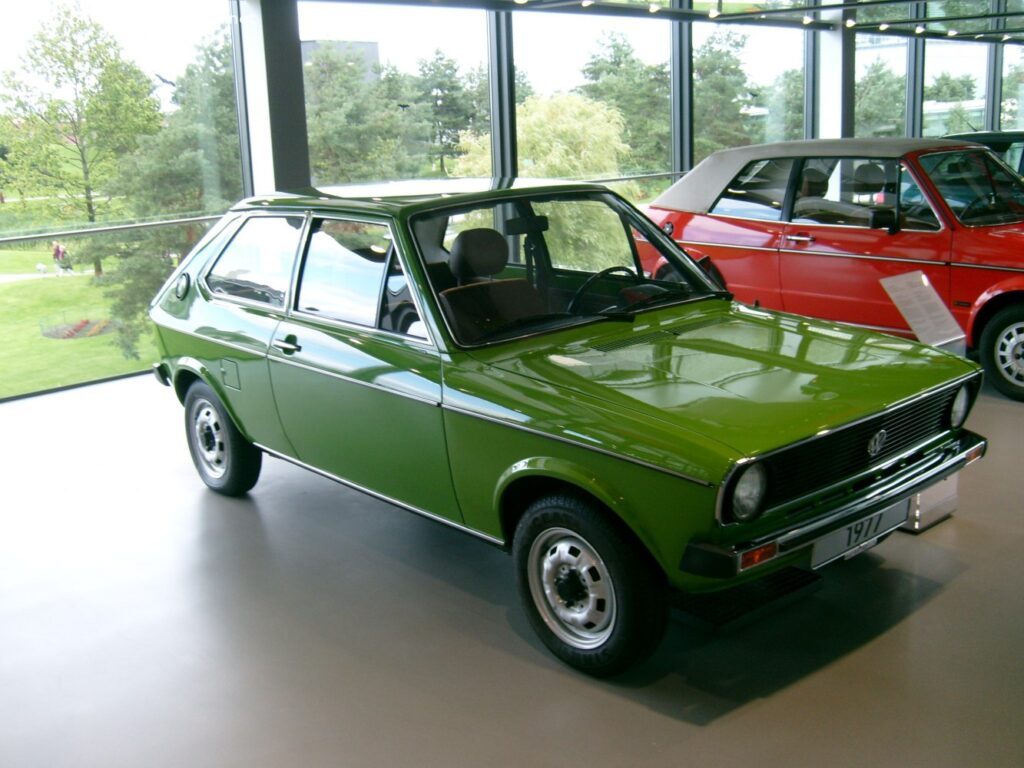
The Volkswagen Polo I (86) 1.1 (60 Hp) represents a pivotal moment in Volkswagen’s history, marking the brand’s definitive entry into the burgeoning supermini segment in Europe. Launched in 1975, the first-generation Polo, internally designated as Type 86, was a smaller, more affordable sibling to the highly successful Golf. While never officially sold in the United States, the Polo quickly became a staple on European roads, embodying Volkswagen’s commitment to practical, efficient, and well-engineered compact vehicles. The 1.1-liter variant, with its 60 horsepower engine, offered a compelling blend of economy and adequate performance for the urban and suburban landscapes of the late 1970s. Produced from 1976 to 1981, this particular iteration played a crucial role in establishing the Polo as a formidable competitor in its class, setting the stage for decades of success in the highly competitive European automotive market.
The Volkswagen Polo I (86) 1.1 (60 Hp): A European Compact Pioneer
The Polo I was Volkswagen’s response to the growing demand for smaller, more fuel-efficient vehicles in the wake of the 1973 oil crisis. Unlike the rear-engined Beetle, and even the front-engined but still relatively large Golf, the Polo offered a truly compact alternative. It was designed to appeal to a broader demographic, particularly those seeking an affordable and reliable city car. The Polo’s success was instrumental in establishing Volkswagen as a major player in the supermini segment, a market previously dominated by British and Italian manufacturers.
Engine & Performance
At the heart of the Volkswagen Polo I (86) 1.1 (60 Hp) was a compact, naturally aspirated 1.1-liter (1093 cm³) inline four-cylinder engine. Designated with the engine code HC, this powerplant delivered a respectable 60 horsepower at a peak of 6000 rpm, a solid output for its displacement and era. Torque figures stood at 85 Newton-meters (approximately 62.69 lb.-ft.) available at 3500 rpm, providing decent low-end grunt for city driving. The engine’s layout was front, transverse, driving the front wheels through a 4-speed manual transmission, a common and reliable setup for compact cars of the period.
Fuel delivery was managed by a carburetor system, a technology that was standard before the widespread adoption of fuel injection. With a compression ratio of 9.7:1 and two valves per cylinder, the engine was designed for simplicity and durability. Its modest power output translated into a 0-60 mph acceleration time of 14.2 seconds, with a top speed of 94.45 mph (152 km/h). While not a performance car by any stretch, these figures were more than adequate for the Polo’s intended purpose as an economical daily driver. The vehicle’s lightweight nature, with a curb weight of just 1563.08 lbs. (709 kg), contributed significantly to its agility and fuel efficiency. It achieved a combined fuel economy of approximately 31.4 US mpg (7.5 liters per 100 km), making it a very economical choice during a time of increasing fuel costs.
Design & Features
The Volkswagen Polo I (86) adopted a practical and unpretentious design, characteristic of European compact cars of the 1970s. It was offered exclusively as a 3-door hatchback, a body style that maximized interior space and cargo versatility within a small footprint. Measuring 137.8 inches (3500 mm) in length, 61.38 inches (1559 mm) in width, and 52.91 inches (1344 mm) in height, the Polo I was remarkably compact, making it ideal for navigating crowded European city streets and tight parking spaces. Its wheelbase of 91.73 inches (2330 mm) contributed to its nimble handling and tight turning circle of 31.5 feet (9.6 meters).
Despite its small exterior dimensions, the Polo I was designed to comfortably accommodate five occupants, though rear legroom was naturally limited. The hatchback configuration provided excellent cargo flexibility, with a minimum trunk space of 10.06 cubic feet (285 liters) that could expand to a generous 31.78 cubic feet (900 liters) with the rear seats folded down. This practicality was a key selling point for families and individuals seeking an economical and versatile vehicle. The minimalist interior design focused on functionality, with durable materials and straightforward controls. Safety features were rudimentary by modern standards, reflecting the regulations and expectations of its era, but its compact size and light weight meant it was an agile vehicle to maneuver. The drag coefficient (Cd) of 0.39 was typical for a small car of its time, balancing aerodynamic efficiency with practical design.
Technical Specifications
| Category | Specification |
| Brand | Volkswagen |
| Model | Polo |
| Generation | Polo I (86) |
| Type (Engine) | 1.1 (60 Hp) |
| Production Start | 1976 year |
| Production End | 1981 year |
| Powertrain Architecture | Internal Combustion engine, Front Wheel Drive |
| Body Type | Hatchback |
| Seats | 5 |
| Doors | 3 |
| Performance Specs | |
| Fuel Consumption (Combined) | 7.5 l/100 km |
| Fuel Consumption (Combined) | 31.4 US mpg |
| Fuel Type | Petrol (Gasoline) |
| Acceleration 0 – 60 mph | 14.2 sec |
| Acceleration 0 – 100 km/h | 14.9 sec |
| Maximum Speed | 152 km/h |
| Maximum Speed | 94.45 mph |
| Weight-to-Power Ratio | 11.8 kg/Hp |
| Weight-to-Power Ratio | 84.6 Hp/tonne |
| Weight-to-Torque Ratio | 8.3 kg/Nm |
| Weight-to-Torque Ratio | 119.9 Nm/tonne |
| Engine Specs | |
| Power | 60 Hp @ 6000 rpm |
| Power per Liter | 54.9 Hp/l |
| Torque | 85 Nm @ 3500 rpm |
| Torque | 62.69 lb.-ft. |
| Engine Layout | Front, Transverse |
| Engine Model/Code | HC |
| Engine Displacement | 1093 cm³ |
| Engine Displacement | 66.7 cu. in. |
| Number of Cylinders | 4 |
| Engine Configuration | Inline |
| Cylinder Bore | 69.5 mm |
| Cylinder Bore | 2.74 in. |
| Piston Stroke | 72 mm |
| Piston Stroke | 2.83 in. |
| Compression Ratio | 9.7:1 |
| Valves per Cylinder | 2 |
| Fuel Injection System | Carburetor |
| Engine Aspiration | Naturally aspirated engine |
| Engine Oil Capacity | 3 l |
| Engine Oil Capacity | 3.17 US qt |
| Coolant Capacity | 4 l |
| Coolant Capacity | 4.23 US qt |
| Space, Volume and Weights | |
| Curb Weight | 709 kg |
| Curb Weight | 1563.08 lbs. |
| Trunk Space (Minimum) | 285 l |
| Trunk Space (Minimum) | 10.06 cu. ft. |
| Trunk Space (Maximum) | 900 l |
| Trunk Space (Maximum) | 31.78 cu. ft. |
| Fuel Tank Capacity | 36 l |
| Fuel Tank Capacity | 9.51 US gal |
| Dimensions | |
| Length | 3500 mm |
| Length | 137.8 in. |
| Width | 1559 mm |
| Width | 61.38 in. |
| Height | 1344 mm |
| Height | 52.91 in. |
| Wheelbase | 2330 mm |
| Wheelbase | 91.73 in. |
| Front Track | 1296 mm |
| Front Track | 51.02 in. |
| Rear Track | 1312 mm |
| Rear Track | 51.65 in. |
| Drag Coefficient (Cd) | 0.39 |
| Minimum Turning Circle | 9.6 m |
| Minimum Turning Circle | 31.5 ft. |
| Drivetrain, Brakes and Suspension Specs | |
| Drivetrain Architecture | Internal combustion engine (ICE) drives the front wheels. |
| Drive Wheel | Front wheel drive |
| Gearbox Type | 4 gears, manual transmission |
Legacy and Market Impact
The Volkswagen Polo I (86) 1.1 (60 Hp) carved out a significant niche for itself in the European automotive landscape during the late 1970s. Positioned as Volkswagen’s entry-level model, it effectively complemented the larger Golf, offering a more compact and economical alternative. Its introduction was a calculated move by Volkswagen to compete in the rapidly expanding supermini segment, which was dominated by popular models like the Ford Fiesta, Fiat 127, Renault 5, and the Mini. The Polo quickly gained a reputation for its robust build quality, reliable mechanics, and efficient operation—qualities that were synonymous with the Volkswagen brand.
Its simple yet effective design, combined with its practical hatchback body, made it an ideal choice for first-time car buyers, small families, and urban commuters across Europe. The 1.1-liter engine, while not powerful, was celebrated for its fuel economy and ease of maintenance, crucial factors for consumers facing rising oil prices. The Polo’s success demonstrated Volkswagen’s ability to adapt its winning formula—pioneered by the Beetle and reinvented with the Golf—to an even smaller scale. It helped solidify Volkswagen’s position as a leading manufacturer of diverse and dependable vehicles.
The Polo I laid the groundwork for future generations of the model, each building upon the original’s core values of practicality, efficiency, and quality. Its enduring legacy is evident in the fact that the Polo nameplate continues to thrive globally, albeit still primarily outside the North American market, as a benchmark in the subcompact class. The first-generation Polo is remembered as a resilient and influential vehicle that perfectly captured the spirit of European motoring in its era, delivering accessible mobility to millions and becoming a true automotive icon in its own right.