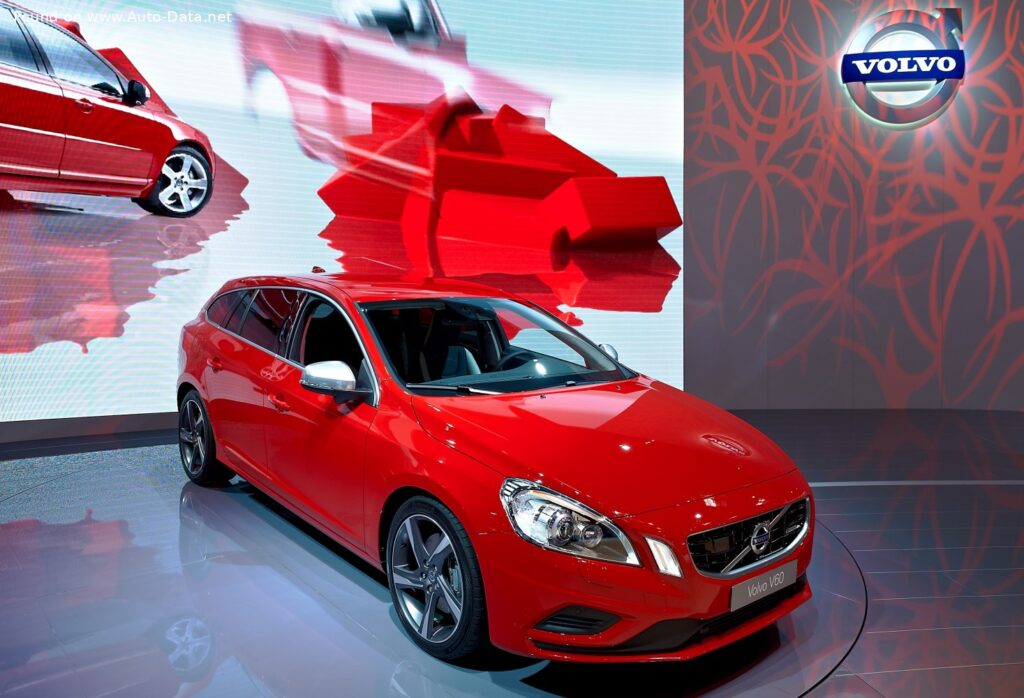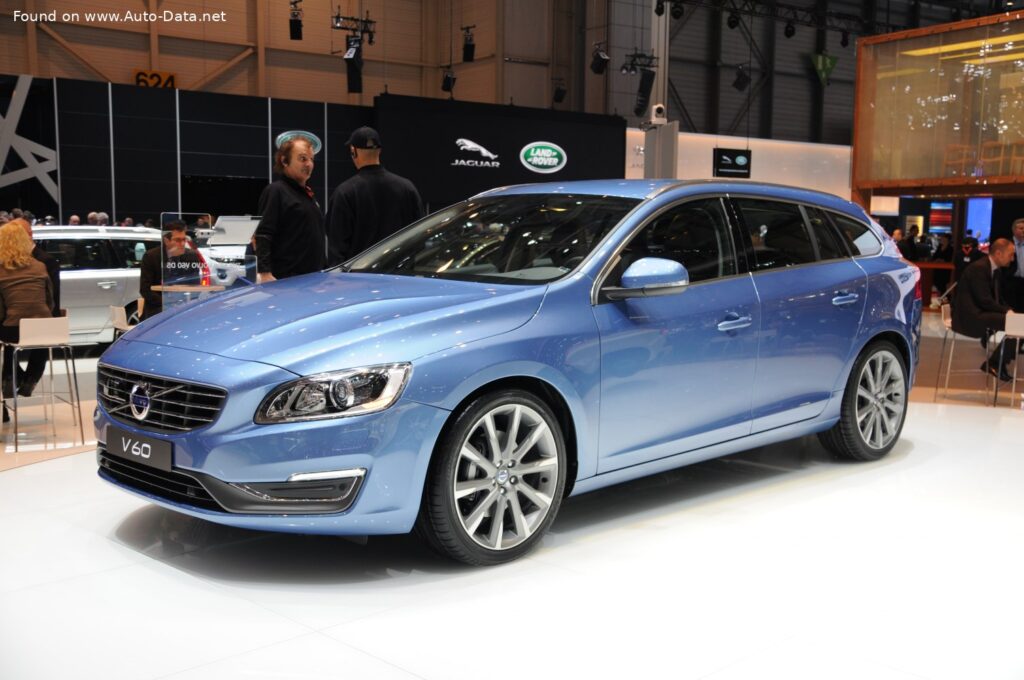
The Volvo V60 I (2013 facelift) 2.0 D3 (136 Hp) start/stop represents a significant iteration of Volvo’s compact executive station wagon, primarily targeted at the discerning European market. Introduced in 2013 as part of a comprehensive refresh for the first-generation V60, this particular variant embodied Volvo’s commitment to combining practical utility with refined performance and impressive fuel efficiency, especially crucial in the diesel-centric automotive landscape of Europe. The V60, first launched in 2010, was designed to compete in the highly competitive premium D-segment, offering a sportier alternative to its larger V70 sibling while retaining the brand’s core values of safety, comfort, and distinctive Scandinavian design.
This facelifted model, produced until 2018, brought a host of aesthetic and technological updates. While the V60 was available in various powertrain configurations, the 2.0 D3 diesel engine with its 136 horsepower output and integrated start/stop system was a popular choice, striking an excellent balance between everyday drivability and economical operation. As a 5-door, 5-seat station wagon, it served as a versatile family vehicle and a capable long-distance cruiser, embodying the modern interpretation of the traditional Volvo estate car for a new generation of buyers.
Engine & Performance of the Volvo V60 I (2013 facelift) 2.0 D3 (136 Hp) Start/Stop
At the heart of this specific Volvo V60 I (2013 facelift) 2.0 D3 (136 Hp) start/stop model lies a robust 2.0-liter (1984 cm3 or 121.07 cu. in.) inline five-cylinder diesel engine, designated with the model code D5204T7. This engine architecture, a hallmark of many Volvo diesel powertrains of the era, is known for its distinctive thrum and smooth power delivery. Equipped with a turbocharger and intercooler, it generated a respectable 136 horsepower at 3500 rpm. More importantly for daily driving and load-carrying, the engine delivered a substantial 258.15 lb-ft (350 Nm) of torque, available across a broad rev range from 1500 to 2250 rpm. This ample low-end torque ensured strong pulling power and effortless acceleration in most scenarios, making it well-suited for both city driving and highway cruising.
Power was sent to the front wheels via a precise 6-speed manual transmission, offering engaging control for the driver while contributing to the vehicle’s overall efficiency. The V60 2.0 D3 could accelerate from 0 to 60 mph in a commendable 9.9 seconds, a respectable figure for a family wagon of its size and power output. Its top speed, while not explicitly provided, would have been more than adequate for European highway speeds. A key feature for this variant was the inclusion of a Start/Stop system, which automatically shuts off the engine when the vehicle is stationary (e.g., at a traffic light) and restarts it seamlessly when the driver presses the clutch. This technology was instrumental in reducing fuel consumption and CO2 emissions, particularly in urban environments.
Fuel economy was a strong suit for the 2.0 D3. The combined cycle reported an impressive 4.5 liters per 100 kilometers, which translates to an excellent 52.3 US miles per gallon. Urban driving yielded 5.2 l/100 km (45.2 US mpg), while extra-urban conditions saw it achieve 4.1 l/100 km (57.4 US mpg). With CO2 emissions rated at 119 g/km, the vehicle met the Euro 5 emission standard, reflecting its relatively clean operation for a diesel of its time. The engine’s compression ratio of 16.5:1, coupled with a common rail fuel injection system, optimized combustion for both power and efficiency. The substantial 17.83 US gallon fuel tank capacity provided an extended driving range, making it an ideal choice for long journeys across the continent.
Design & Features
The V60 I (2013 facelift) retained the core design philosophy of the original V60 but introduced a refreshed aesthetic that aligned it with Volvo’s evolving design language. The most notable exterior changes included a redesigned front fascia with a wider grille, new headlights that integrated daytime running lights, and a more sculptured hood. These updates gave the V60 a more assertive and contemporary appearance, moving away from some of the softer lines of the pre-facelift model. The rear received subtle tweaks to the taillight clusters and bumper, maintaining its distinctive, almost coupé-like profile despite its station wagon body style.
Measuring 182.48 inches in length, 71.85 inches in width, and 58.43 inches in height, with a wheelbase of 109.29 inches, the V60 struck a balance between exterior compactness and interior spaciousness. The station wagon body type offered practical utility, providing 15.19 cubic feet (430 liters) of trunk space with the rear seats in place. While perhaps not the largest in its class, the cargo area was intelligently designed for ease of loading and versatility, expandable for larger items. The interior maintained Volvo’s reputation for ergonomic design and high-quality materials. The 2013 facelift also brought updates to the infotainment system, with a larger screen and improved connectivity options, including Volvo’s Sensus infotainment system.
Safety, as always with Volvo, was paramount. The V60 came equipped with a comprehensive suite of active and passive safety features, including ABS (Anti-lock Braking System) as standard. Depending on the trim level and optional packages, it could feature advanced driver-assistance systems such as City Safety (automatic braking at low speeds), pedestrian detection, adaptive cruise control, and blind-spot monitoring, all contributing to its strong safety ratings and Volvo’s long-standing reputation for occupant protection.
Legacy and Market Impact
The Volvo V60 I, particularly its facelifted version from 2013-2018, played a crucial role in Volvo’s strategy to expand its presence in the premium compact executive segment. While not offered with diesel powertrains in the United States, in its primary European market, the Volvo V60 I (2013 facelift) 2.0 D3 (136 Hp) start/stop was a highly relevant and competitive offering. It carved out a niche for buyers seeking a sophisticated and safe family vehicle that eschewed the more aggressive styling of some German rivals in favor of a distinctively Scandinavian, elegant, and understated aesthetic.
Its reputation was built on several pillars: Volvo’s legendary safety record, comfortable and supportive seating, high-quality interior finishes, and the practicality of a station wagon body. The 2.0 D3 engine, in particular, solidified its appeal as a sensible choice, offering a compelling blend of performance and exceptional fuel economy that was highly valued in regions with higher fuel prices and stricter emission regulations. The inclusion of a particulate filter and adherence to Euro 5 standards underscored Volvo’s commitment to environmental responsibility, a growing concern for European consumers.
In the competitive European landscape, the V60 D3 faced formidable rivals such as the BMW 3 Series Touring, Audi A4 Avant, Mercedes-Benz C-Class Estate, and even the Volkswagen Passat Estate. While some competitors might have offered sportier handling or more opulent interiors, the V60 consistently stood out for its unique design, emphasis on safety innovation, and a more relaxed, long-distance cruising demeanor. It appealed to a demographic that appreciated subtle luxury, robust build quality, and a focus on real-world usability rather than outright performance figures.
Ultimately, the first-generation V60, particularly in its facelifted form with efficient diesel engines like the D3, helped cement Volvo’s position as a strong contender in the premium segment. It demonstrated that practicality could coexist with style and advanced technology, all wrapped in a package that prioritized occupant well-being. Its success laid the groundwork for future Volvo models, reinforcing the brand’s image as a leader in automotive safety and design, and paving the way for the critically acclaimed second-generation V60 that would follow.
| Category | Specification |
| Brand | Volvo |
| Model | V60 |
| Generation | V60 I (2013 facelift) |
| Engine Type | 2.0 D3 (136 Hp) start/stop |
| Production Start | 2013 |
| Production End | 2018 |
| Powertrain Architecture | Internal Combustion engine |
| Body type | Station wagon (estate) |
| Seats | 5 |
| Doors | 5 |
| Performance Specs | |
| Fuel consumption (economy) – urban | 5.2 l/100 km (45.2 US mpg) |
| Fuel consumption (economy) – extra urban | 4.1 l/100 km (57.4 US mpg) |
| Fuel consumption (economy) – combined | 4.5 l/100 km (52.3 US mpg) |
| CO2 emissions | 119 g/km |
| Fuel Type | Diesel |
| Acceleration 0 – 60 mph | 9.9 sec |
| Acceleration 0 – 100 km/h | 10.4 sec |
| Emission standard | Euro 5 |
| Weight-to-power ratio | 12.5 kg/Hp, 80.2 Hp/tonne |
| Weight-to-torque ratio | 4.8 kg/Nm, 206.5 Nm/tonne |
| Engine Specs | |
| Power | 136 Hp @ 3500 rpm |
| Power per liter | 68.5 Hp/l |
| Torque | 350 Nm (258.15 lb-ft) @ 1500-2250 rpm |
| Engine layout | Front, Transverse |
| Engine Model/Code | D5204T7 |
| Engine displacement | 1984 cm3 (121.07 cu. in.) |
| Number of cylinders | 5 |
| Engine configuration | Inline |
| Cylinder Bore | 81 mm (3.19 in.) |
| Piston Stroke | 77 mm (3.03 in.) |
| Compression ratio | 16.5:1 |
| Fuel injection system | Diesel Commonrail |
| Engine aspiration | Turbocharger, Intercooler |
| Engine oil capacity | 5.9 l (6.23 US qt) |
| Coolant | 8.9 l (9.4 US qt) |
| Engine Systems | |
| Systems | Start & Stop System, Particulate filter |
| Space, Volume and Weights | |
| Kerb Weight | 1695 kg (3736.84 lbs) |
| Max. weight | 2180 kg (4806.08 lbs) |
| Max load | 485 kg (1069.24 lbs) |
| Trunk (boot) space – minimum | 430 l (15.19 cu. ft.) |
| Fuel tank capacity | 67.5 l (17.83 US gal) |
| Dimensions | |
| Length | 4635 mm (182.48 in.) |
| Width | 1825 mm (71.85 in.) |
| Height | 1484 mm (58.43 in.) |
| Wheelbase | 2776 mm (109.29 in.) |
| Front track | 1588 mm (62.52 in.) |
| Rear (Back) track | 1585 mm (62.4 in.) |
| Minimum turning circle (turning diameter) | 11.3 m (37.07 ft.) |
| Drivetrain, Brakes and Suspension Specs | |
| Drivetrain Architecture | The Internal combustion engine (ICE) drives the front wheels of the vehicle. |
| Drive wheel | Front wheel drive |
| Number of gears and type of gearbox | 6 gears, manual transmission |
| Assisting systems | ABS (Anti-lock braking system) |
| Steering type | Steering rack and pinion |