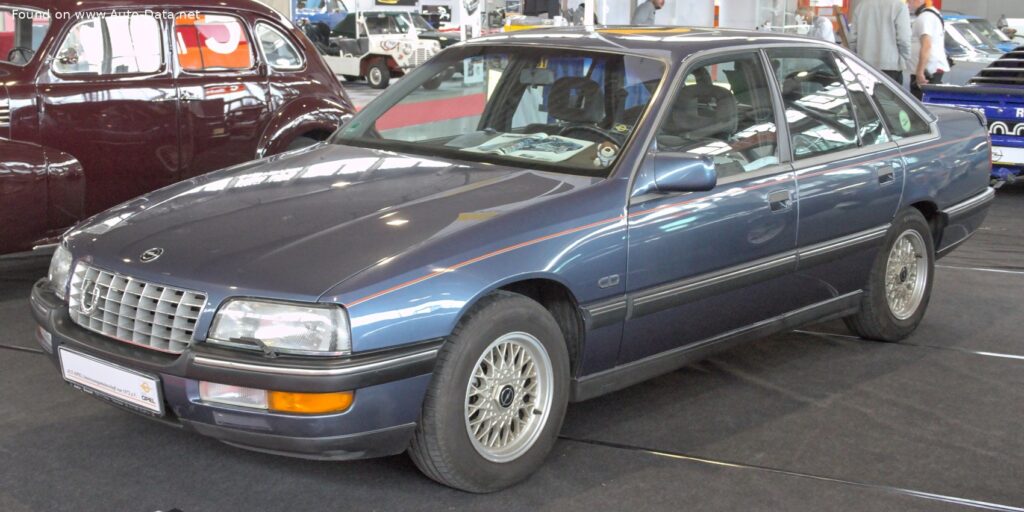
The Opel Senator B 3.0i 24V represents a significant chapter in the history of Opel, General Motors’ primary European brand. Introduced in October 1989 as the second and final generation of the Senator line, this full-size, executive sedan was Opel’s flagship offering, designed to compete in the highly competitive E-segment of the European market. While never officially sold in the United States under the Opel badge, the Senator B carved out a niche for itself across Europe, offering a blend of robust engineering, sophisticated comfort, and impressive performance for its era. This particular variant, the 3.0i 24V, stood as the pinnacle of the Senator B lineup, showcasing Opel’s engineering prowess with its advanced multi-valve inline-six engine and rear-wheel-drive architecture. Produced until May 1993, the Senator B was a testament to traditional European executive car values, prioritizing smooth power delivery, a composed ride, and spacious accommodations.
Opel Senator B 3.0i 24V: A Detailed Overview
The Senator B was conceived as a replacement for the earlier Senator A, aiming to provide a more modern and refined experience for discerning European drivers. It was positioned above the Opel Rekord in terms of size, luxury, and performance, serving as a direct competitor to models like the Ford Scorpio, BMW 5 Series, and Mercedes-Benz E-Class. The 3.0i 24V model, with its upgraded engine, represented the ultimate expression of the Senator B’s capabilities, offering a compelling combination of power and refinement.
Engine & Performance
At the heart of the Opel Senator B 3.0i 24V lies Opel’s C30SE engine, a 3.0-liter (2969 cm³, or 181.18 cu. in.) naturally aspirated inline-six gasoline engine. This engine was a technological achievement for its time, featuring a Double Overhead Camshaft (DOHC) valvetrain with four valves per cylinder – a total of 24 valves. This multi-valve design maximized airflow and combustion efficiency, resulting in increased power and smoother operation. The C30SE produced 204 horsepower at 6000 rpm, achieving a specific output of 68.7 horsepower per liter. Torque peaked at 199.14 lb.-ft. (270 Nm) at 3600 rpm, providing a broad and usable powerband. Power was transferred to the rear wheels through a smooth-shifting 5-speed manual transmission, favored by enthusiasts for its direct connection. Performance figures included a 0 to 60 mph time of 7.4 seconds and a 0-100 km/h acceleration of 7.8 seconds. The top speed reached an impressive 149.13 mph (240 km/h). Despite a curb weight of 3251.82 lbs. (1475 kg), the Senator B 3.0i 24V boasted a weight-to-power ratio of 7.2 kg/Hp (138.3 Hp/tonne). Fuel economy was respectable for a large-displacement inline-six, averaging 25.6 US mpg combined (9.2 l/100 km), with highway figures reaching 30.9 US mpg (7.6 l/100 km).
Design & Features
The Opel Senator B showcased a classic, understated executive sedan design typical of late 1980s and early 1990s European automobiles. Its four-door, five-seat body conveyed elegance without being ostentatious. The vehicle measured 190.75 inches (4845 mm) in length, 69.41 inches (1763 mm) in width, and 57.09 inches (1450 mm) in height, presenting a substantial road presence. A 107.48-inch (2730 mm) wheelbase contributed to both ride stability and interior spaciousness. Aerodynamics were considered in the design, with a drag coefficient (Cd) of 0.31, competitive for a large sedan of the era and aiding fuel efficiency and reducing wind noise. The interior prioritized comfort and practicality, offering ample legroom and headroom for all occupants. Trunk capacity ranged from 18.72 cu. ft. (530 liters) to 32.84 cu. ft. (930 liters) with the rear seats folded, providing excellent cargo versatility. The chassis featured an independent McPherson strut front suspension with coil springs and an anti-roll bar, paired with an independent coil spring rear suspension with a transverse stabilizer and trailing arms, delivering a comfortable ride and good handling. Braking was handled by ventilated discs at the front and solid discs at the rear, equipped with a standard Anti-lock Braking System (ABS). Steering was hydraulic power-assisted cone worm with recirculation balls, offering precise feedback. The car rode on 205/65 R15 tires mounted on 6J x 15-inch wheel rims.
Technical Specifications
| Brand | Opel |
| Model | Senator |
| Generation | Senator B |
| Type (Engine) | 3.0i 24V (204 Hp) |
| Start of production | October, 1989 |
| End of production | May, 1993 |
| Powertrain Architecture | Internal Combustion engine |
| Body type | Sedan |
| Seats | 5 |
| Doors | 4 |
| Fuel consumption (economy) – urban | 14.3 l/100 km (16.4 US mpg) |
| Fuel consumption (economy) – extra urban | 7.6 l/100 km (30.9 US mpg) |
| Fuel consumption (economy) – combined | 9.2 l/100 km (25.6 US mpg) |
| Fuel Type | Petrol (Gasoline) |
| Acceleration 0 – 60 mph | 7.4 sec |
| Acceleration 0 – 100 km/h | 7.8 sec |
| Maximum speed | 240 km/h (149.13 mph) |
| Weight-to-power ratio | 7.2 kg/Hp (138.3 Hp/tonne) |
| Engine Power | 204 Hp @ 6000 rpm. |
| Engine Torque | 270 Nm @ 3600 rpm. (199.14 lb.-ft.) |
| Engine Displacement | 2969 cm³ (181.18 cu. in.) |
| Kerb Weight | 1475 kg (3251.82 lbs.) |
| Trunk (boot) space – minimum | 530 l (18.72 cu. ft.) |
| Trunk (boot) space – maximum | 930 l (32.84 cu. ft.) |
| Length | 4845 mm (190.75 in.) |
| Width | 1763 mm (69.41 in.) |
| Height | 1450 mm (57.09 in.) |
| Wheelbase | 2730 mm (107.48 in.) |
| Drag coefficient (Cd) | 0.31 |
The Opel Senator B 3.0i 24V occupied a unique position in the European automotive market during its production run. While it didn’t achieve the same prestige as its German luxury competitors, it offered a compelling alternative with its blend of comfort, space, performance, and value. The robust C30SE engine and rear-wheel-drive platform made it a capable and enjoyable driving experience. Today, the Senator B, particularly the 3.0i 24V, is remembered as a well-engineered and comfortable European executive car, representing a significant piece of Opel’s heritage and engineering ambition. It remains a sought-after classic for enthusiasts who appreciate its robust mechanicals and understated styling.