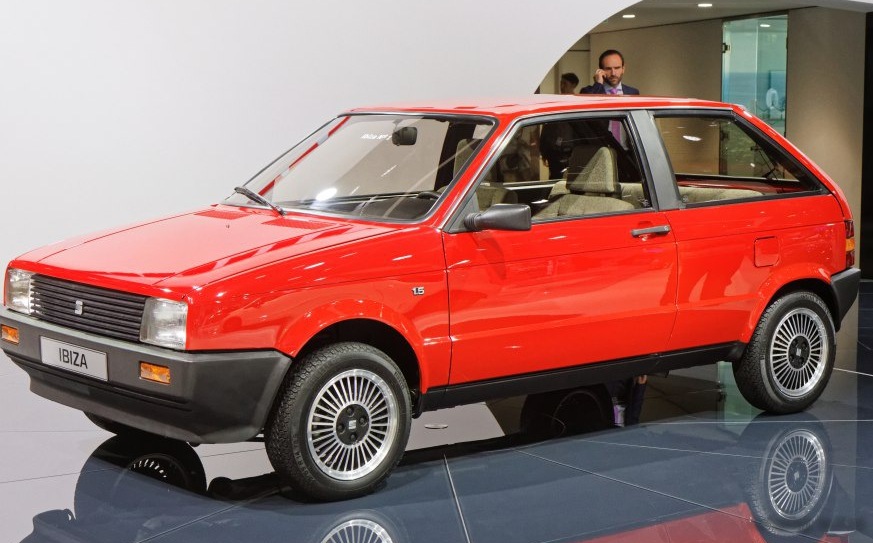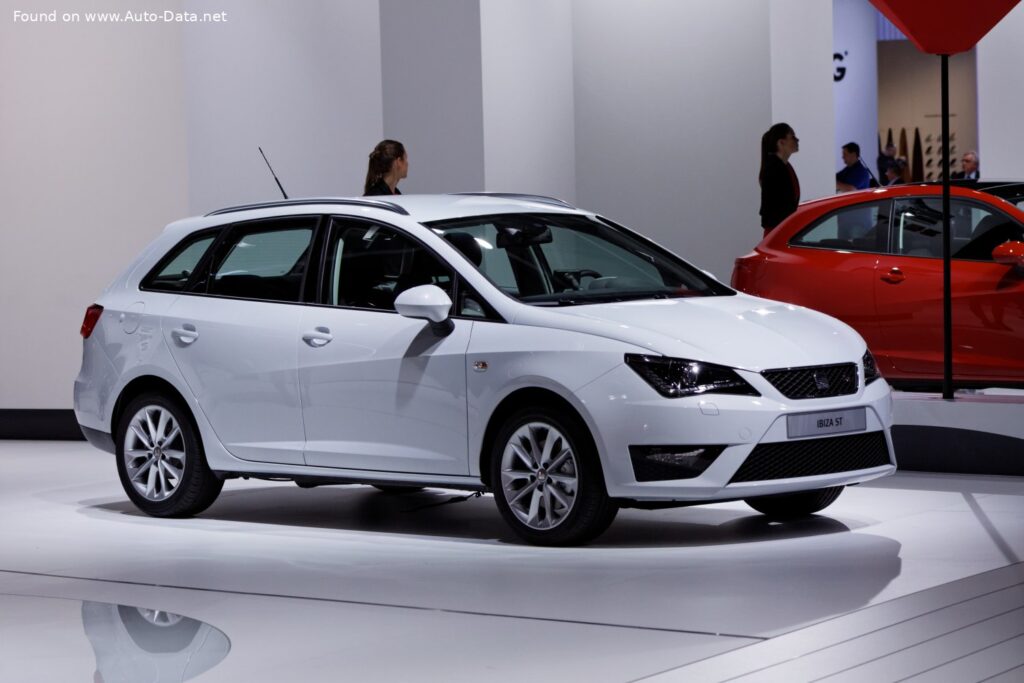
The SEAT Ibiza IV ST (facelift 2012) represents a significant iteration of SEAT’s popular subcompact car, tailored for the European market. SEAT, a Spanish automaker and a member of the Volkswagen Group, is renowned for infusing a sporty character into its vehicles, often sharing platforms and powertrains with Volkswagen and Skoda models. The Ibiza, particularly in its fourth generation (6J chassis code), was a cornerstone of the brand’s lineup, offering various body styles including a three-door hatchback (SC), a five-door hatchback, and the practical five-door station wagon (ST, for Sport Tourer) variant. The facelifted model, introduced in 2012, brought a refreshed aesthetic and updated technological features, maintaining its competitive edge in the highly contested European B-segment.
This specific configuration, the Seat Ibiza IV ST (facelift 2012) 1.2 TSI (105 Hp) DSG, highlights a blend of efficient turbocharged gasoline power and the convenience of a sophisticated automatic transmission. While SEAT vehicles are not officially sold in the United States, understanding their engineering and market positioning offers valuable insight into global automotive trends and the diverse needs of international consumers. The Ibiza ST carved out a niche for itself by offering the compact dimensions suitable for urban European environments, combined with the enhanced cargo capacity of a small wagon, making it an ideal choice for young families or individuals requiring more utility than a standard hatchback.
Engine & Performance: The 1.2 TSI and DSG Powertrain in the Seat Ibiza IV ST (facelift 2012)
At the heart of this particular Seat Ibiza IV ST (facelift 2012) model is the highly efficient 1.2-liter TSI (Turbocharged Stratified Injection) gasoline engine, designated with the internal code CBZB. This inline four-cylinder unit, with a displacement of 1,197 cubic centimeters (approximately 73.05 cubic inches), exemplifies the Volkswagen Group’s commitment to downsizing technology. Despite its relatively small displacement, the engine produces a respectable 105 horsepower at 5000 revolutions per minute, largely thanks to its turbocharger and intercooler setup. This allows for a power output of 87.7 horsepower per liter, a commendable figure for its class.
Torque delivery is equally impressive for an engine of this size, peaking at 175 Newton-meters (approximately 129.07 pound-feet) across a broad and accessible range from 1550 to 4100 rpm. This wide torque band is crucial for real-world drivability, ensuring that the car feels responsive and capable in various driving conditions, from city traffic to highway cruising. The engine’s direct fuel injection system further enhances efficiency and performance by precisely atomizing fuel directly into the combustion chambers. With a compression ratio of 10:1 and two valves per cylinder, the engine balances performance with fuel economy, adhering to Euro 5 emission standards, which were stringent for its production era.
Power is channeled to the front wheels through a sophisticated 7-speed automatic DSG (Direct Shift Gearbox) transmission. Volkswagen Group’s DSG technology, a dual-clutch system, is renowned for its rapid, smooth gear changes and its ability to contribute to both performance and fuel efficiency. The combination of the punchy 1.2 TSI engine and the quick-shifting DSG allows the Ibiza ST to accelerate from 0 to 60 miles per hour in a brisk 9.5 seconds, with a top speed of 118.06 mph (190 km/h).
Fuel economy for this powertrain is a key selling point in markets where fuel costs are a significant consideration. The combined fuel consumption is rated at 5.3 liters per 100 kilometers, which translates to an impressive 44.4 US miles per gallon. Urban driving yields approximately 33.6 US mpg, while extra-urban (highway) driving can see figures as high as 53.5 US mpg. CO2 emissions are kept relatively low at 124 grams per kilometer, making it an environmentally conscious choice for its time. The car’s weight-to-power ratio stands at 11.1 kilograms per horsepower, or 90.1 horsepower per metric ton, indicating a well-balanced power-to-weight characteristic for its segment.
Design & Features: Practicality Meets European Style
The 2012 facelift of the Seat Ibiza IV ST brought subtle yet effective updates to its exterior and interior design, enhancing its appeal without departing from its established sporty aesthetic. As a five-door station wagon (often referred to as an “estate” in Europe), the Ibiza ST prioritizes practicality and versatility. Its dimensions – 166.77 inches in length, 66.65 inches in width, and 56.89 inches in height – make it a compact vehicle, ideally suited for navigating tight city streets and parking in congested urban areas. Despite its compact footprint, the wheelbase of 97.2 inches contributes to a stable ride and a surprisingly spacious interior for its class.
The exterior design of the facelifted Ibiza ST featured revised headlights, a redesigned front bumper, and updated grille, giving it a sharper, more contemporary look. SEAT’s signature “Arrow Design” cues were evident, with angular lines and a dynamic stance that conveyed a sense of athleticism. The station wagon body style seamlessly integrated a longer roofline and a more upright tailgate compared to its hatchback siblings, significantly enhancing cargo capacity. The minimum trunk (boot) space of 430 liters (15.19 cubic feet) was a strong selling point, offering substantially more utility than many direct competitors in the subcompact segment. With the rear seats folded, this capacity would expand further, making it capable of accommodating larger items for weekend trips or daily errands.
Inside, the Ibiza ST offered a functional and well-appointed cabin designed for five occupants. The facelift introduced updated trim materials, improved ergonomics, and new infotainment options, reflecting the increasing importance of connectivity and user experience in modern vehicles. Standard features for the era would typically include air conditioning, power windows, and a decent audio system. Safety was also a priority, with the car equipped with an Anti-lock Braking System (ABS) as standard, along with multiple airbags. The front suspension utilized an independent McPherson strut setup with coil springs and an anti-roll bar, providing a comfortable yet engaging ride, while the rear featured a trailing arm design. Braking performance was handled by ventilated discs at the front and solid discs at the rear, ensuring confident stopping power. Electric power steering, with a rack and pinion system, offered light and precise control, making urban maneuvers easier with a minimum turning circle of 34.38 feet.
Technical Specifications
| Category | Specification |
| General Information | |
| Brand | SEAT |
| Model | Ibiza |
| Generation | Ibiza IV ST (facelift 2012) |
| Type (Engine) | 1.2 TSI (105 Hp) DSG |
| Production Start | 2012 |
| Production End | 2015 |
| Powertrain Architecture | Internal Combustion Engine |
| Body Type | Station wagon (estate) |
| Seats | 5 |
| Doors | 5 |
| Performance Specs | |
| Fuel Consumption (Urban) | 7 l/100 km (33.6 US mpg) |
| Fuel Consumption (Extra Urban) | 4.4 l/100 km (53.5 US mpg) |
| Fuel Consumption (Combined) | 5.3 l/100 km (44.4 US mpg) |
| CO2 Emissions | 124 g/km |
| Fuel Type | Petrol (Gasoline) |
| Acceleration 0-60 mph | 9.5 sec |
| Acceleration 0-62 mph (0-100 km/h) | 10 sec |
| Maximum Speed | 118.06 mph (190 km/h) |
| Emission Standard | Euro 5 |
| Weight-to-Power Ratio | 11.1 kg/Hp (90.1 Hp/tonne) |
| Weight-to-Torque Ratio | 6.7 kg/Nm (150.2 Nm/tonne) |
| Engine Specs | |
| Power | 105 Hp @ 5000 rpm |
| Power per Liter | 87.7 Hp/l |
| Torque | 175 Nm (129.07 lb.-ft.) @ 1550-4100 rpm |
| Engine Layout | Front, Transverse |
| Engine Model/Code | CBZB |
| Engine Displacement | 1197 cm3 (1.2 liters / 73.05 cu. in.) |
| Number of Cylinders | 4 |
| Engine Configuration | Inline |
| Cylinder Bore | 71 mm (2.8 in.) |
| Piston Stroke | 75.6 mm (2.98 in.) |
| Compression Ratio | 10:1 |
| Number of Valves per Cylinder | 2 |
| Fuel Injection System | Direct Injection |
| Engine Aspiration | Turbocharger, Intercooler |
| Engine Oil Capacity | 3.9 l (4.12 US qt) |
| Coolant Capacity | 5.6 l (5.92 US qt) |
| Space, Volume and Weights | |
| Kerb Weight | 1165 kg (2568.39 lbs.) |
| Max. Weight | 1640 kg (3615.58 lbs.) |
| Max Load | 475 kg (1047.2 lbs.) |
| Trunk (Boot) Space – Minimum | 430 l (15.19 cu. ft.) |
| Fuel Tank Capacity | 45 l (11.89 US gal) |
| Dimensions | |
| Length | 4236 mm (166.77 in.) |
| Width | 1693 mm (66.65 in.) |
| Height | 1445 mm (56.89 in.) |
| Wheelbase | 2469 mm (97.2 in.) |
| Front Track | 1465 mm (57.68 in.) |
| Rear Track | 1457 mm (57.36 in.) |
| Minimum Turning Circle | 10.48 m (34.38 ft.) |
| Drivetrain, Brakes and Suspension Specs | |
| Drivetrain Architecture | Front-wheel drive, Internal Combustion Engine |
| Drive Wheel | Front wheel drive |
| Number of Gears and Gearbox Type | 7 gears, automatic transmission DSG |
| Front Suspension | Independent, McPherson with coil spring and anti-roll bar |
| Rear Suspension | Trailing arm |
| Front Brakes | Ventilated discs |
| Rear Brakes | Disc |
| Assisting Systems | ABS (Anti-lock Braking System) |
| Steering Type | Steering rack and pinion |
| Power Steering | Electric Steering |
Legacy and Market Impact of the Seat Ibiza IV ST (facelift 2012)
The SEAT Ibiza IV ST (facelift 2012) played a crucial role in SEAT’s strategy to capture a broader segment of the European market. By offering a practical station wagon variant of its popular Ibiza supermini, SEAT provided a more versatile option for buyers who needed extra cargo space but still desired the compact dimensions and agile handling of a small car. In its primary markets, particularly across Southern and Western Europe, the Ibiza ST was positioned as a stylish and more dynamically oriented alternative to its Volkswagen Group stablemate, the Skoda Fabia Combi, and other competitors like the Renault Clio Estate (Sport Tourer) and Peugeot 207 SW (before the 208 SW).
Its reputation was built on a combination of factors: SEAT’s distinctive design language, which often incorporated sharper lines and a more aggressive stance than its VW counterparts; the proven efficiency and performance of Volkswagen Group powertrains like the 1.2 TSI and DSG; and its competitive pricing. The facelifted model, in particular, helped maintain its contemporary appeal during its production run from 2012 to 2015. It was seen as a practical yet fun-to-drive option, upholding SEAT’s brand identity as the “sporty” choice within the VW Group.
The 1.2 TSI (105 Hp) DSG variant, specifically, was highly regarded for its balance of power and economy. This powertrain configuration offered a compelling package for daily commuting and longer journeys, providing sufficient power for highway speeds while keeping fuel costs in check. The seamless operation of the DSG transmission was a significant draw, enhancing both comfort and the perception of a more premium driving experience in a budget-friendly segment.
Historically, the Ibiza ST contributed to the diversification of the compact car segment, demonstrating that small cars could indeed offer substantial utility without sacrificing style or driving enjoyment. While the trend for compact wagons has somewhat diminished in favor of small crossovers and SUVs in recent years, models like the Ibiza ST paved the way by proving the viability of such practical body styles. Its legacy is one of a well-engineered, efficient, and versatile vehicle that successfully catered to the demands of European consumers seeking a blend of urban maneuverability and family-friendly cargo capacity, all wrapped in a distinctly Spanish package. The Ibiza continues to be a top seller for SEAT, and the ST variant remains a testament to its adaptable and enduring design.