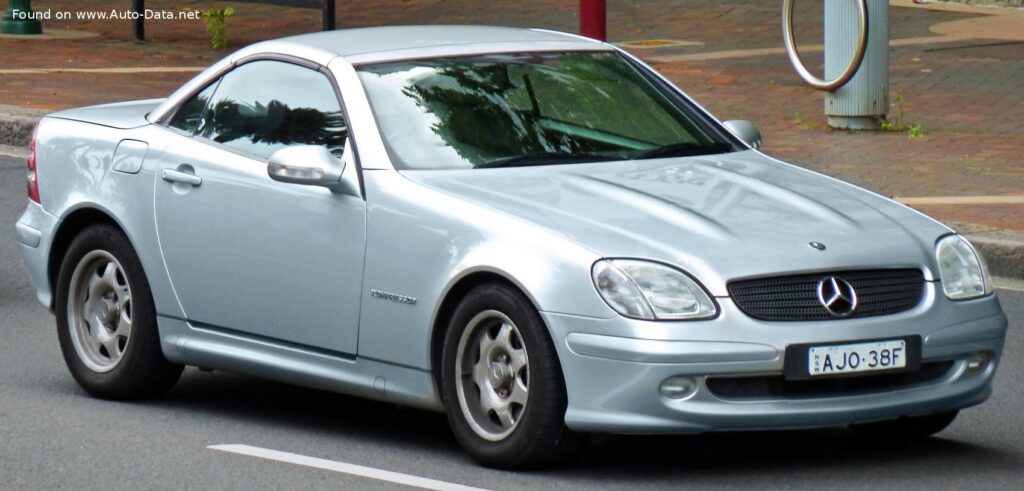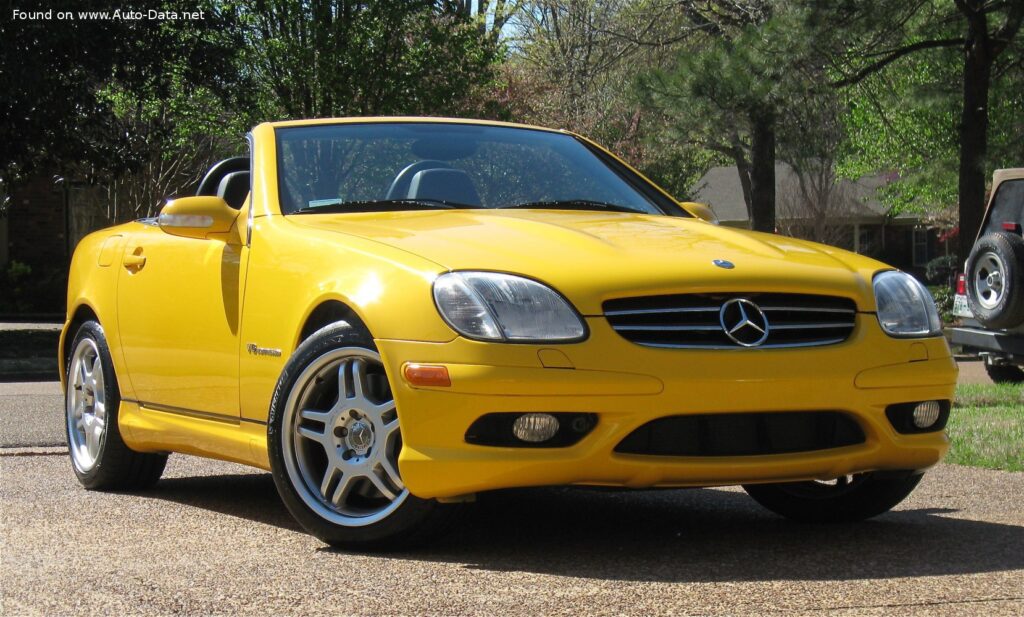
The Mercedes-Benz SLK (R170) marked a significant milestone for the German luxury automaker, introducing a compact, two-seater roadster with a revolutionary retractable hardtop, dubbed the “Vario-Roof.” Launched in 1996, the R170 quickly garnered attention for its blend of open-air exhilaration and coupe-like security and refinement. The model underwent a comprehensive facelift in February 2000, bringing aesthetic updates and mechanical enhancements across its range. Among the updated offerings was the Mercedes-Benz SLK (R170, facelift 2000) SLK 200 Kompressor (163 Hp), a key variant predominantly marketed in European and Asian regions, where it served as a popular entry point into Mercedes-Benz’s roadster lineup, balancing performance with efficiency.
Mercedes-Benz SLK (R170, facelift 2000) SLK 200 Kompressor: An Overview
This facelifted R170 generation, produced from 2000 to 2004, solidified the SLK’s position in the burgeoning premium compact roadster segment. The SLK 200 Kompressor, specifically, showcased Mercedes-Benz’s engineering prowess, utilizing forced induction to extract impressive power from a relatively small displacement engine, making it a compelling choice for drivers seeking a spirited yet economical luxury convertible experience in markets where larger engine variants might incur higher taxes or fuel costs. The SLK represented a departure for Mercedes-Benz, offering a more accessible and youthful alternative to its traditionally larger and more conservative roadster offerings.
Engine & Performance: The Kompressor Advantage
At the core of the Mercedes-Benz SLK (R170, facelift 2000) SLK 200 Kompressor lies a robust 2.0-liter (1998 cm3, or 121.93 cubic inches) inline-four engine, designated by the internal code M 111.958. This powertrain is distinguished by its supercharger and intercooler, a setup that was a hallmark of Mercedes-Benz’s “Kompressor” models during this era. Unlike naturally aspirated engines, the supercharger delivers instant boost, providing a more linear and responsive power delivery across the rev range, mitigating the typical lag associated with turbochargers. This immediate response was particularly beneficial in a roadster application, enhancing the driving experience.
The engine produces a respectable 163 horsepower at 5300 rpm, translating to a power-per-liter figure of 81.6 Hp/l. More notably, it generates 230 Nm (169.64 lb.-ft.) of torque, available broadly between 2500 and 4800 rpm. This wide torque band is crucial for a roadster, ensuring strong acceleration from low speeds and flexible in-gear performance. The power is transmitted to the rear wheels via a precise 6-speed manual transmission, offering an engaging driving experience that appeals to enthusiasts. An automatic transmission was also available, though the manual was favored by driving purists.
In terms of outright performance, the SLK 200 Kompressor is no slouch. It accelerates from 0 to 60 mph in an estimated 7.8 seconds (0-100 km/h in 8.2 seconds) and can reach a top speed of 138.57 mph (223 km/h). These figures placed it competitively within its segment, offering a blend of sportiness and everyday usability. Despite its performance capabilities, the Kompressor engine also demonstrated reasonable fuel efficiency for a luxury sports car of its time. The combined fuel economy (NEDC) stood at 9.6 liters per 100 kilometers, or approximately 24.5 US miles per gallon, with CO2 emissions of 228 g/km, meeting the Euro 4 emission standard.
Design & Features: A Roadster for the Modern Era
The R170 generation of the SLK was a design triumph for Mercedes-Benz, characterized by its sleek lines, short overhangs, and a classic roadster profile. The 2000 facelift subtly refined this successful formula. Exterior updates included redesigned front and rear bumpers, body-colored side skirts, clear-lens taillights, and new wheel designs, giving the car a fresher, more modern appearance while retaining its distinctive identity. The SLK 200 Kompressor, like all R170s, featured the groundbreaking “Vario-Roof,” a fully automatic, electro-hydraulically operated retractable hardtop that could transform the car from a coupe to an open-top roadster in about 25 seconds. This innovation offered the best of both worlds: the security and refinement of a coupe with the joy of open-air motoring, a feature that set it apart from many soft-top competitors.
Inside, the two-seater cabin received enhancements during the facelift, including new trim options, updated upholstery, and a redesigned instrument cluster. Despite its compact dimensions (157.87 inches long, 67.52 inches wide, 50.16 inches tall, with a 94.49-inch wheelbase), the interior was well-appointed, reflecting Mercedes-Benz’s commitment to luxury and ergonomic design. Standard features typically included power windows, air conditioning, and a premium audio system. Safety was also a priority, with the SLK 200 Kompressor equipped with an Anti-lock Braking System (ABS), front and side airbags, and a robust body structure designed to protect occupants in the event of a collision. The car’s chassis featured a double wishbone front suspension and an independent multi-link rear suspension, providing a comfortable ride and precise handling.
Technical Specifications
| Category | Specification |
| General Information | |
| Brand | Mercedes-Benz |
| Model | SLK |
| Generation | SLK (R170, facelift 2000) |
| Type (Engine) | SLK 200 Kompressor (163 Hp) |
| Production Start | February, 2000 |
| Production End | April, 2004 |
| Powertrain Architecture | Internal Combustion Engine |
| Body Type | Roadster |
| Seats | 2 |
| Doors | 2 |
| Performance Specs | |
| Fuel Consumption (Urban) | 13.8 l/100 km (17 US mpg) |
| Fuel Consumption (Extra Urban) | 7.2 l/100 km (32.7 US mpg) |
| Fuel Consumption (Combined) | 9.6 l/100 km (24.5 US mpg) |
| CO2 Emissions (NEDC) | 228 g/km |
| Fuel Type | Petrol (Gasoline) |
| Acceleration 0-60 mph | 7.8 sec |
| Acceleration 0-100 km/h | 8.2 sec |
| Maximum Speed | 138.57 mph (223 km/h) |
| Emission Standard | Euro 4 |
| Weight-to-Power Ratio | 7.9 kg/Hp (126.4 Hp/tonne) |
| Weight-to-Torque Ratio | 5.6 kg/Nm (178.3 Nm/tonne) |
| Engine Specs | |
| Power | 163 Hp @ 5300 rpm |
| Power per Liter | 81.6 Hp/l |
| Torque | 230 Nm (169.64 lb.-ft.) @ 2500-4800 rpm |
| Engine Layout | Front, Longitudinal |
| Engine Model/Code | M 111.958 |
| Engine Displacement | 1998 cm3 (121.93 cu. in.) |
| Number of Cylinders | 4 |
| Engine Configuration | Inline |
| Cylinder Bore | 89.9 mm (3.54 in.) |
| Piston Stroke | 78.7 mm (3.1 in.) |
| Compression Ratio | 9.5:1 |
| Valves per Cylinder | 4 |
| Fuel Injection System | Multi-port manifold injection |
| Engine Aspiration | Supercharger, Intercooler |
| Valvetrain | DOHC |
| Engine Oil Capacity | 5.5 l (5.81 US qt) |
| Coolant Capacity | 8 l (8.45 US qt) |
| Space, Volume and Weights | |
| Kerb Weight | 1290 kg (2843.96 lbs) |
| Maximum Weight | 1625 kg (3582.51 lbs) |
| Maximum Load | 335 kg (738.55 lbs) |
| Trunk (Boot) Space (Min) | 145 l (5.12 cu. ft.) |
| Trunk (Boot) Space (Max) | 348 l (12.29 cu. ft.) |
| Fuel Tank Capacity | 60 l (15.85 US gal) |
| Maximum Roof Load | 30 kg (66.14 lbs) |
| Dimensions | |
| Length | 4010 mm (157.87 in.) |
| Width | 1715 mm (67.52 in.) |
| Height | 1274 mm (50.16 in.) |
| Wheelbase | 2400 mm (94.49 in.) |
| Front Track | 1488 mm (58.58 in.) |
| Rear Track | 1471 mm (57.91 in.) |
| Drag Coefficient (Cd) | 0.33 |
| Minimum Turning Circle | 10.6 m (34.78 ft.) |
| Drivetrain, Brakes and Suspension Specs | |
| Drivetrain Architecture | Rear wheel drive |
| Drive Wheel | Rear wheel drive |
| Number of Gears/Gearbox Type | 6 gears, manual transmission |
| Front Suspension | Coil spring, Double wishbone, Transverse stabilizer |
| Rear Suspension | Independent multi-link suspension, Transverse stabilizer, Coil spring |
| Front Brakes | Ventilated discs |
| Rear Brakes | Disc |
| Assisting Systems | ABS (Anti-lock braking system) |
| Steering Type | Cone worm with recirculation balls |
| Power Steering | Hydraulic Steering |
| Tires Size | 205/60 R 15 91 V |
| Wheel Rims Size | 7 J x 15 H 2 |
Legacy and Market Impact
The Mercedes-Benz SLK (R170) series, including the facelifted SLK 200 Kompressor, left a significant mark on the automotive landscape. It was instrumental in popularizing the retractable hardtop design, a feature that many competitors would later adopt. The R170’s success spurred a new wave of compact luxury roadsters, making open-top motoring more accessible and appealing to a broader audience than traditional soft-top designs.
While the SLK 200 Kompressor variant was not officially sold in the United States, its role in key international markets, particularly in Europe and Asia, was pivotal. It offered a compelling alternative to the larger V6 and V8 engines available in other SLK models, providing a more fuel-efficient and often tax-advantageous option without sacrificing the prestige and driving enjoyment associated with the Mercedes-Benz brand. Its supercharged 2.0-liter engine was praised for its robust torque delivery and respectable performance, making it an ideal daily driver that could also deliver thrills on winding roads.
In its primary markets, the SLK 200 Kompressor competed against rivals such as the BMW Z3 2.0/2.2i, the Audi TT Roadster 1.8T, and to some extent, the Porsche Boxster 2.5/2.7, though the Boxster occupied a slightly higher performance and price bracket. The SLK distinguished itself with its unique Vario-Roof, classic Mercedes-Benz build quality, and a driving experience that blended sportiness with comfort. Its enduring design and the robust engineering of its M111 Kompressor engine have contributed to its status as a modern classic, still sought after by enthusiasts today for its unique character and relatively affordable entry into luxury roadster ownership.
The R170 generation, particularly after its facelift, became a symbol of accessible luxury and innovative engineering. The SLK 200 Kompressor variant perfectly encapsulated this spirit, offering a balanced package that resonated with a wide range of buyers who desired style, performance, and the allure of a Mercedes-Benz roadster.