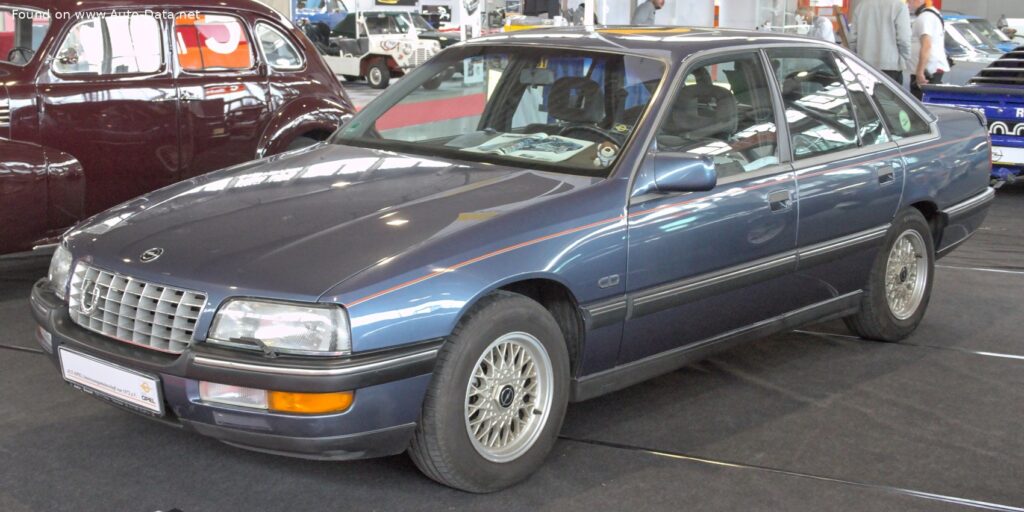
The Opel Senator B 3.0i CAT (177 Hp) represents the second and final generation of Opel’s flagship executive sedan, produced from January 1988 to May 1993. As a prominent offering from the German automaker Opel, a subsidiary of General Motors, the Senator B was designed to compete in the highly competitive European executive car segment, challenging established rivals from BMW and Mercedes-Benz. While never officially sold in the United States, the Senator B embodied the era’s ideal of a comfortable, capable, and refined rear-wheel-drive sedan, blending traditional German engineering with a focus on interior space and value. It was a sophisticated vehicle for its time, offering a compelling blend of performance, luxury, and practicality to European buyers.
Opel Senator B 3.0i CAT: A European Executive Sedan
The Senator B was positioned as Opel’s top-of-the-line offering, intended to provide a spacious and well-equipped alternative to the more prestigious, and often more expensive, German luxury brands. It served as a key model in Opel’s lineup, demonstrating the company’s engineering prowess and design capabilities. The car’s appeal lay in its combination of a powerful engine, comfortable ride, and relatively affordable price point, making it a popular choice for business professionals and families alike.
Engine & Performance
Under the hood, the Opel Senator B 3.0i CAT (177 Hp) was powered by a robust 3.0-liter (2969 cm3 or 181.18 cu. in.) inline-six gasoline engine, designated with the code C30NE. This naturally aspirated unit featured a multi-port manifold injection system, ensuring precise fuel delivery and efficient combustion. A notable aspect of Opel’s engineering at the time was the CIH (Cam-in-head) valvetrain, which, while not as common as OHC designs by the late 1980s, contributed to the engine’s compact packaging and characteristic power delivery.
The engine produced a respectable 177 horsepower at 5800 rpm, delivering ample power for comfortable highway cruising and confident overtaking. Torque output stood at 177.01 lb.-ft. (240 Nm) at a relatively accessible 4200 rpm, providing a strong mid-range pull. Power was sent to the rear wheels via a smooth-shifting 5-speed manual transmission, emphasizing a driver-focused experience. This powertrain architecture was a hallmark of executive sedans of the era, offering balanced handling characteristics.
Performance figures for the Senator B 3.0i CAT were quite competitive for its segment. It could accelerate from 0 to 60 mph in a brisk 8.6 seconds, with a 0 to 100 km/h sprint completed in 9 seconds. The top speed was rated at 139.81 mph (225 km/h), making it a capable performer on the unrestricted sections of the Autobahn. The inclusion of a catalytic converter (CAT) was a crucial step towards meeting evolving European emissions standards, reflecting a growing environmental consciousness in automotive design. Despite its performance, the Senator B also aimed for a reasonable balance in fuel economy. The combined fuel consumption was rated at 24.8 US mpg (9.5 l/100 km). In urban driving, it achieved 15.2 US mpg (15.5 l/100 km), while extra-urban driving saw a more efficient 30.2 US mpg (7.8 l/100 km). With a generous 19.81 US gallon (75-liter) fuel tank, the Senator B offered a substantial cruising range, a desirable trait for long-distance European travel.
Design & Features
The Opel Senator B adopted a more rounded and aerodynamic design compared to its predecessor, reflecting the late 1980s trend towards smoother body lines and improved efficiency. As a 4-door, 5-seat sedan, its dimensions were substantial, measuring 190.75 inches (4845 mm) in length, 69.41 inches (1763 mm) in width, and 57.09 inches (1450 mm) in height. The design, while conservative, achieved an impressive drag coefficient (Cd) of 0.30, contributing to both fuel efficiency and reduced wind noise at higher speeds.
Inside, the Senator B emphasized comfort and refinement, typical of an executive-class vehicle. The cabin was spacious, designed to comfortably accommodate five adults with ample legroom and headroom. The trunk offered a practical minimum capacity of 18.72 cu. ft. (530 liters), which could be expanded to 32.84 cu. ft. (930 liters) with the rear seats folded, making it suitable for family trips or business travel. The chassis featured an independent suspension setup both front and rear, designed to provide a comfortable ride without sacrificing handling stability. The front utilized a McPherson strut system with coil springs and an anti-roll bar, while the rear employed an independent coil spring setup with a transverse stabilizer and trailing arms. This sophisticated suspension ensured predictable road manners and a compliant ride quality, essential for long journeys.
Safety features for the era included ventilated disc brakes at the front and disc brakes at the rear, complemented by an Anti-lock Braking System (ABS), which was a significant safety enhancement for the late 1980s. The hydraulic power steering, utilizing a cone worm with recirculation balls, provided precise control and good feedback to the driver. The Senator B rode on 205/65 R15 tires mounted on 6J x 15 wheel rims, offering a good balance of grip and ride comfort.
Technical Specifications
| Category | Specification |
| Brand | Opel |
| Model | Senator |
| Generation | Senator B |
| Type (Engine) | 3.0i CAT (177 Hp) |
| Production Start | January, 1988 |
| Production End | May, 1993 |
| Body Type | Sedan |
| Seats | 5 |
| Doors | 4 |
| Powertrain Architecture | Internal Combustion engine |
| Fuel Consumption (Urban) | 15.5 l/100 km |
| Fuel Consumption (Extra Urban) | 7.8 l/100 km |
| Fuel Consumption (Combined) | 9.5 l/100 km |
| Fuel Type | Petrol (Gasoline) |
| Acceleration 0-60 mph | 8.6 sec |
| Acceleration 0-100 km/h | 9 sec |
| Maximum Speed | 225 km/h |
| Weight-to-power ratio | 8.1 kg/Hp |
| Engine Specs | |
| Power | 177 Hp @ 5800 rpm |
| Torque | 240 Nm @ 4200 rpm |
| Maximum Engine Speed | 6300 rpm |
| Engine Displacement | 2969 cm3 |
| Number of Cylinders | 6 |
| Engine Configuration | Inline |
| Fuel Injection System | Multi-port manifold injection |
| Valvetrain | CIH |
| Space, Volume & Weights | |
| Kerb Weight | 1435 kg |
| Trunk (Boot) Space – Minimum | 530 l |
| Fuel Tank Capacity | 75 l |
| Length | 4845 mm |
| Width | 1763 mm |
| Height | 1450 mm |
| Drag Coefficient (Cd) | 0.30 |
The Opel Senator B 3.0i CAT (177 Hp) held a significant position as Opel’s flagship model in Europe during its production run. It was designed to offer a compelling alternative to more expensive executive sedans like the BMW 5-Series and Mercedes-Benz E-Class, as well as contemporaries like the Ford Scorpio and Volvo 960. While it may not have achieved the same global recognition or prestige as its premium German rivals, the Senator B carved out a niche for itself by offering a robust, comfortable, and well-equipped package at a more accessible price point.
Its reputation was built on its smooth inline-six engines, comfortable ride quality, and durable construction. The Senator B was often favored by professionals, government officials, and police forces in various European countries, a testament to its reliability and solid build quality. Its rear-wheel-drive architecture appealed to traditionalists and offered a classic driving dynamic that many enthusiasts appreciated.
In retrospect, the Opel Senator B 3.0i CAT (177 Hp) stands as a testament to Opel’s capability in the executive sedan segment, offering a blend of performance, luxury, and practicality that was highly valued in its primary European market. It solidified Opel’s image as a manufacturer capable of producing sophisticated, full-size vehicles that offered compelling value without compromising on quality or driving experience. Today, well-preserved examples are appreciated by collectors and enthusiasts for their classic German engineering and comfortable, understated elegance.