
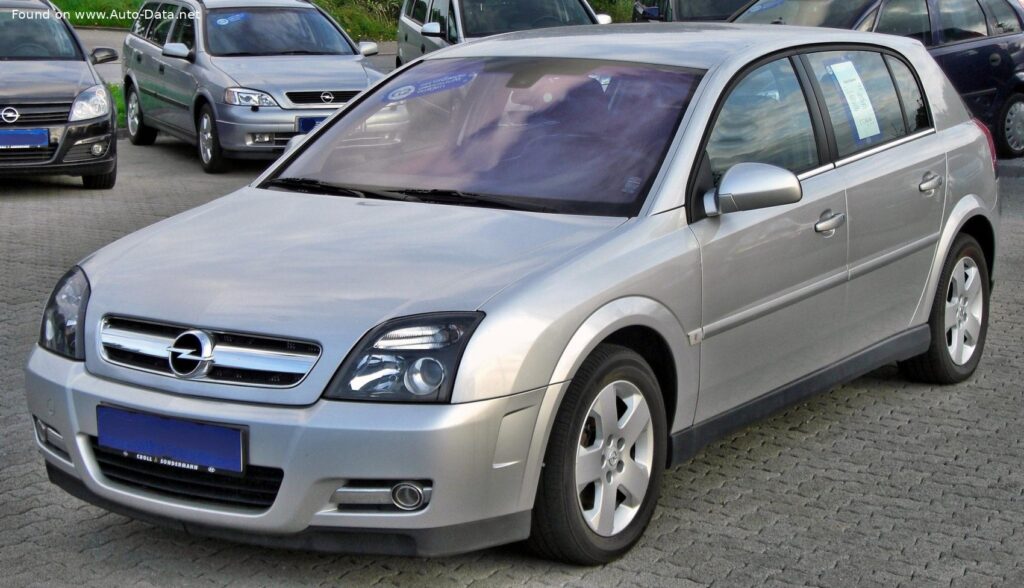
The Opel Signum 1.8i 16V ECOTEC represents a distinctive chapter in European automotive design, launched in May 2003 as a unique proposition in the large family car segment. Developed by the German automaker Opel, a subsidiary of General Motors at the time, the Signum was conceived as a premium-oriented, five-door hatchback that aimed to blend the spaciousness and versatility of a wagon with the comfort and executive appeal of a sedan. Positioned above the conventional Opel Vectra, with which it shared its platform, the Signum carved out a niche market, prioritizing rear passenger comfort and modularity. It was not marketed in the United States, focusing instead on European markets where its innovative concept sought to attract buyers looking for something beyond the traditional sedan or estate car.
During its production run from May 2003 to October 2005, the Signum, particularly the 1.8i 16V ECOTEC variant, was designed to offer a practical yet refined driving experience. This model, powered by Opel’s well-regarded ECOTEC engine family, emphasized efficiency and smooth power delivery, making it a sensible choice for European families and business users. Its unique body style and focus on interior flexibility set it apart from direct competitors, attempting to create a new sub-segment within the D-segment of the European market. The Signum was an ambitious project by Opel to offer a vehicle that combined the best attributes of several vehicle types, catering to a sophisticated consumer base that valued space, comfort, and intelligent design.
The Opel Signum: A Unique Approach to the D-Segment
The Opel Signum was an attempt to redefine the expectations of the European driver in the mid-size, or D-segment. While vehicles like the Ford Mondeo, Volkswagen Passat, and Peugeot 407 offered traditional sedan and wagon configurations, the Signum aimed for a more versatile and premium experience. It wasn’t simply a hatchback; Opel marketed it as a “lifestyle station wagon,” emphasizing its flexible interior and focus on passenger well-being. This positioning was a deliberate move to attract buyers who found conventional offerings too mundane or lacking in sophistication. The Signum’s design and features were geared towards those who appreciated a blend of practicality and a more upscale driving environment.
Engine & Performance
At the heart of the Opel Signum 1.8i 16V ECOTEC (122 Hp) lies the Z18XE engine, a naturally aspirated 1.8-liter (1796 cubic centimeters or 109.6 cubic inches) inline-four gasoline unit. This engine, a staple of Opel’s ECOTEC family, was engineered for a balance of performance, fuel economy, and reliability, characteristic of European family vehicles of the early 2000s. The ECOTEC designation signified Opel’s commitment to efficient combustion technology, featuring multi-point fuel injection and a double overhead camshaft (DOHC) configuration with four valves per cylinder. This design allowed for optimized airflow and efficient combustion, contributing to the engine’s relatively smooth power delivery.
The Z18XE engine produced 122 horsepower (91 kW) at 5,600 rpm and 170 Nm (125 lb-ft) of torque at 3,800 rpm. Power was typically delivered to the front wheels through a five-speed manual transmission, although a five-speed automatic transmission was also available as an option. Performance figures were modest by modern standards, with a 0-60 mph (0-97 km/h) time of around 10.8 seconds and a top speed of approximately 127 mph (204 km/h). However, the Signum wasn’t designed for outright speed; its focus was on providing a comfortable and refined driving experience, with sufficient power for everyday driving and highway cruising. The engine’s emphasis on fuel efficiency was also a key selling point, particularly in a European market with high fuel prices.
Design & Features
The Opel Signum’s most striking feature was its unconventional body style. While technically a five-door hatchback, its long wheelbase and sloping roofline gave it a more coupe-like appearance. This design contributed to a spacious interior, particularly for rear passengers. Opel emphasized the Signum’s “Travel Assist” system, which allowed for significant customization of the rear seating area. The rear seats could be folded flat, slid forward or backward, or even completely removed to create a large, van-like cargo space. This modularity was a key differentiator for the Signum, appealing to buyers who needed a versatile vehicle for both passengers and cargo.
Inside, the Signum offered a relatively well-equipped interior for its time. Standard features included air conditioning, power windows, central locking, and an audio system. Higher trim levels added features such as leather upholstery, automatic climate control, and a CD changer. Safety features included dual front airbags, side airbags, and anti-lock brakes (ABS). While not groundbreaking by today’s standards, these features were competitive for the D-segment in the early 2000s. The Signum’s dashboard design was clean and functional, with a focus on ergonomics and ease of use. The overall interior ambiance aimed for a premium feel, reflecting the Signum’s positioning as a more upscale alternative to conventional family cars.
The Signum’s suspension was tuned for comfort, providing a smooth and controlled ride. The steering was precise and responsive, offering a good balance between feedback and ease of use. While not a particularly sporty vehicle, the Signum was enjoyable to drive, particularly on long journeys. The car’s relatively quiet cabin and comfortable seats further enhanced the driving experience.
Technical Specifications
| Engine Type | Z18XE, Inline-4, Naturally Aspirated |
| Engine Displacement | 1.8 Liters (1796 cc / 109.6 cu in) |
| Horsepower | 122 HP (91 kW) @ 5,600 rpm |
| Torque | 170 Nm (125 lb-ft) @ 3,800 rpm |
| Fuel System | Multi-Point Fuel Injection |
| Valvetrain | DOHC, 4 Valves per Cylinder |
| Transmission | 5-Speed Manual or 5-Speed Automatic |
| Drivetrain | Front-Wheel Drive |
| Curb Weight | Approximately 1,480 kg (3,263 lbs) |
| Top Speed | Approximately 204 km/h (127 mph) |
| 0-60 mph | Approximately 10.8 seconds |
| Fuel Economy (Combined) | Approximately 7.5 – 8.5 L/100km (31-33 mpg) |
| Body Style | 5-Door Hatchback |
| Production Years | 2003-2005 |
Despite its innovative concept and appealing features, the Opel Signum ultimately failed to achieve significant sales success. Its higher price point compared to conventional D-segment vehicles, combined with its somewhat polarizing styling, limited its appeal to a niche market. The Signum was discontinued in October 2005, leaving behind a legacy as an ambitious but ultimately unsuccessful attempt to redefine the European family car. However, it remains a noteworthy example of Opel’s willingness to experiment with new designs and concepts, and its focus on interior flexibility and passenger comfort foreshadowed trends that would become more prevalent in later vehicle designs.
