
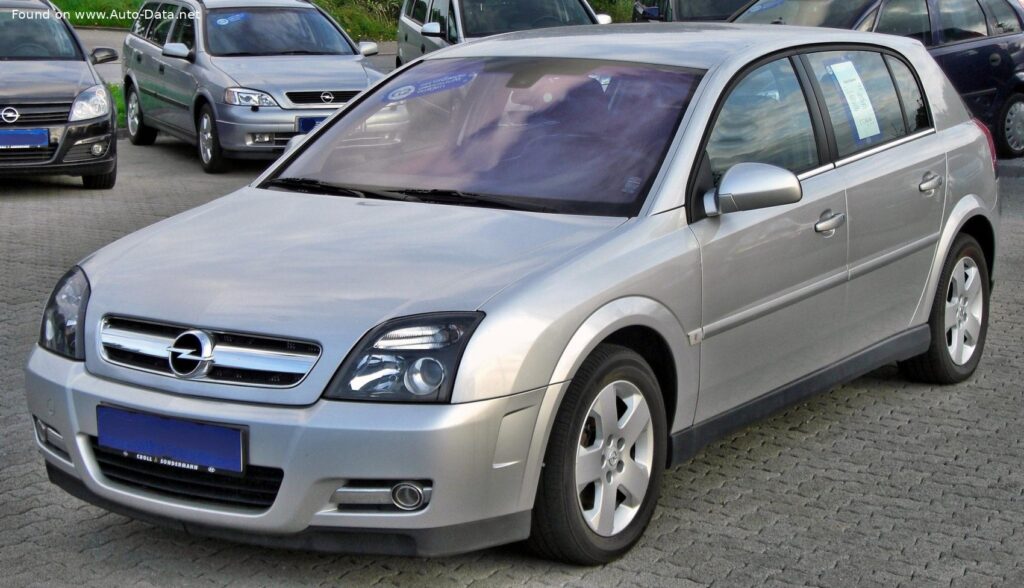
The Opel Signum 1.9 CDTI Automatic represents a distinctive and ambitious effort by the German automaker Opel, then part of General Motors Europe, to establish a new niche within the competitive European market. Launched in 2003 and built upon the extended platform of the Opel Vectra C, the Signum aimed to combine the spaciousness and practicality of a station wagon with the comfort and refinement expected of a premium sedan. This detailed analysis focuses on the Opel Signum 1.9 CDTI (150 Hp) Automatic variant, a popular diesel powertrain option produced from May 2004 to 2005. Designed primarily for European consumers – particularly business professionals and families prioritizing versatility and comfort – the Signum was never officially sold in the United States, making it a fascinating example of European automotive engineering and market strategy.
Opel Signum 1.9 CDTI: A Unique European Proposition
The Signum’s concept was somewhat ahead of its time, proposing a vehicle offering greater interior flexibility than traditional sedans without fully embracing the utility vehicle aesthetic of a minivan or SUV. It was positioned above the standard Vectra hatchback, targeting customers who might otherwise consider vehicles like the Volkswagen Passat Variant (wagon) or entry-level premium offerings. The 1.9 CDTI engine, a robust and efficient diesel, coupled with an automatic transmission, underscored its appeal as a comfortable and economical long-distance cruiser, well-suited to the demands of European highways.
Engine & Performance
The Opel Signum 1.9 CDTI Automatic is powered by a sophisticated 1.9-liter (1910 cm3 or 116.56 cu. in.) inline four-cylinder diesel engine, designated with the code Z19DTH. This engine, a product of a joint venture between General Motors and Fiat Powertrain Technologies (FPT), was highly regarded for its strong performance and excellent fuel economy. It utilizes a common rail direct fuel injection system, turbocharger, and intercooler, delivering 150 horsepower at 4000 rpm. Impressively for a diesel, it produces 236.02 lb-ft (320 Nm) of torque at a low 2000 rpm, providing strong pulling power and effortless acceleration, particularly beneficial for highway overtaking and carrying loads.
The engine’s architecture features a double overhead camshaft (DOHC) valvetrain with four valves per cylinder, contributing to efficient combustion and power delivery. A compression ratio of 17.5:1 optimizes diesel fuel efficiency. The power-to-weight ratio for this variant is 95.8 Hp per tonne (10.4 kg/Hp), while the torque-to-weight ratio is 204.5 Nm per tonne (4.9 kg/Nm), indicating a well-balanced powertrain for its size and intended use.
A smooth-shifting 6-speed automatic transmission is mated to this potent diesel engine, engineered to provide a comfortable and refined driving experience, minimizing driver fatigue on long journeys while efficiently managing the engine’s torque output. Performance figures reflect its competence: 0 to 60 mph in 10.2 seconds (0-100 km/h in 10.7 seconds) and a maximum speed of 127.38 mph (205 km/h).
Fuel efficiency was a key selling point. The Signum 1.9 CDTI Automatic achieved an impressive 24 US mpg (9.8 l/100 km) in urban driving and an even better 41.3 US mpg (5.7 l/100 km) on the extra-urban cycle. These figures were highly competitive for a vehicle of its size and class in the mid-2000s, offering significant cost savings for high-mileage drivers in Europe where diesel fuel was prevalent and often favorably taxed.
Design & Features
The Opel Signum’s design was truly distinctive, diverging from traditional hatchback or sedan formulas. Classified as a 5-door hatchback, its extended wheelbase (111.42 inches or 2830 mm) – shared with the long-wheelbase Vectra Caravan (wagon) – allowed for exceptional rear passenger space, a primary design focus. The overall dimensions are: length 182.52 inches (4636 mm), width 70.79 inches (1798 mm), and height 57.48 inches (1460 mm). Its profile features an elongated, coupe-like roofline that gently slopes towards a practical tailgate, providing good access to the cargo area. The drag coefficient (Cd) of 0.33 was respectable for its class, contributing to highway efficiency and reduced wind noise.
The interior showcased the innovative “FlexSpace” concept. Unlike a conventional sedan, the rear cabin offered two individual full-size seats that could slide forwards and backwards by 5.1 inches (130 mm), recline, and fold flat independently. A third, narrower central seat could also fold down to reveal a multi-functional storage and armrest unit, complete with cupholders and an optional integrated refrigerator. This level of flexibility was unparalleled in its segment, providing a first-class experience for rear passengers, ideal for executive transport or family road trips.
Standard features included hydraulic power steering (rack and pinion type), front-wheel drive, and a robust suspension setup with coil springs at both the front and rear. Braking was handled by ventilated discs at the front and solid discs at the rear, complemented by an Anti-lock Braking System (ABS) for enhanced safety. The car rode on 215/55 R16 tires mounted on 6.5J x 16-inch wheel rims, providing a comfortable and stable ride.
Cargo capacity was also impressive for its body style. With the rear seats in their standard position, the trunk offered 12.89 cu. ft. (365 liters) of space. Folding the rear seats expanded this to 49.79 cu. ft. (1410 liters), rivaling many traditional station wagons. This adaptability underscored the Signum’s commitment to practicality and versatility.
Technical Specifications
| Category | Specification |
| Brand | Opel |
| Model | Signum |
| Generation | Signum |
| Type (Engine) | 1.9 CDTI (150 Hp) Automatic |
| Start of Production | May, 2004 |
| End of Production | 2005 |
| Powertrain Architecture | Internal Combustion engine |
| Body Type | Hatchback |
| Seats | 5 |
| Doors | 5 |
| Fuel Consumption (Urban) | 9.8 l/100 km |
| Fuel Consumption (Extra Urban) | 5.7 l/100 km |
| Fuel Type | Diesel |
| Acceleration 0-60 mph | 10.2 sec |
| Acceleration 0-100 km/h | 10.7 sec |
| Maximum Speed | 205 km/h |
| Weight-to-Power Ratio | 10.4 kg/Hp |
| Weight-to-Torque Ratio | 4.9 kg/Nm |
| Power | 150 Hp @ 4000 rpm |
| Torque | 320 Nm @ 2000 rpm |
| Engine Displacement | 1910 cm3 |
| Number of Cylinders | 4 |
| Compression Ratio | 17.5:1 |
| Kerb Weight | 1565 kg |
| Trunk (boot) Space – Minimum | 365 l |
| Trunk (boot) Space – Maximum | 1410 l |
| Length | 4636 mm |
| Width | 1798 mm |
| Height | 1460 mm |
| Wheelbase | 2830 mm |
The Opel Signum, particularly the 1.9 CDTI Automatic variant, holds a unique place in Opel’s history. It was a bold attempt to create a new market segment, focusing on executive comfort and unparalleled interior flexibility. Despite its innovative design and practical advantages, the Signum struggled to achieve widespread commercial success. Its unconventional styling and niche positioning meant many buyers were unsure where to place it within the established automotive hierarchy. While it may not have been a sales blockbuster, its legacy lies in its contribution to the ongoing quest for adaptable and user-centric vehicle interiors, influencing subsequent designs that prioritize modularity and space utilization. For those in Europe seeking a comfortable, efficient, and uniquely practical executive car, the Signum 1.9 CDTI Automatic offered a compelling, if unconventional, choice.
