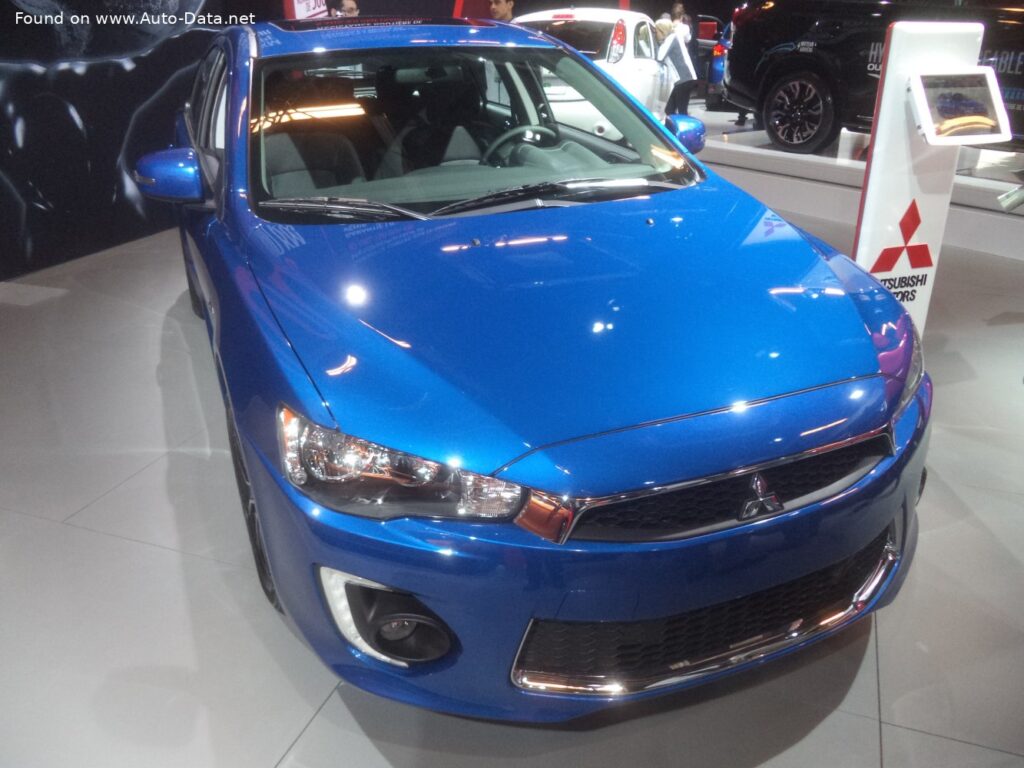
The Mitsubishi Lancer Sportback IX (facelift 2015) represents a crucial iteration of Mitsubishi’s long-standing compact car nameplate, specifically tailored for markets outside of North America, where the Lancer sedan continued its run. This facelifted model, produced from 2015 to 2017, maintained the Lancer’s reputation for reliability and value while offering the enhanced practicality of a five-door hatchback body style. Positioned in the highly competitive compact segment, the Sportback aimed to appeal to buyers seeking a versatile, fuel-efficient, and well-equipped vehicle for daily commuting and family duties. Unlike its sedan counterpart, which had a more significant presence in the United States, the Sportback variant found its stride in European, Asian, and Oceanic markets, where hatchbacks are a dominant force in the compact class. The 1.8-liter engine paired with a Continuously Variable Transmission (CVT) underscored a focus on smooth power delivery and optimized fuel economy, aligning with contemporary demands for efficiency and comfort in urban and highway driving.
Mitsubishi Lancer Sportback IX (facelift 2015): An Overview
The Lancer Sportback IX (facelift 2015) is a member of the ninth generation of the Mitsubishi Lancer, a model with a history stretching back to 1973. While the Lancer sedan enjoyed a longer lifespan in the North American market, the Sportback – a five-door hatchback version – was primarily developed and sold in regions where this body style is preferred. The 2015 facelift brought subtle styling updates and continued Mitsubishi’s commitment to providing a practical and affordable vehicle in the compact segment. It competed directly with popular European and Asian hatchbacks, offering a blend of efficiency, reliability, and a reasonable level of equipment.
Engine & Performance
Under the hood of the Mitsubishi Lancer Sportback IX (facelift 2015) lies a 1.8-liter (1798 cm3 or 109.72 cu. in.) naturally aspirated inline-four engine, designated the 4B10. This engine was designed to balance power output with fuel efficiency. It produces a peak of 140 horsepower at 6000 rpm, achieving a power-per-liter ratio of 77.9 HP/l. Torque is rated at 129.81 lb.-ft. (176 Nm) at 4200 rpm, providing sufficient pulling power for everyday driving. The engine features a single overhead camshaft (SOHC) valvetrain with four valves per cylinder and utilizes a multi-port fuel injection system for consistent performance.
Power is delivered to the front wheels through a Continuously Variable Transmission (CVT) designed to simulate six gears. This transmission is a key component in maximizing fuel economy by allowing the engine to operate at its most efficient rpm range. The Lancer Sportback 1.8 CVT achieves a combined fuel economy of 35.6 US mpg (6.6 l/100 km), with urban consumption at 27.4 US mpg (8.6 l/100 km) and extra-urban at 43.6 US mpg (5.4 l/100 km). It meets Euro 6 emission standards, with CO2 emissions of 153 g/km. Performance figures include a 0 to 60 mph acceleration time of 11.3 seconds (0-100 km/h in 11.9 seconds) and a maximum speed of 113.71 mph (183 km/h). The vehicle’s weight-to-power ratio is 9.8 kg/Hp, or 101.8 Hp/tonne.
Design & Features
The Mitsubishi Lancer Sportback IX (facelift 2015) retains the core design elements of the ninth-generation Lancer, with the facelift incorporating refinements to the front fascia, grille, bumpers, and lighting. Its five-door hatchback configuration provides a practical alternative to the sedan, offering increased cargo versatility. The vehicle’s dimensions – a length of 182.68 inches, a width of 69.29 inches (79.88 – 80.47 inches including mirrors), and a height of 59.25 inches – place it firmly within the compact segment, ensuring maneuverability in urban environments.
The Sportback’s 103.74-inch wheelbase contributes to a stable ride and a spacious cabin for five passengers. The hatchback body style provides a flexible cargo area, offering 12.15 cubic feet (344 liters) of space with the rear seats up, expandable to 47.64 cubic feet (1349 liters) with the rear seats folded down. A 15.59 US gallon (59 liters) fuel tank provides a good driving range. The chassis features an independent McPherson strut front suspension with coil springs and an anti-roll bar, and an independent multi-link rear suspension with a stabilizer, enhancing ride quality and handling. Ventilated front discs and solid rear discs provide braking power, assisted by an Anti-lock Braking System (ABS). Electric power-assisted rack and pinion steering offers ease of maneuverability, and the vehicle is equipped with 205/60 R16 tires on 6.5J X 16 wheel rims.
Technical Specifications
| Category | Specification |
| General Information | |
| Brand | Mitsubishi |
| Model | Lancer |
| Generation | Lancer Sportback IX (facelift 2015) |
| Type (Engine) | 1.8 (140 Hp) CVT |
| Start of Production | 2015 |
| End of Production | 2017 |
| Powertrain Architecture | Internal Combustion engine |
| Body type | Hatchback |
| Seats | 5 |
| Doors | 5 |
| Performance Specs | |
| Fuel consumption (economy) – urban | 8.6 l/100 km (27.4 US mpg) |
| Fuel consumption (economy) – extra urban | 5.4 l/100 km (43.6 US mpg) |
| Fuel consumption (economy) – combined | 6.6 l/100 km (35.6 US mpg) |
| CO2 emissions | 153 g/km |
| Fuel Type | Petrol (Gasoline) |
| Acceleration 0 – 60 mph | 11.3 sec |
| Acceleration 0 – 100 km/h | 11.9 sec |
| Maximum speed | 183 km/h (113.71 mph) |
| Emission standard | Euro 6 |
| Weight-to-power ratio | 9.8 kg/Hp (101.8 Hp/tonne) |
| Weight-to-torque ratio | 7.8 kg/Nm (128 Nm/tonne) |
| Engine Specs | |
| Power | 140 Hp @ 6000 rpm |
| Power per liter | 77.9 Hp/l |
| Torque | 176 Nm @ 4200 rpm (129.81 lb.-ft. @ 4200 rpm) |
| Engine layout | Front, Transverse |
| Engine Model/Code | 4B10 |
| Engine displacement | 1798 cm3 (1.8 l / 109.72 cu. in.) |
| Number of cylinders | 4 |
| Engine configuration | Inline |
| Cylinder Bore | 86 mm (3.39 in.) |
| Piston Stroke | 77.4 mm (3.05 in.) |
| Compression ratio | 10.7:1 |
| Number of valves per cylinder | 4 |
| Fuel injection system | Multi-port manifold injection |
| Engine aspiration | Naturally aspirated engine |
| Valvetrain | SOHC |
| Engine oil capacity | 4.3 l (4.54 US qt) |
| Coolant | 7 l (7.4 US qt) |
| Space, Volume and Weights | |
| Kerb Weight | 1375 kg (3031.36 lbs.) |
| Max. weight | 1900 kg (4188.78 lbs.) |
| Max load | 525 kg (1157.43 lbs.) |
| Trunk (boot) space – minimum | 344 l (12.15 cu. ft.) |
| Trunk (boot) space – maximum | 1349 l (47.64 cu. ft.) |
| Fuel tank capacity | 59 l (15.59 US gal) |
| Dimensions | |
| Length | 4640 mm (182.68 in.) |
| Width | 1760 mm (69.29 in.) |
| Width including mirrors | 2029-2044 mm (79.88 – 80.47 in.) |
| Height | 1505 mm (59.25 in.) |
| Wheelbase | 2635 mm (103.74 in.) |
Legacy and Market Impact
The Mitsubishi Lancer Sportback IX (facelift 2015) played a significant role in Mitsubishi’s product lineup during the mid-2010s, particularly in markets where compact hatchbacks were highly favored. While the Lancer nameplate has a rich history globally, including the iconic Evolution models, the Sportback variant focused on delivering practical, reliable, and efficient transportation for a broader audience. It was a direct competitor to established players in its segment, such as the Volkswagen Golf, Ford Focus, Mazda 3, Honda Civic hatchback, and Toyota Auris (Corolla hatchback). In these markets, the Sportback distinguished itself with its robust build quality, competitive pricing, and Mitsubishi’s reputation for durability.
The Sportback’s appeal lay in its blend of sensible engineering and versatile packaging. The 1.8-liter engine with the CVT offered a smooth and economical driving experience, ideal for the stop-and-go traffic of urban centers as well as comfortable highway cruising. Its spacious and adaptable interior, coupled with a generous cargo volume, made it a practical choice for small families or individuals requiring flexibility for hobbies and errands. The facelift ensured the Lancer Sportback remained visually current, featuring modern styling cues that helped it maintain relevance in a rapidly evolving design landscape.
However, as the automotive industry began its shift towards SUVs and crossovers, the demand for traditional compact sedans and hatchbacks, particularly from non-premium brands, started to wane in many regions. Mitsubishi, in particular, began to pivot its global strategy towards SUVs and electrified vehicles, eventually leading to the discontinuation of the Lancer Sportback and the Lancer nameplate altogether after the 2017 model year. Despite its eventual retirement, the Lancer Sportback IX (facelift 2015) stands as a testament to Mitsubishi’s efforts to offer a well-rounded and dependable compact vehicle, embodying the brand’s core values of reliability and practicality during a transitional period for both the company and the automotive market.