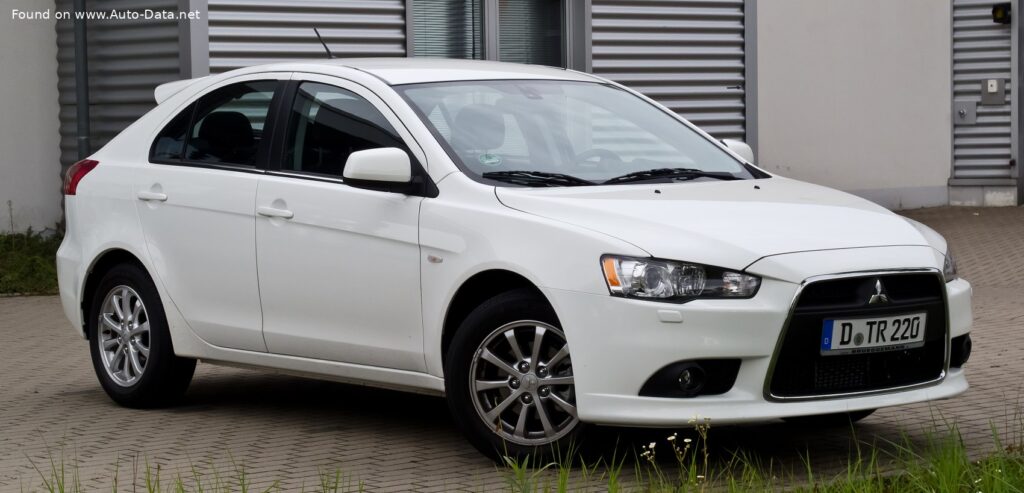
The Mitsubishi Lancer Sportback IX (GS44S) represents a significant evolution in Mitsubishi’s venerable Lancer lineage, specifically designed to cater to markets outside of North America where compact hatchbacks hold considerable sway. Introduced in June 2008 and produced until May 2010, this iteration of the Lancer Sportback was a direct response to the growing demand for versatile, family-friendly vehicles that combined the practicality of a hatchback with the dynamic styling cues of its sedan counterpart. While the Lancer sedan, particularly its Evolution performance variant, enjoyed a strong following in the United States, the Sportback model, especially with the 1.5-liter engine, was primarily targeted at European and Asian consumers seeking efficiency, maneuverability, and cargo flexibility in the competitive C-segment. This article delves into the specifics of the Mitsubishi Lancer Sportback IX (GS44S) 1.5 (109 Hp), examining its powertrain, design, features, and its impact on the global automotive landscape.
Engine & Performance of the Mitsubishi Lancer Sportback IX (GS44S)
Under the hood, the Mitsubishi Lancer Sportback IX (GS44S) 1.5 (109 Hp) was powered by Mitsubishi’s 4A91 engine, a naturally aspirated inline-four cylinder petrol (gasoline) unit. This powerplant, with an engine displacement of 1499 cubic centimeters (91.47 cubic inches), was engineered for a balance of everyday performance and fuel economy, fitting perfectly within the parameters expected of a compact family car in its target markets. It delivered a respectable 109 horsepower at 6000 revolutions per minute (rpm), making it capable enough for urban commutes and comfortable highway cruising.
Torque figures stood at 145 Newton-meters (approximately 107 lb.-ft.) at 4000 rpm, providing adequate pulling power for its class. The engine featured a DOHC (Double Overhead Camshaft) valvetrain with 4 valves per cylinder, a common configuration for maximizing efficiency and power output in small displacement engines. Fuel was delivered via a multi-port manifold injection system, ensuring precise fuel metering and combustion. With a compression ratio of 10.5:1, the engine demonstrated a focus on efficiency without resorting to forced induction.
Power was sent to the front wheels through a standard 5-speed manual transmission, a choice that emphasized driver engagement and allowed for optimal control over the engine’s power band. This drivetrain architecture, combined with the modest power output, contributed to the vehicle’s commendable fuel economy figures. The Sportback 1.5 (109 Hp) achieved an urban fuel economy of approximately 28.3 US miles per gallon (8.3 l/100 km), while extra-urban driving saw figures climb to an impressive 42 US miles per gallon (5.6 l/100 km). The combined cycle averaged around 35.6 US miles per gallon (6.6 l/100 km). These numbers positioned it as a cost-effective option for daily drivers. The car’s maximum speed was rated at 182 kilometers per hour (approximately 113.09 mph), and it complied with the Euro 4 emission standard, reflecting its environmental considerations for the time.
Design & Features of the Mitsubishi Lancer Sportback IX (GS44S)
The Lancer Sportback IX (GS44S) adopted a sleek and modern design, distinguishing itself from its sedan sibling primarily through its rear-end treatment. As a 5-door hatchback, it offered enhanced practicality and cargo versatility. The exterior design shared the aggressive, “jet fighter” grille aesthetic prevalent across the Lancer lineup of the era, giving it a sporty and contemporary appeal. Its dimensions—a length of 180.51 inches, a width of 69.29 inches, and a height of 59.65 inches—placed it firmly in the compact segment, making it easy to maneuver in crowded urban environments. The wheelbase of 103.74 inches contributed to a stable ride and adequate interior space.
Inside, the Sportback was designed to comfortably accommodate five occupants. The primary draw of the Sportback body style was its flexible cargo capacity. With the rear seats in place, it offered a minimum trunk space of 12.15 cubic feet (344 liters), which could be expanded significantly to 47.64 cubic feet (1349 liters) by folding down the rear seats. This made it a highly practical choice for families or individuals needing to transport larger items.
In terms of chassis and handling, the Sportback featured an independent McPherson strut suspension at the front and an independent multi-link suspension at the rear. This setup aimed to provide a comfortable ride while maintaining competent handling dynamics. Braking was handled by ventilated discs at the front and solid discs at the rear, augmented by an Anti-lock Braking System (ABS) for enhanced safety. The steering system utilized a hydraulic rack and pinion setup, offering direct feedback to the driver. The vehicle was equipped with 205/60 R16 tires mounted on 6.5JJ x 16 wheel rims, contributing to both ride comfort and grip.
Mitsubishi Lancer Sportback IX (GS44S): Technical Specifications
| Category | Specification |
| Brand | Mitsubishi |
| Model | Lancer |
| Generation | Lancer Sportback IX (GS44S) |
| Type (Engine) | 1.5 (109 Hp) |
| Production Start | June, 2008 |
| Production End | May, 2010 |
| Powertrain Architecture | Internal Combustion engine |
| Body type | Hatchback |
| Seats | 5 |
| Doors | 5 |
| Performance Specs | |
| Fuel consumption (economy) – urban | 8.3 l/100 km (28.3 US mpg) |
| Fuel consumption (economy) – extra urban | 5.6 l/100 km (42 US mpg) |
| Fuel consumption (economy) – combined | 6.6 l/100 km (35.6 US mpg) |
| Fuel Type | Petrol (Gasoline) |
| Maximum speed | 182 km/h (113.09 mph) |
| Emission standard | Euro 4 |
| Engine Specs | |
| Power | 109 Hp @ 6000 rpm |
| Power per liter | 72.7 Hp/l |
| Torque | 145 Nm @ 4000 rpm (106.95 lb.-ft. @ 4000 rpm) |
| Engine layout | Front, Transverse |
| Engine Model/Code | 4A91 |
| Engine displacement | 1499 cm3 (91.47 cu. in.) |
| Number of cylinders | 4 |
| Engine configuration | Inline |
| Cylinder Bore | 75 mm (2.95 in.) |
| Piston Stroke | 84.8 mm (3.34 in.) |
| Compression ratio | 10.5:1 |
| Number of valves per cylinder | 4 |
| Fuel injection system | Multi-port manifold injection |
| Engine aspiration | Naturally aspirated engine |
| Valvetrain | DOHC |
| Engine oil capacity | 4.2 l (4.44 US qt) |
| Coolant | 6 l (6.34 US qt) |
| Space, Volume and Weights | |
| Trunk (boot) space – minimum | 344 l (12.15 cu. ft.) |
| Trunk (boot) space – maximum | 1349 l (47.64 cu. ft.) |
| Fuel tank capacity | 59 l (15.59 US gal) |
| Dimensions | |
| Length | 4585 mm (180.51 in.) |
| Width | 1760 mm (69.29 in.) |
| Height | 1515 mm (59.65 in.) |
| Wheelbase | 2635 mm (103.74 in.) |
| Front track | 1530 mm (60.24 in.) |
| Rear (Back) track | 1530 mm (60.24 in.) |
| Minimum turning circle (turning diameter) | 10 m (32.81 ft.) |
| Drivetrain, Brakes and Suspension Specs | |
| Drivetrain Architecture | Front wheel drive, Internal Combustion engine |
| Drive wheel | Front wheel drive |
| Number of gears and type of gearbox | 5 gears, manual transmission |
| Front suspension | Independent type McPherson |
| Rear suspension | Independent multi-link suspension |
| Front brakes | Ventilated discs |
| Rear brakes | Disc |
| Assisting systems | ABS (Anti-lock braking system) |
| Steering type | Steering rack and pinion |
| Power steering | Hydraulic Steering |
| Tires size | 205/60 R16 |
| Wheel rims size | 6.5JJ x 16 |
Legacy and Market Impact
The Mitsubishi Lancer, in its various forms, has always been a significant player in the global compact car market. The IX generation, launched in 2007 (with the Sportback following in 2008), continued this legacy, offering a blend of reliability, sporty aesthetics, and practical utility. While the sedan garnered more attention in the North American market, often associated with its rally-bred Evolution variant, the Sportback was Mitsubishi’s strategic move to capture market share in regions like Europe and Asia, where the hatchback body style is overwhelmingly popular.
In its primary markets, the Lancer Sportback 1.5 (109 Hp) competed against a formidable array of established compact hatchbacks, including the Volkswagen Golf, Ford Focus, Opel Astra, Mazda 3, Honda Civic hatchback, and Toyota Auris (Corolla hatchback). Against these rivals, the Lancer Sportback aimed to differentiate itself with its distinctive styling, robust build quality, and Mitsubishi’s reputation for reliability. While it might not have offered the same level of interior refinement as some European competitors, its straightforward mechanicals and competitive pricing made it an attractive option for budget-conscious buyers.
The Sportback’s versatility, particularly its generous cargo capacity when the rear seats were folded, was a key selling point. It appealed to young families and individuals with active lifestyles who needed more space than a traditional sedan could offer, without the larger footprint or higher running costs of an SUV. Its Euro 4 emission standard compliance and respectable fuel economy figures were also crucial in markets increasingly focused on environmental responsibility and running costs.
The production run for this specific 1.5-liter Sportback model, from June 2008 to May 2010, was relatively short, indicating a targeted market strategy or perhaps a quick evolution within Mitsubishi’s product planning. Despite its niche positioning in the broader Lancer family, the Mitsubishi Lancer Sportback IX (GS44S) 1.5 (109 Hp) played an important role in Mitsubishi’s global portfolio, demonstrating the brand’s commitment to offering practical and efficient vehicles tailored to diverse international consumer demands. It remains a testament to Mitsubishi’s engineering philosophy of creating durable and functional automobiles for everyday use.