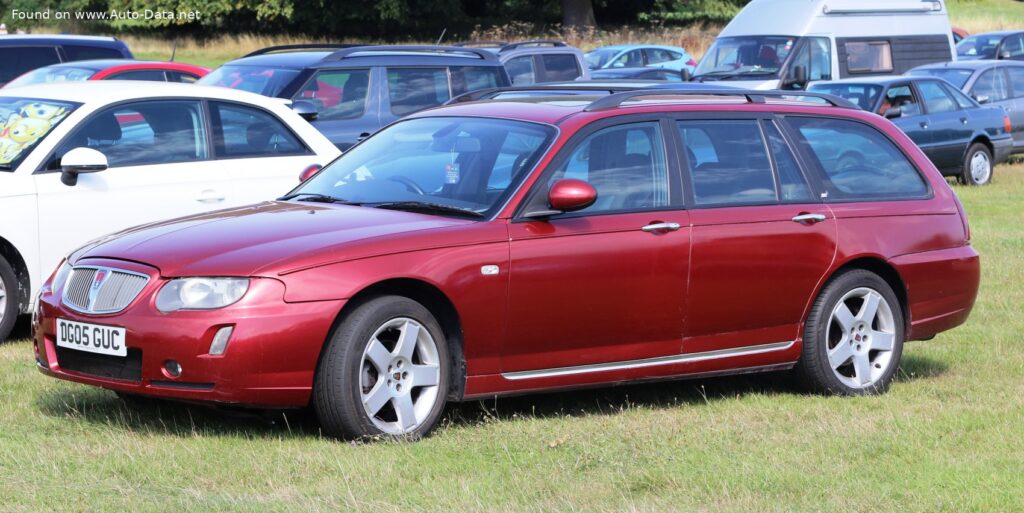
The Rover 75 Tourer (facelift 2004) 1.8 T (150 Hp) Automatic represents a fascinating, if ultimately poignant, chapter in British automotive history. Introduced as part of a mid-life refresh in 2004, this station wagon (or “estate” as it’s known in Europe) variant of the Rover 75 aimed to modernize the model’s appeal and bolster sales in its core European markets. While production was brief, running from 2004 to 2005 alongside the challenging final years of MG Rover, the 75 Tourer distinguished itself with its unique design, comfortable ride, and a determined effort to compete in a segment dominated by established German and European manufacturers. This particular version, equipped with a turbocharged 1.8-liter engine and automatic transmission, offered a compelling package for buyers seeking refinement and versatility.
Rover 75 Tourer (facelift 2004): A British Executive Wagon
The Rover 75, originally launched in 1998, was a mid-size executive car produced by Rover Group and later MG Rover. The Tourer variant, introduced later, expanded the 75’s appeal by adding the practicality of a station wagon body style. The 2004 facelift brought subtle but effective styling updates, including revised headlights, a new grille, and updated bumpers, aiming to give the car a more contemporary look while retaining its distinctive retro-futuristic aesthetic. Despite the company’s financial difficulties, the 75 Tourer offered a genuine alternative to mainstream competitors, appealing to buyers who valued comfort, style, and a touch of British character.
Engine & Performance
Powering the Rover 75 Tourer (facelift 2004) 1.8 T Automatic is a 1.8-liter (1796 cm3 or 109.6 cu. in.) inline-four petrol engine, internally designated 18K4G. This engine benefits from turbocharging and an intercooler, enabling it to produce 150 horsepower at 5500 rpm. A healthy 158.58 lb-ft (215 Nm) of torque is available from just 2100 rpm, providing responsive and flexible performance. The engine features a DOHC (Double Overhead Camshaft) valvetrain with four valves per cylinder for efficient breathing, and a multi-port fuel injection system for precise fuel delivery. Power is transmitted to the front wheels via a smooth-shifting 5-speed automatic transmission, contributing to a relaxed driving experience appropriate for its executive positioning.
While not designed for outright performance, the 1.8 T automatic variant can accelerate from 0 to 60 mph in approximately 10 seconds and achieve a top speed of 124.27 mph (200 km/h). Fuel economy is rated at 26.4 US mpg (8.9 l/100 km) on the combined cycle, with 18.4 US mpg (12.8 l/100 km) in urban driving and 35.6 US mpg (6.6 l/100 km) on the open road. The vehicle meets Euro 3 emission standards, with CO2 emissions of 214 g/km, reflecting the environmental regulations of the time.
Design & Features
The 2004 facelift subtly refined the Rover 75’s exterior, enhancing its contemporary appeal. The five-door station wagon body style is central to the Tourer’s practicality, offering significantly more cargo space than the sedan. The vehicle measures 188.58 inches (4790 mm) in length and 70 inches (1778 mm) in width, with a wheelbase of 108.11 inches (2746 mm) contributing to a stable and comfortable ride. A turning circle of 37.17 feet (11.33 m) provides reasonable maneuverability.
Inside, the Rover 75 Tourer comfortably accommodates five passengers. The station wagon configuration provides a generous 14.13 cubic feet (400 liters) of trunk space, expanding to 43.15 cubic feet (1222 liters) with the rear seats folded. This versatility makes it suitable for families and those needing substantial cargo capacity. Standard features include hydraulic power steering, front ventilated disc brakes, rear disc brakes, and an Anti-lock Braking System (ABS) for enhanced safety. The suspension utilizes an independent McPherson strut setup with coil springs and an anti-roll bar at the front, paired with an independent multi-link spring suspension with a stabilizer at the rear, delivering a renowned ride comfort and composed handling. Wheel options range from 15-inch to 16-inch sizes, allowing for some customization of ride and aesthetics.
Technical Specifications
| Category | Specification |
| General Information | |
| Brand | Rover |
| Model | 75 |
| Generation | 75 Tourer (facelift 2004) |
| Type (Engine) | 1.8 T (150 Hp) Automatic |
| Start of Production | 2004 |
| End of Production | 2005 |
| Powertrain Architecture | Internal Combustion engine |
| Body type | Station wagon (estate) |
| Seats | 5 |
| Doors | 5 |
| Performance Specifications | |
| Fuel consumption (economy) – urban | 12.8 l/100 km (18.4 US mpg) |
| Fuel consumption (economy) – extra urban | 6.6 l/100 km (35.6 US mpg) |
| Fuel consumption (economy) – combined | 8.9 l/100 km (26.4 US mpg) |
| CO2 emissions | 214 g/km |
| Fuel Type | Petrol (Gasoline) |
| Acceleration 0 – 60 mph | 10 sec |
| Maximum speed | 124.27 mph (200 km/h) |
| Emission standard | Euro 3 |
| Weight-to-power ratio | 10.5 kg/Hp (95.5 Hp/tonne) |
| Weight-to-torque ratio | 7.3 kg/Nm (136.9 Nm/tonne) |
| Engine Specifications | |
| Power | 150 Hp @ 5500 rpm |
| Power per liter | 83.5 Hp/l |
| Torque | 158.58 lb.-ft. (215 Nm) @ 2100 rpm |
| Engine layout | Front, Transverse |
| Engine Model/Code | 18K4G |
| Engine displacement | 1.8 liters (1796 cm3 / 109.6 cu. in.) |
| Number of cylinders | 4 |
| Engine configuration | Inline |
| Cylinder Bore | 3.15 in. (80 mm) |
| Piston Stroke | 3.52 in. (89.3 mm) |
| Compression ratio | 9.2:1 |
| Number of valves per cylinder | 4 |
| Fuel injection system | Multi-port manifold injection |
| Engine aspiration | Turbocharger, Intercooler |
| Valvetrain | DOHC |
| Engine oil capacity | 4.76 US qt (4.5 l) |
| Coolant capacity | 6.55 US qt (6.2 l) |
| Space, Volume and Weights | |
| Kerb Weight | 3461.26 – 3692.74 lbs. (1570-1675 kg) |
| Max. weight (GVWR) | 4607.66 lbs. (2090 kg) |
| Max load | 914.92 – 1146.4 lbs. (415-520 kg) |
| Trunk (boot) space – minimum | 14.13 cu. ft. (400 l) |
| Trunk (boot) space – maximum | 43.15 cu. ft. (1222 l) |
| Fuel tank capacity | 17.17 US gal (65 l) |
| Max. roof load | 220.46 lbs. (100 kg) |
| Permitted trailer load with brakes (12%) | 3527.4 lbs. (1600 kg) |
| Permitted trailer load without brakes | 1653.47 lbs. (750 kg) |
| Permitted towbar download | 220.46 lbs. (100 kg) |
| Dimensions | |
| Length | 188.58 in. (4790 mm) |
| Width | 70 in. (1778 mm) |
| Width including mirrors | 77.56 in. (1970 mm) |
| Wheelbase | 108.11 in. (2746 mm) |
| Front track | 59.49 in. (1511 mm) |
| Rear (Back) track | 59.21 in. (1504 mm) |
| Minimum turning circle (turning diameter) | 37.17 ft. (11.33 m) |
| Drivetrain, Brakes and Suspension | |
| Drivetrain Architecture | Front wheel drive, Internal Combustion engine |
| Drive wheel | Front wheel drive |
| Number of gears and type of gearbox | 5 gears, automatic transmission |
| Front suspension | Independent, type McPherson with coil spring and anti-roll bar |
| Rear suspension | Independent multi-link spring suspension with stabilizer |
| Front brakes | Ventilated discs |
| Rear brakes | Disc |
| Assisting systems | ABS (Anti-lock braking system) |
| Steering type | Steering rack and pinion |
| Power steering | Hydraulic Steering |
| Tires size | 195/65 R15; 205/60 R15; 215/55 R16 |
| Wheel rims size | 6J x 15; 6.5J x 16 |
The Rover 75 Tourer, while never officially sold in the United States, remains a significant vehicle in European automotive history. It was a final, valiant effort by the British manufacturer to compete in a challenging market segment. The car’s blend of traditional British styling, comfortable ride, and practical station wagon body style appealed to a dedicated following. Today, it is remembered as a poignant symbol of a bygone era, representing the engineering talent and design flair that once characterized the British automotive industry.