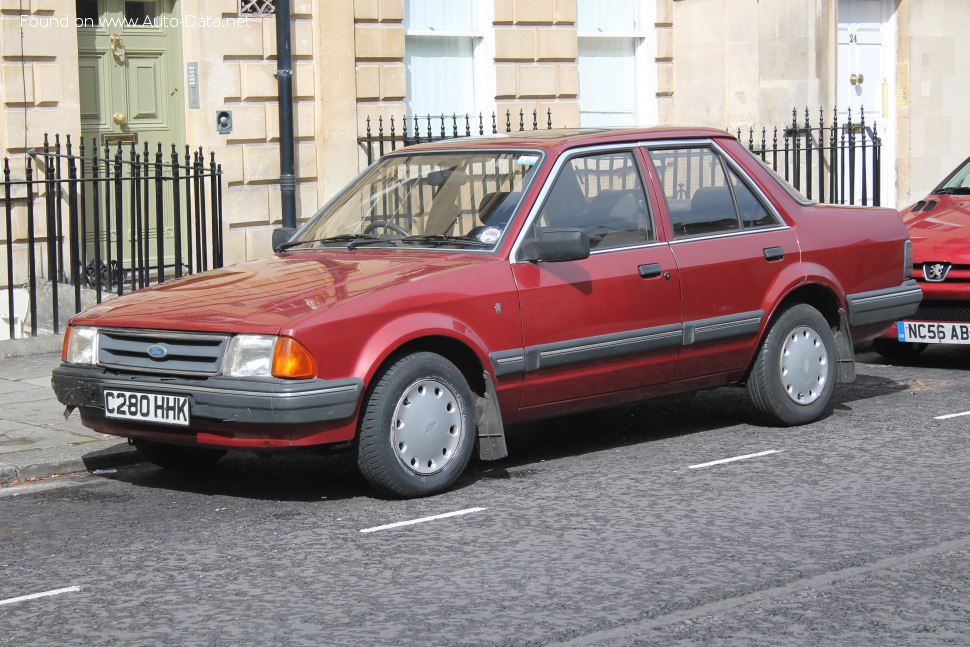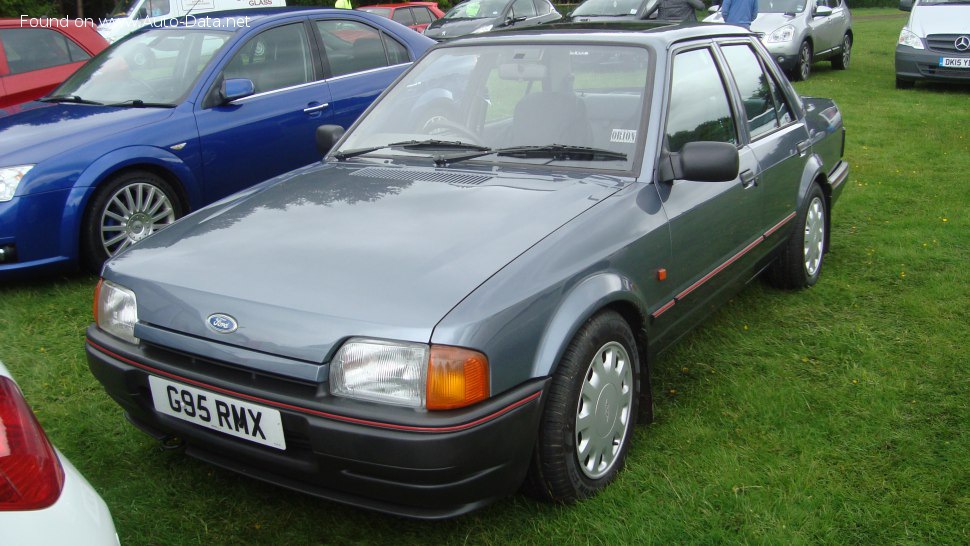
The Ford Orion II (AFF) represents a significant chapter in Ford of Europe’s strategy to capture the compact sedan market during the late 1980s. Launched in 1986, this generation, internally designated AFF, served as the sedan variant of the highly successful third-generation Ford Escort (Mk3), offering a more traditional and upmarket alternative to its hatchback sibling. While never officially sold in the United States, the Orion carved out a substantial niche in European markets, particularly in the UK, Germany, and Spain, appealing to buyers who desired the practicality and economy of a compact car but preferred the more formal styling and perceived prestige of a three-box sedan. The 1.6 i (105 Hp) model, specifically, stood out as a well-balanced offering, combining respectable performance with modern (for its era) fuel injection technology, making it a popular choice for families and business users alike.
The Orion’s lineage traces back to Ford’s global “world car” philosophy, sharing its underpinnings with the Escort, a car designed to be adaptable across various international markets. However, the Orion was specifically tailored for European tastes, focusing on an integrated trunk design that many buyers in the region preferred over hatchbacks for security and aesthetics. This second generation, the Orion II (AFF), refined the original Orion’s concept, bringing updated styling cues, improved aerodynamics, and a host of mechanical enhancements that kept it competitive in a fiercely contested segment.
The Ford Orion II (AFF) 1.6 i (105 Hp): Engineering and Performance
Engine & Powertrain Dynamics
At the heart of the Ford Orion II (AFF) 1.6 i (105 Hp) was a 1.6-liter inline four-cylinder gasoline engine. The “i” designation indicated the presence of electronic fuel injection, a technological advancement over carbureted engines common at the time. This Bosch K-Jetronic or later Ford EEC-IV system (depending on production year and market) allowed for more precise fuel delivery, improving fuel efficiency, smoothing power delivery, and reducing emissions.
With a power output of 105 horsepower, the 1.6 i engine provided the Orion with a lively character. In an era when many compact sedans offered considerably less power, the 105 Hp made the Orion a capable performer on both urban streets and European highways. The engine was naturally aspirated, relying on atmospheric pressure for air intake, contributing to its reliability and straightforward maintenance.
Power was routed to the front wheels, a configuration inherited from the Escort platform. This front-wheel-drive (FWD) layout was a hallmark of modern compact car design in the 1980s, offering advantages in packaging efficiency, interior space, and predictable handling, especially in adverse weather conditions. A manual five-speed transmission was likely standard, offering drivers engaging control, with an automatic option available on higher trims. The combination of a responsive engine and a well-sorted FWD chassis made the Orion II 1.6 i a pleasant and confidence-inspiring car to drive, suited to the diverse driving demands of its European customer base.
Design & Features of the Orion II (AFF) Sedan
Exterior and Interior Aesthetics
The Ford Orion II (AFF) maintained the elegant three-box sedan profile of its predecessor, but with subtle updates aligning it with Ford’s design language of the late 1980s. Its body type was unequivocally a sedan, characterized by a distinct, integrated trunk separate from the passenger compartment. This contrasted with the Escort’s hatchback design, giving the Orion a more executive or mature appearance. The styling was clean and aerodynamic, with flush-fitting headlights and a revised grille. The overall aesthetic was one of understated sophistication.
Inside, the Orion II benefited from Ford’s focus on practicality and ergonomics. Base models were relatively spartan, but the 1.6 i trim often included a more generous equipment list. Key features likely included comfortable cloth upholstery, a functional dashboard layout with clear instrumentation, and a capable heating and ventilation system. Depending on the market and trim level, features like power steering, central locking, electric front windows, and a basic radio/cassette player would have been available.
Safety features, by modern standards, were rudimentary but typical for the era. Seatbelts were standard for all occupants, and the car’s unibody construction provided a degree of passive safety. Ford’s engineering focused on predictable handling and braking to aid in accident avoidance. The trunk offered a substantial cargo capacity, a key selling point for sedan buyers who valued secure and separate luggage space. The Orion II’s design blended conservative appeal with contemporary functionality, reinforcing its position as a reliable and respectable family or business vehicle.
Technical Specifications: Ford Orion II (AFF) 1.6 i (105 Hp)
| Category | Specification |
| General Information | |
| Brand | Ford |
| Model | Orion |
| Generation | Orion II (AFF) |
| Type (Engine) | 1.6 i (105 Hp) |
| Start of Production | 1986 |
| End of Production | 1990 |
| Powertrain Architecture | Internal Combustion engine |
| Body Type | Sedan |
| Performance Specs | |
| Fuel Type | Petrol (Gasoline) |
| Engine Specs | |
| Power | 105 Hp |
| Engine Aspiration | Naturally aspirated engine |
| Drivetrain | Front-Wheel Drive (FWD) |
The Ford Orion II (AFF) played a crucial role in Ford of Europe’s product lineup during the latter half of the 1980s. It bridged the gap between the mass-market Escort hatchback and the larger Sierra sedan, offering a compelling option for those who found the Escort too utilitarian and the Sierra perhaps too large or expensive. Its primary competitors in the European market included the Vauxhall Cavalier (Opel Ascona/Vectra), Volkswagen Jetta, Peugeot 309/405, and Renault 19/21. The Orion distinguished itself with its strong Ford branding, extensive dealer network, and a reputation for solid engineering.
The 1.6 i (105 Hp) model was well-regarded for its balance of performance and economy. The introduction of fuel injection made it a more refined and efficient choice compared to carbureted rivals, aligning with growing consumer demand for more advanced engine technology and better fuel economy. Its modest power output was more than adequate for daily driving, and its predictable handling characteristics contributed to its widespread appeal.
Historically, the Orion solidified Ford’s dominance in the European compact segment, demonstrating the company’s ability to diversify its offerings from a common platform. It was seen as a practical, reliable, and affordable family car, often favored by company fleets and private buyers looking for a dependable vehicle. While it might not have garnered the same enthusiast following as some performance-oriented Escort variants, its impact on the everyday motoring landscape of Europe was substantial. The Orion nameplate continued until 1993, when it was integrated back into the Escort range, effectively making the Escort sedan its successor. This decision underscored a shift in market preferences, but the Orion’s tenure firmly established its place as a quintessential European compact sedan of its era, remembered for its understated style, robust mechanics, and consistent performance.