In the vast tapestry of automotive history, few vehicle lines boast the enduring legacy and global recognition of the Volkswagen Transporter. From the iconic T1 “Microbus” that captured the free spirit of the 1960s to the versatile modern iterations, the Transporter has consistently redefined utility and mobility. While North American audiences primarily associate the name with passenger-focused variants like the EuroVan or the beloved Vanagon, the heart of the Transporter’s success, particularly in its native Europe, has always been its robust and adaptable commercial variants. Among these, the Volkswagen Transporter (T5) Panel Van 2.5 TDI (130 Hp) Tiptronic L2H2, produced between 2003 and 2006, stands as a prime example of a meticulously engineered workhorse – a vehicle designed not for glamour, but for unwavering reliability and immense practicality.
This particular T5 variant, with its long wheelbase (L2) and high roof (H2) configuration, combined with a potent diesel engine and automatic transmission, represented a sophisticated solution for businesses across the continent. Though its direct presence in the North American market was limited, its influence on global van design and Volkswagen’s engineering prowess resonated far beyond European borders, shaping expectations for commercial efficiency and driver comfort in a segment often overlooked by enthusiasts.
The Volkswagen Transporter (T5): A Commercial Cornerstone
The Volkswagen Transporter T5, launched in 2003, represented a significant leap forward for the iconic van. It moved away from the more utilitarian focus of earlier generations, incorporating more passenger car-derived technology and comfort features while retaining the core attributes of durability and practicality that defined the Transporter name. The T5 was available in a wide range of configurations, catering to diverse commercial needs, from basic cargo vans to fully equipped mobile workshops. The Panel Van, particularly in the L2H2 specification, became a staple for businesses requiring substantial cargo capacity and a reliable platform for their operations.
Engine & Performance
At the core of the Volkswagen Transporter (T5) Panel Van 2.5 TDI (130 Hp) Tiptronic L2H2 was its formidable 2.5-liter, five-cylinder TDI (Turbocharged Direct Injection) diesel engine. Codenamed EA153 / AXD, this inline-five powerplant was a marvel of diesel engineering for its time, designed for both durability and efficiency under demanding commercial use. It delivered a respectable 130 horsepower at 3500 rpm, providing ample muscle for hauling significant loads.
More crucial for a commercial vehicle, however, was its torque output. The 2.5 TDI generated a substantial 250.77 lb-ft of torque (340 Nm), available across a broad and usable band from 2000 to 2300 rpm. This low-end grunt was essential for effortless starts, confident merging into traffic, and tackling inclines even when fully laden. The engine’s aspiration system, featuring a turbocharger and intercooler, ensured efficient combustion and consistent power delivery, a hallmark of Volkswagen’s TDI technology. Mated to this robust engine was a sophisticated 6-speed Tiptronic automatic transmission. For a panel van, an automatic gearbox offered a significant advantage, particularly in urban environments with frequent stops and starts, reducing driver fatigue and optimizing fuel consumption. While not built for speed, the T5 Panel Van could accelerate from 0 to 60 mph in a respectable 14.8 seconds, reaching a maximum speed of 98.8 mph. Its fuel economy was particularly noteworthy, achieving an impressive 35.1 US mpg (6.7 L/100km) on the extra-urban cycle – a critical factor for businesses managing operational costs.
Design & Features
The T5 generation Transporter marked a significant evolution in Volkswagen’s van design. While maintaining the brand’s characteristic clean lines and functional aesthetic, the T5 introduced a more aerodynamic profile and a refined interior that blurred the lines between commercial utility and passenger comfort. For the Panel Van, the focus remained squarely on practicality and durability.
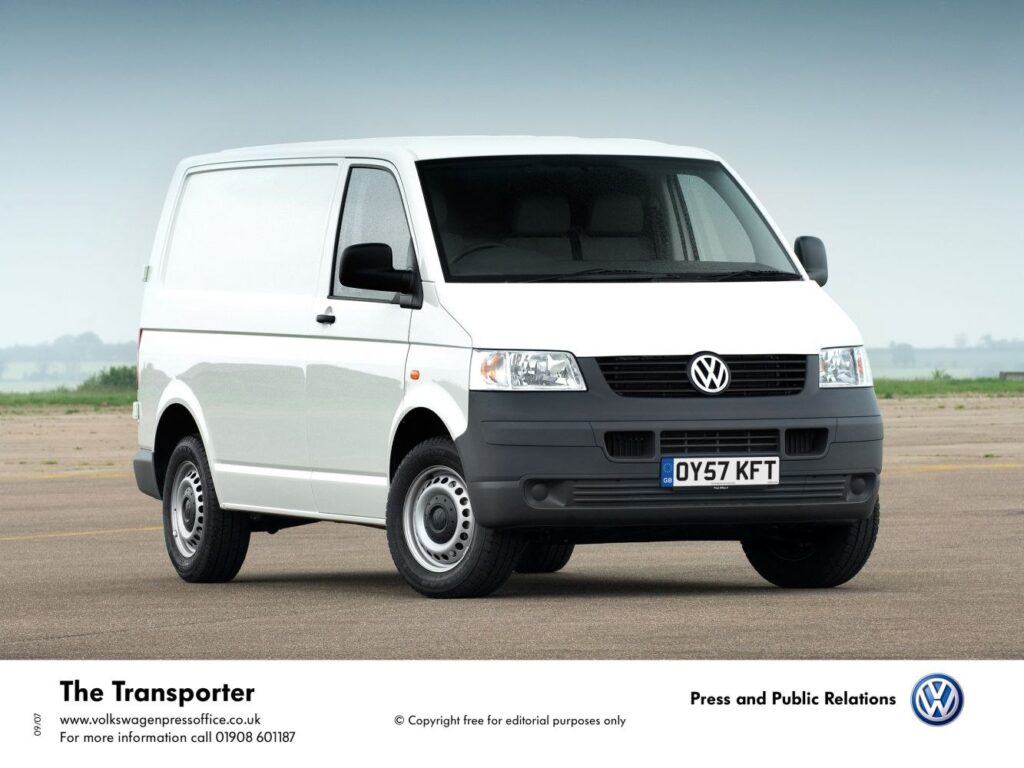
The T5’s exterior presented a robust yet modern appearance. Its high roof (H2) and long wheelbase (L2) configuration were key to its immense utility, providing a generous and easily accessible cargo area. The L2H2 variant offered significantly more internal volume compared to standard or short-wheelbase, low-roof models, making it ideal for tradespeople requiring ample space for tools, materials, or even palletized goods. The body featured wide-opening rear doors and a sliding side door, facilitating easy loading and unloading from various angles, a critical design aspect for busy commercial operations. The aerodynamic design not only contributed to its modern aesthetic but also helped improve fuel efficiency and reduce wind noise at highway speeds, enhancing driver comfort.
Inside, the T5 Panel Van’s cabin was designed with the working professional in mind. Volkswagen prioritized ergonomics, ensuring controls were intuitively placed and easy to reach. The driver’s seat offered good adjustability, reducing fatigue during long hours on the road. While materials were chosen for their durability and ease of cleaning, typical for a commercial vehicle, the overall fit and finish were notably superior to many competitors in its class, reflecting Volkswagen’s passenger car standards. Practical storage solutions, including door pockets, dashboard compartments, and overhead shelves, were integrated to keep documents, tools, and personal items organized. Basic amenities such as power steering, power windows, and central locking were standard or widely available, along with optional features like air conditioning and a capable sound system, all contributing to a more comfortable and productive work environment.
Safety was a significant consideration in the T5’s design. Standard features included anti-lock brakes (ABS) and driver and passenger airbags, with electronic stability program (ESP) available on many models, providing crucial assistance in adverse driving conditions. The robust chassis and body structure were engineered to offer substantial protection in the event of a collision. Furthermore, the T5 upheld Volkswagen’s reputation for reliability, a non-negotiable trait for commercial vehicles where downtime directly impacts profitability. Its solid construction and proven mechanical components ensured a long service life, even under demanding operational conditions.
Technical Specifications
| Category | Detail |
| Model | Volkswagen Transporter (T5) Panel Van 2.5 TDI (130 Hp) Tiptronic L2H2 |
| Production Years | 2003 – 2006 |
| Body Type | Panel Van, Long Wheelbase (L2), High Roof (H2) |
| Engine Type | 2.5-liter, Inline 5-cylinder TDI Diesel |
| Engine Code | EA153 / AXD |
| Aspiration | Turbocharged with Intercooler |
| Horsepower | 130 hp at 3500 rpm |
| Torque | 250.77 lb-ft (340 Nm) at 2000-2300 rpm |
| Transmission | 6-speed Tiptronic Automatic |
| Drive Type | Front-Wheel Drive (FWD) |
| 0-60 mph Acceleration | 14.8 seconds |
| Top Speed | 98.8 mph (159 km/h) |
| Fuel Economy (Extra-Urban) | 35.1 US mpg (6.7 L/100km) |
The Volkswagen Transporter (T5) Panel Van 2.5 TDI (130 Hp) Tiptronic L2H2, like its Transporter siblings, enjoyed a formidable reputation across Europe and other international markets. It was widely regarded as a benchmark in the light commercial vehicle (LCV) segment, praised for its robust build quality, powerful yet efficient diesel engines, and versatile cargo capabilities. Its status as a premium offering in the segment meant it often commanded a higher price point than some rivals, but this was justified by its superior driving dynamics, comfort, and, crucially for businesses, its strong residual values and renowned longevity.
In the fiercely competitive European LCV market, the T5 faced strong contenders such as the Mercedes-Benz Vito, Ford Transit, Renault Trafic, and Opel Vivaro (Vauxhall Vivaro in the UK). What set the Transporter apart was its blend of passenger-car-like refinement with uncompromising commercial utility. The 2.5 TDI engine, in particular, was a favorite for its ability to deliver both performance for heavy loads and impressive fuel economy, a critical factor for businesses managing fleet operating costs. The Tiptronic automatic transmission further enhanced its appeal, offering ease of driving in congested urban environments, a significant advantage for delivery services and tradespeople. The T5 generation continued the Transporter’s legacy of setting standards for commercial vans. Its influence extended beyond mere sales figures; it helped redefine expectations for driver comfort, safety features, and technological integration in a segment traditionally focused solely on bare-bones utility. The L2H2 configuration, with its maximum cargo volume, became an indispensable tool for countless businesses, from construction and logistics to service industries. Its enduring popularity on the used market, even years after production ceased, is a testament to its robust engineering and the trust placed in the Volkswagen badge. The T5 remains a common sight on European roads, a testament to its design and the reliability that made it an unsung workhorse for a generation of businesses.