The early 2000s saw a flourishing market for compact luxury roadsters in North America, and the Mercedes-Benz SLK (R171) emerged as a significant contender. Building on the success of its innovative predecessor, the R171 generation, particularly models like the SLK 280 V6, established itself as a desirable combination of style, performance, and practicality. It wasn’t merely a convertible; it represented accessible luxury and engineering excellence, offering the open-air experience of a roadster with the security and refinement of a coupe, thanks to its signature retractable hardtop.
The Mercedes-Benz SLK (R171) SLK 280 V6: A Mid-Range Roadster Powerhouse
Introduced in April 2005, the Mercedes-Benz SLK (R171) SLK 280 V6 was a key component of the second-generation SLK roadster family. Designed to provide a compelling balance of performance and efficiency, it quickly became a popular choice for those seeking a stylish two-seater convertible with the quality and luxury associated with Mercedes-Benz. Production of this specific variant concluded in December 2007, making it a relatively short-lived, yet impactful, model within the R171’s lifecycle.
Engine & Performance
The heart of the SLK 280 V6 was Mercedes-Benz’s M 272.942 engine, a naturally aspirated V6 powerplant. Displacing 2996 cubic centimeters (182.83 cubic inches), this engine was engineered for smooth power delivery and a refined auditory experience. It featured a Double Overhead Camshaft (DOHC) valvetrain with four valves per cylinder and multi-port fuel injection, optimizing combustion and efficiency.
The engine generated 231 horsepower at 6000 rpm, resulting in a power-to-liter ratio of 77.1 hp/l. Crucially for everyday driving, it produced 300 Nm (221.27 lb.-ft.) of torque across a broad rev range, from 2400 to 5000 rpm. This wide torque band ensured responsive acceleration and effortless cruising. Primarily paired with a precise 6-speed manual transmission, the SLK 280 V6 could accelerate from 0 to 60 mph in 6 seconds, and 0-100 km/h in 6.3 seconds. Its top speed was electronically limited to 250 km/h (155.34 mph), a standard practice for German luxury vehicles.
Fuel economy was respectable for its class and era, with combined figures ranging from 9.7-9.9 l/100 km (approximately 23.8-24.2 US mpg). Urban consumption was rated at 13.8-14.0 l/100 km (16.8-17 US mpg), while extra-urban driving could achieve 7.2-7.4 l/100 km (31.8-32.7 US mpg). The vehicle met Euro 4 emission standards, with CO2 emissions between 231-236 g/km.
The SLK 280 V6 utilized a rear-wheel-drive architecture with a longitudinally mounted engine. This configuration contributed to balanced weight distribution and engaging driving dynamics. The suspension comprised an independent McPherson strut setup with a transverse stabilizer at the front and an independent multi-link suspension with a transverse stabilizer at the rear, balancing ride comfort and sporty handling. Ventilated disc brakes at the front and disc brakes at the rear, coupled with an Anti-lock Braking System (ABS), provided reliable stopping power.
Design & Features
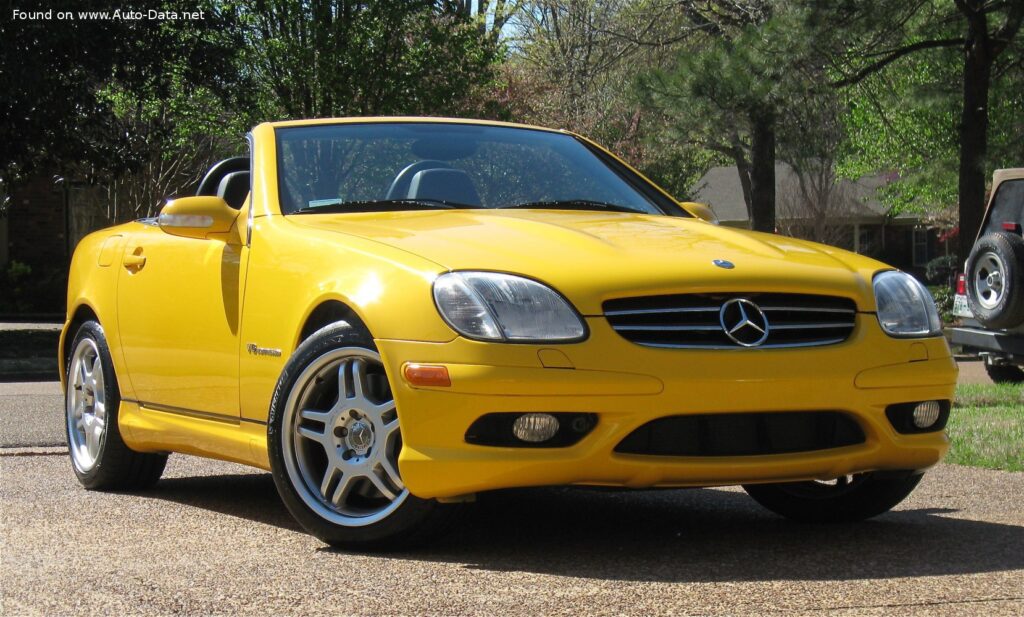
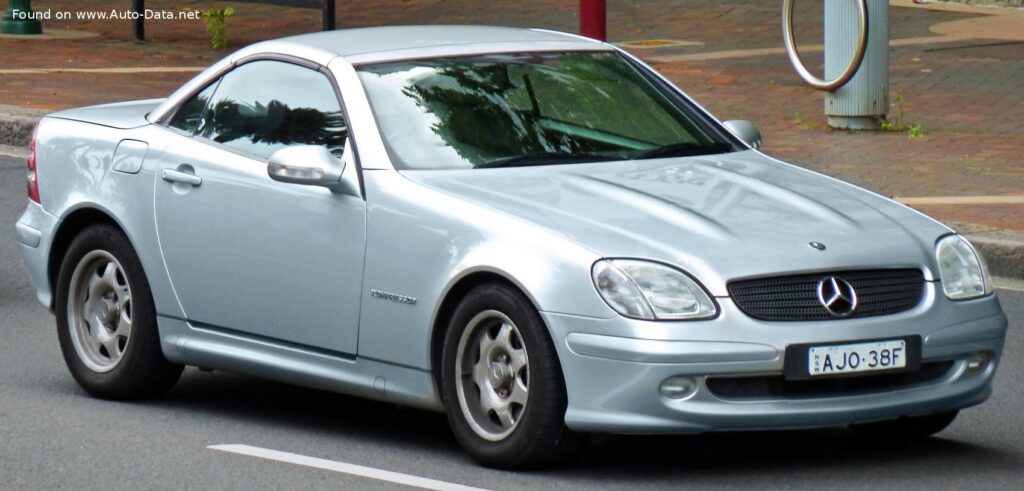
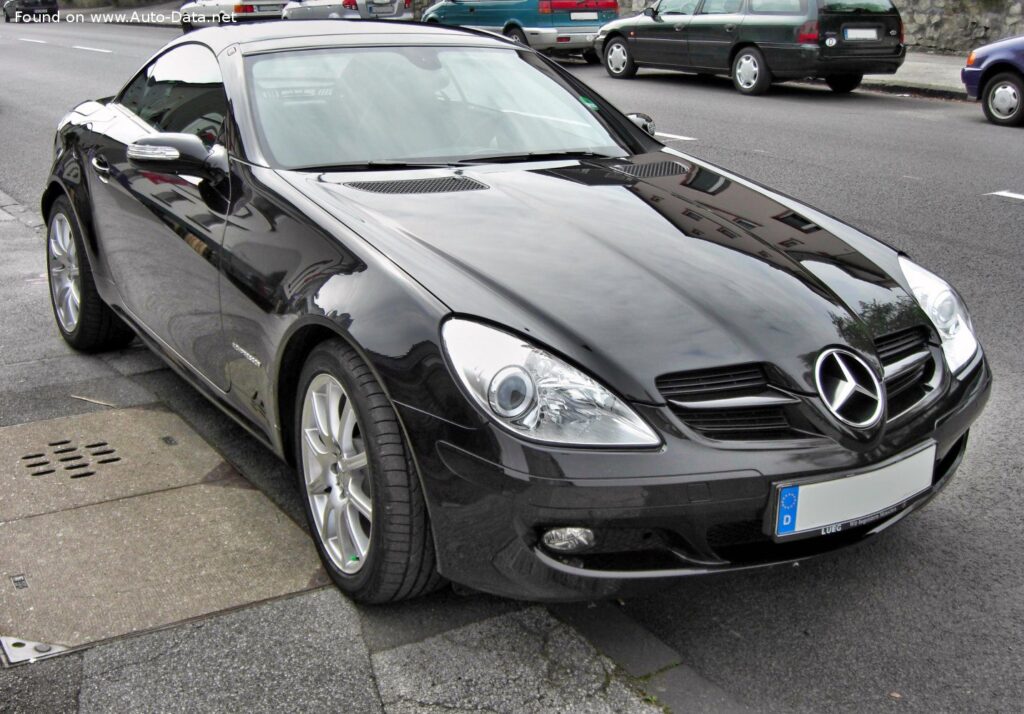
The R171 generation SLK represented a significant stylistic departure from its predecessor, adopting a sharper, more aggressive aesthetic inspired by the Mercedes-Benz SLR McLaren supercar. This design language was evident in the long hood, short rear deck, and the distinctive “Formula 1” nose cone, giving the SLK 280 V6 a contemporary appearance. Its compact dimensions – 160.98 inches in length, 70.39 inches in width, and 51.1 inches in height – contributed to its agility and maneuverability.
A defining feature of the SLK, refined in the R171, was the electro-hydraulically operated Vario-roof. This retractable hardtop transformed the car from a coupe to a roadster in just 22 seconds, offering the benefits of both body styles: the security and quietness of a fixed roof, and the exhilaration of open-air driving. This feature was a major selling point, allowing drivers to enjoy their convertible year-round.
The interior of the SLK 280 V6 offered a premium, driver-focused cockpit. Mercedes-Benz interiors of this era typically featured high-quality materials, comfortable leather seating, and optional features like heated seats, premium audio systems, and integrated navigation. Safety was prioritized, with standard features like ABS and a comprehensive airbag system. The hydraulic power steering system, a rack and pinion setup, provided direct feedback, enhancing the car’s driving experience.
Market Legacy
Upon its release, the Mercedes-Benz SLK (R171) SLK 280 V6 entered a competitive North American market for premium two-seat roadsters. Its main rivals included the BMW Z4, Porsche Boxster, and Audi TT Roadster. While the SLK 280 V6 didn’t match the raw driving dynamics of a Boxster or the precise steering of a Z4 for some enthusiasts, it offered a compelling blend of Mercedes-Benz luxury, a more comfortable ride, and the versatility of its Vario-roof.
Its sophisticated styling, often compared to the SLR McLaren, also provided a visual advantage. Launch pricing (MSRP) for the SLK 280 in North America typically started in the low to mid-$40,000 range (USD), positioning it as an accessible entry point into the Mercedes-Benz convertible lineup, below the more powerful SLK 350 and the later SLK 55 AMG.
North American drivers generally responded positively to the R171 generation, including the SLK 280 V6. Its improved performance, more engaging handling compared to the first-generation R170, and striking design resonated with buyers seeking a stylish and luxurious daily driver that could also provide spirited weekend enjoyment. The retractable hardtop remained a critical differentiator, appealing to those who wanted the best of both coupe and convertible worlds without compromise. The SLK 280 V6 successfully carved out a niche as a refined, elegant, and enjoyable premium roadster, solidifying the SLK’s enduring appeal.
| Category | Specification |
| General Information | Mercedes-Benz |
| Model | SLK |
| Generation | SLK (R171) |
| Type (Engine) | SLK 280 V6 (231 Hp) |
| Start of Production | April, 2005 |
| End of Production | December, 2007 |
| Powertrain Architecture | Internal Combustion Engine |
| Body Type | Roadster |
| Seats | 2 |
| Doors | 2 |
| Performance Specifications | |
| Fuel Consumption – Urban (NEDC) | 13.8-14.0 l/100 km (16.8-17 US mpg) |
| Fuel Consumption – Extra Urban (NEDC) | 7.2-7.4 l/100 km (31.8-32.7 US mpg) |
| Fuel Consumption – Combined (NEDC) | 9.7-9.9 l/100 km (23.8-24.2 US mpg) |
| CO2 Emissions (NEDC) | 231-236 g/km |
| Fuel Type | Petrol (Gasoline) |
| Acceleration 0 – 60 mph | 6 seconds |
| Acceleration 0 – 100 km/h | 6.3 seconds |
| Maximum Speed | 250 km/h (155.34 mph, Electronically limited) |
| Emission Standard | Euro 4 |
| Weight-to-Power Ratio | 5.9 kg/Hp (169.2 Hp/tonne) |
| Weight-to-Torque Ratio | 4.6 kg/Nm (219.8 Nm/tonne) |
| Engine Specifications | |
| Power | 231 Hp @ 6000 rpm |
| Power per Liter | 77.1 Hp/l |
| Torque | 300 Nm (221.27 lb.-ft.) @ 2400-5000 rpm |
| Engine Layout | Front, Longitudinal |
| Engine Model/Code | M 272.942 |
| Engine Displacement | 2996 cm³ (182.83 cu. in.) |
| Number of Cylinders | 6 |
| Engine Configuration | V-engine |
| Cylinder Bore | 88 mm (3.46 in.) |
| Piston Stroke | 82.1 mm (3.23 in.) |
| Compression Ratio | 11.1:1 |
| Number of Valves per Cylinder | 4 |
| Fuel Injection System | Multi-port manifold injection |
| Engine Aspiration | Naturally Aspirated |