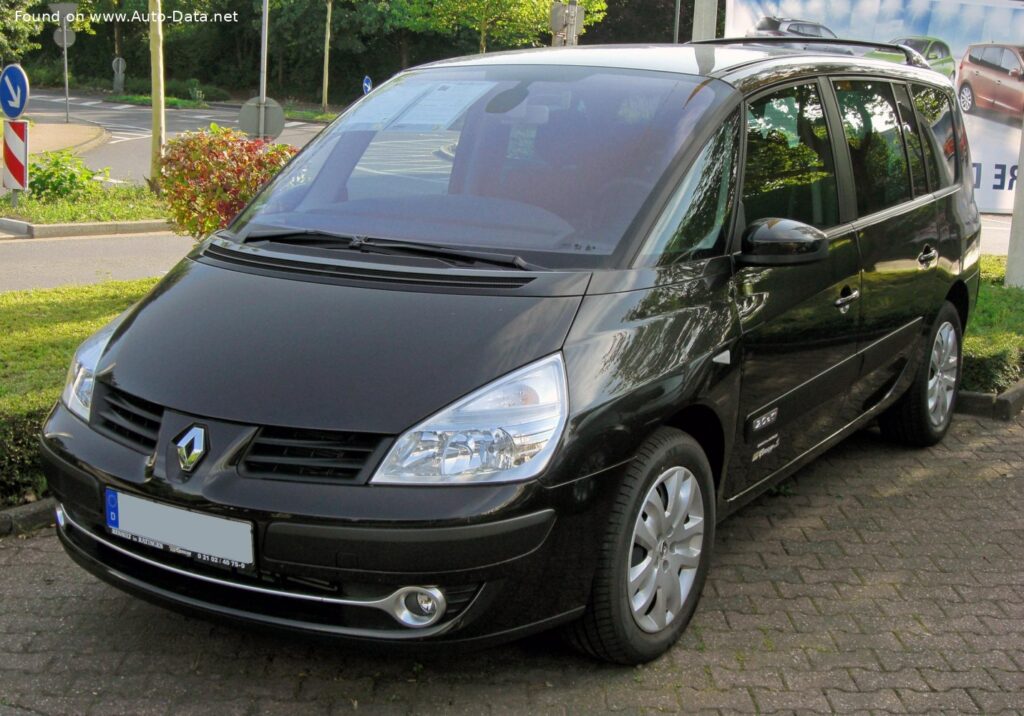
The Renault Espace IV (Phase II, 2006) 2.0 dCi Automatic represents a pivotal chapter in the history of the European multi-purpose vehicle (MPV) segment. Though never officially sold in the United States, the Espace has been a groundbreaking and benchmark vehicle for family transportation across Europe for decades. This Phase II iteration, launched in 2006, showcases the refined engineering and dedication to practicality that defined Renault’s approach to the segment during the mid-2000s. Positioned as a large, comfortable, and versatile minivan, it catered to families and individuals seeking substantial space, flexible seating for up to seven passengers, and efficient long-distance travel capabilities, all within a distinctly European design aesthetic. The 2.0 dCi engine paired with an automatic transmission epitomized the blend of performance and efficiency valued in its primary markets.
Evolution and Market Positioning of the Espace IV
The fourth-generation Espace, introduced in 2002, marked a significant departure from its predecessors in its construction. It adopted a more conventional steel unibody chassis, moving away from the previous models’ composite body panels over a galvanized steel spaceframe. The Phase II refresh, beginning in 2007 and running through 2009 for this specific powertrain, brought subtle but important updates to styling, interior refinement, and powertrain options to maintain the Espace’s competitiveness. In a market segment dominated in the US by models like the Chrysler Town & Country or Honda Odyssey, the Espace offered a distinctly European flavor – emphasizing driving dynamics, sophisticated diesel powertrains, and a more avant-garde interior design philosophy. Its role was to serve as a flagship family vehicle, offering premium features and comfort without sacrificing the inherent utility of the MPV concept.
Engine & Performance: The 2.0 dCi Powerplant
The Renault Espace IV Phase II model is powered by a capable 2.0-liter dCi (Diesel Common Rail) inline-four engine, internally designated M9R. This powerplant was a key component of Renault’s diesel engine lineup, known for its balance of power, refinement, and fuel efficiency. Producing 173 horsepower at 3750 rpm and 265.52 lb.-ft. of torque from 1750 rpm, the engine delivered strong acceleration and effortless cruising, crucial for a vehicle designed to carry multiple passengers and cargo. The ample torque made highway merging and uphill climbs easy, contributing to the Espace’s substantial 4409.25 lbs. towing capacity (with brakes).
The engine’s technical specifications were advanced for its time. It features a DOHC (Double Overhead Camshaft) valvetrain with four valves per cylinder, optimizing airflow for combustion. Fuel delivery is managed by a sophisticated Diesel Commonrail injection system, ensuring precise fuel metering and efficient combustion, which contributed to lower emissions and better fuel economy. A turbocharger with an intercooler further boosts performance by force-feeding air into the engine, enhancing power output across the rev range. Paired with a smooth-shifting 6-speed automatic transmission, the powertrain delivered a refined driving experience, ideal for long European road trips. Performance figures include a 0 to 60 mph acceleration time of 10.5 seconds and a top speed of 123.03 mph.
Fuel efficiency, a major concern in European markets, was a strong suit for the 2.0 dCi. Combined fuel consumption was rated at 28.7 US mpg (8.2 l/100 km), with extra-urban figures reaching 34.6 US mpg (6.8 l/100 km). These figures, combined with a 21.93 US gallon fuel tank, provided an excellent cruising range. Emissions were managed to meet the Euro 4 standard, with CO2 output recorded at 217 g/km, reflecting the engineering effort to balance performance with environmental responsibility.
Design & Features: Practicality Meets European Style
The Renault Espace IV (Phase II, 2006) retained the distinctive, almost futuristic silhouette of the fourth generation while incorporating subtle updates. As a Minivan/MPV, its primary design objective was to maximize interior space and versatility. The vehicle measured 183.31 inches in length, 73.23 inches in width (74.57 inches including mirrors), and 68.03 inches in height, with a substantial 110.35-inch wheelbase. These dimensions contributed to a spacious cabin capable of comfortably accommodating seven occupants across its five doors.
Inside, the Espace was renowned for its flexible seating arrangement, allowing individual seats to be removed, slid, or folded to reconfigure the cabin for various passenger and cargo needs. Trunk space ranged from 10.28 cubic feet with all seats in place, expanding to a cavernous 101 cubic feet with the rear seats removed, making it exceptionally practical for hauling large items or luggage for extended trips. The interior design featured a centrally mounted digital instrument cluster, an innovative feature at the time aimed at enhancing driver focus.
Standard features included power steering with a rack and pinion system, ensuring responsive handling for its size. The braking system comprised ventilated discs at the front and solid discs at the rear, augmented by an Anti-lock Braking System (ABS) for enhanced safety and stopping power. The suspension featured an independent MacPherson strut design at the front and a semi-independent coil spring system at the rear, providing a comfortable ride quality suitable for both city driving and highway cruising. The vehicle rode on 17-inch wheels fitted with 225/55 R17 tires, offering a good balance of grip and ride comfort. The Espace IV Phase II emphasized technology and comfort, aiming to make every journey as pleasant and effortless as possible.
Technical Specifications: Renault Espace IV (Phase II, 2006) 2.0 dCi (173 Hp) Automatic
| Category | Specification |
| Brand | Renault |
| Model | Espace IV (Phase II, 2006) |
| Type (Engine) | 2.0 dCi (173 Hp) Automatic |
| Production Start | 2007 |
| Production End | 2009 |
| Powertrain Architecture | Internal Combustion engine |
| Body Type | Minivan, MPV |
| Seats | 7 |
| Doors | 5 |
| Fuel Consumption (Urban) | 10.6 l/100 km |
| Fuel Consumption (Extra Urban) | 6.8 l/100 km |
| Fuel Consumption (Combined) | 8.2 l/100 km |
| CO2 Emissions | 217 g/km |
| Fuel Type | Diesel |
| Acceleration 0-60 mph | 10.5 sec |
| Maximum Speed | 198 km/h |
| Emission Standard | Euro 4 |
| Engine Power | 173 Hp @ 3750 rpm |
| Engine Torque | 360 Nm @ 1750 rpm |
| Engine Displacement | 1995 cm3 |
| Number of Cylinders | 4 |
| Fuel Injection System | Diesel Commonrail |
| Kerb Weight | 1890 kg |
| Trunk (Boot) Space – Minimum | 291 l |
| Trunk (Boot) Space – Maximum | 2860 l |
| Fuel Tank Capacity | 83 l |
| Length | 4656 mm |
| Width | 1860 mm |
| Height | 1728 mm |
| Wheelbase | 2803 mm |
Legacy & Market Impact: The Enduring Appeal of the Renault Espace
The Renault Espace holds a significant place in automotive history, particularly in Europe, as one of the pioneers of the modern MPV concept. The fourth generation, and its Phase II refinement, continued this legacy, adapting to evolving consumer demands for sophistication, safety, and efficiency. While it faced competition from rivals such as the Ford Galaxy/S-Max, Volkswagen Sharan, and the PSA Group’s Citroën C8 and Peugeot 807, the Espace maintained its unique identity, often lauded for its innovative interior layouts, comfort, and distinctive styling.
Its reputation was built on providing a genuinely versatile family vehicle that excelled at long-distance travel. The 2.0 dCi engine, in particular, was instrumental in its success, offering a compelling blend of strong performance and impressive fuel economy that resonated deeply with European buyers. The automatic transmission further enhanced its appeal, offering ease of driving in congested urban environments as well as on extended highway journeys. The Espace IV helped solidify Renault’s position as a leader in the MPV segment, a testament to its forward-thinking design and engineering.
The impact of the Espace IV was profound, shaping expectations for what a family vehicle could offer in terms of space, flexibility, and driving refinement. It demonstrated that practicality didn’t have to come at the expense of style or technological advancement. Although the MPV segment has since seen a decline in favor of SUVs and crossovers, the Espace IV remains a significant reference point, representing a golden era for multi-purpose vehicles that prioritized passenger comfort and versatility above all else. Its influence can still be seen in the design philosophies of contemporary family haulers, proving the enduring relevance of its core principles.