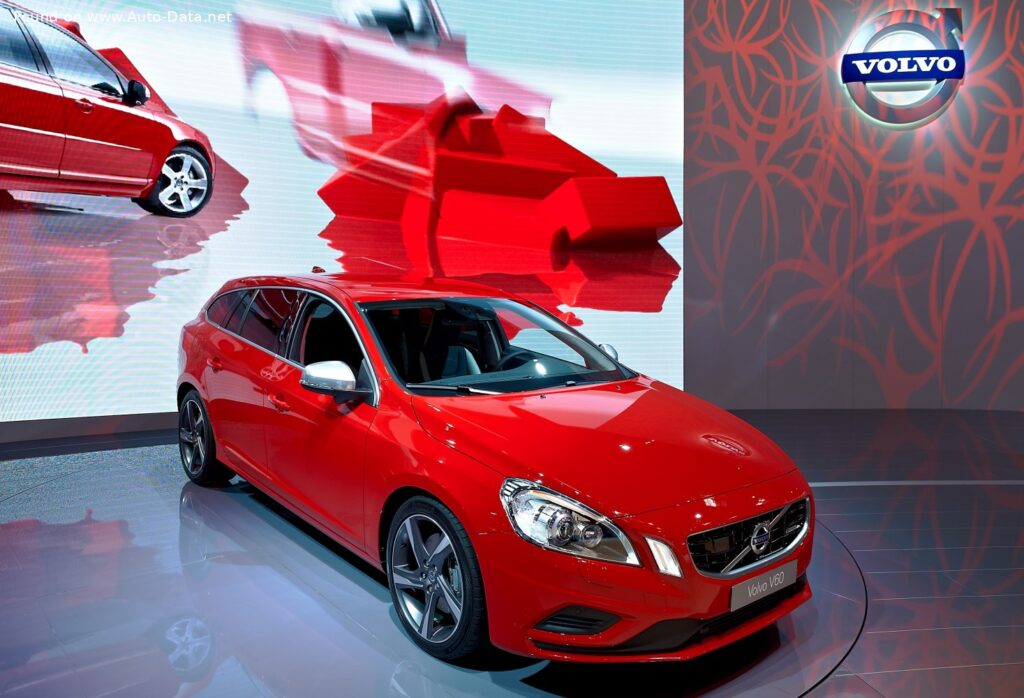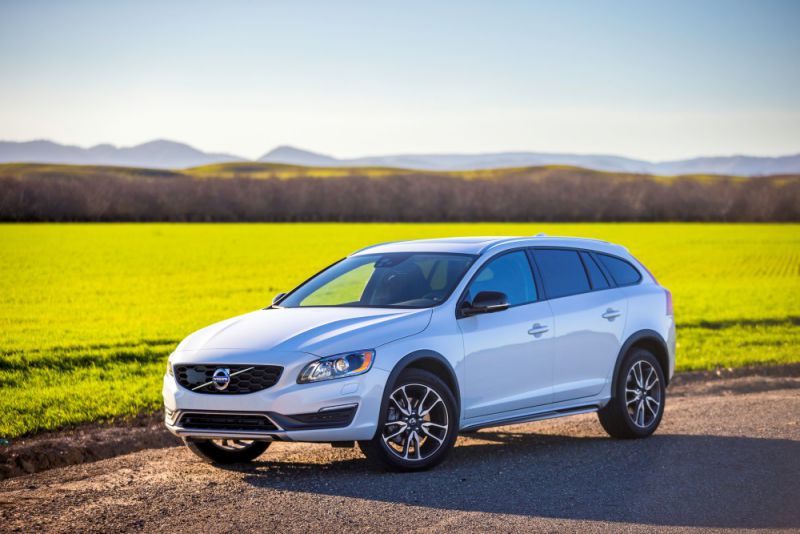
The Volvo V60 I Cross Country represents a distinctive blend of a traditional European station wagon (estate) and a light-duty crossover, designed to offer enhanced versatility and a more rugged aesthetic than its standard V60 counterpart. Introduced in 2015 as part of the first-generation V60 lineup, this particular variant, the Volvo V60 I Cross Country 2.0 T5 (245 Hp) Automatic, was produced until 2018. It carved out a niche in the premium mid-size segment, appealing to consumers seeking the practicality of a wagon combined with the adventurous spirit and increased ground clearance typically associated with SUVs. While the V60 Cross Country was available with all-wheel drive in many markets, the specific technical data provided for this variant indicates a front-wheel-drive (FWD) powertrain architecture, an intriguing configuration for a model bearing the “Cross Country” badge.
Volvo V60 I Cross Country 2.0 T5: A Detailed Overview
The V60 Cross Country aimed to bridge the gap between the practicality of a wagon and the perceived capability of a crossover SUV. Volvo recognized a growing demand for vehicles that could handle diverse conditions and lifestyles without sacrificing the refined driving experience associated with their brand. The “Cross Country” designation, historically used by Volvo, signifies a model designed for more challenging terrains and weather conditions than a standard passenger car. This first-generation V60 Cross Country sought to capitalize on that legacy while offering a unique proposition in the premium segment.
Engine & Performance
At the heart of the Volvo V60 I Cross Country 2.0 T5 (245 Hp) Automatic lies Volvo’s advanced Drive-E powertrain. This features a 2.0-liter (1969 cm³, 120.16 cu. in.) turbocharged inline-four engine, coded B4204T11. This powerplant delivers 245 horsepower at 5500 rpm, showcasing modern engineering principles focused on both performance and efficiency. Direct fuel injection and a turbocharger with an intercooler contribute to the engine’s responsiveness and power output. The engine generates 258.15 lb.-ft. of torque between 1500 and 4800 rpm, providing ample power for everyday driving and highway passing maneuvers. The power-to-liter ratio of 124.4 Hp/l underscores the engine’s efficiency.
Power is transferred to the front wheels via a smooth and responsive 8-speed automatic transmission. Despite the “Cross Country” branding, this specific variant utilizes a front-wheel-drive (FWD) configuration. This allows for a 0 to 60 mph acceleration time of 6.3 seconds and a maximum speed of 130.49 mph (210 km/h). Fuel economy is commendable, with a combined rating of 35.6 US mpg (6.6 l/100 km). Urban driving yields approximately 27 US mpg (8.7 l/100 km), while extra-urban conditions can achieve up to 43.6 US mpg (5.4 l/100 km). CO2 emissions are rated at 153 g/km, reflecting Volvo’s commitment to reducing environmental impact.
Design & Features
The Volvo V60 I Cross Country masterfully blends the elegant lines of the V60 station wagon with rugged, off-road-inspired design elements. Classified as a station wagon (estate) and crossover, it offers five doors and seating for five passengers. Key differentiating features include a raised ride height of 7.91 inches (201 mm), providing increased ground clearance. Robust black plastic cladding around the wheel arches, sills, and lower bumpers enhances the vehicle’s adventurous aesthetic and offers protection against minor damage. Silver skid plates, front and rear, further emphasize its readiness for light off-road excursions.
Inside, the V60 Cross Country maintains Volvo’s reputation for ergonomic design, high-quality materials, and a strong focus on safety. The cabin features a clean, Scandinavian aesthetic, creating a comfortable and intuitive environment. Practicality is a key strength, with a minimum trunk (boot) space of 43.83 cu. ft. (1241 liters). The suspension consists of an independent McPherson strut front suspension and an independent coil spring rear suspension, contributing to a balanced ride. Braking is handled by ventilated discs at the front and disc brakes at the rear, supported by an Anti-lock Braking System (ABS). The rack and pinion steering system provides precise and predictable handling. The vehicle’s dimensions – 182.6 inches (4638 mm) in length, 71.85 inches (1825 mm) in width, and 60.83 inches (1545 mm) in height – along with a 109.21-inch (2774 mm) wheelbase, ensure a stable footprint and ample interior space.
Technical Specifications
| Category | Specification |
| General Information | |
| Brand | Volvo |
| Model | V60 |
| Generation | V60 I Cross Country |
| Type (Engine) | 2.0 T5 (245 Hp) Automatic |
| Start of Production | 2015 |
| End of Production | 2018 |
| Powertrain Architecture | Internal Combustion engine |
| Body type | Station wagon (estate), Crossover |
| Seats | 5 |
| Doors | 5 |
| Performance Specs | |
| Fuel consumption (economy) – urban | 8.7 l/100 km (27 US mpg) |
| Fuel consumption (economy) – extra urban | 5.4 l/100 km (43.6 US mpg) |
| Fuel consumption (economy) – combined | 6.6 l/100 km (35.6 US mpg) |
| CO2 emissions | 153 g/km |
| Fuel Type | Petrol (Gasoline) |
| Acceleration 0 – 60 mph | 6.3 seconds |
| Acceleration 0 – 100 km/h | 6.6 seconds |
| Maximum speed | 130.49 mph (210 km/h) |
| Engine Specs | |
| Power | 245 Hp @ 5500 rpm |
| Power per liter | 124.4 Hp/l |
| Torque | 258.15 lb.-ft. @ 1500-4800 rpm (350 Nm) |
| Engine layout | Front, Transverse |
| Engine Model/Code | B4204T11 |
| Engine displacement | 1969 cm³ (120.16 cu. in.) |
| Number of cylinders | 4 |
| Engine configuration | Inline |
| Cylinder Bore | 3.23 in. (82 mm) |
| Piston Stroke | 3.67 in. (93.2 mm) |
| Compression ratio | 10.8:1 |
| Number of valves per cylinder | 4 |
| Fuel injection system | Direct injection |
| Engine aspiration | Turbocharger, Intercooler |
| Valvetrain | DOHC |
| Engine oil capacity | 6.23 US qt (5.9 l) |
| Coolant capacity | 8.77 US qt (8.3 l) |
| Space, Volume and Weights | |
| Trunk (boot) space – minimum | 43.83 cu. ft. (1241 l) |
| Fuel tank capacity | 17.83 US gal (67.5 l) |
| Max. roof load | 165.35 lbs. (75 kg) |
| Permitted trailer load with brakes (8%) | 4188.78 lbs. (1900 kg) |
| Permitted trailer load with brakes (12%) | 3527.4 lbs. (1600 kg) |
| Dimensions | |
| Length | 182.6 in. (4638 mm) |
| Width | 71.85 in. (1825 mm) |
| Width with mirrors folded | 73.46 in. (1866 mm) |
| Width including mirrors | 82.56 in. (2097 mm) |
| Height | 60.83 in. (1545 mm) |
| Wheelbase | 109.21 in. (2774 mm) |
| Front track | 63.74 – 63.35 in. (1619-1609 mm) |
| Rear (Back) track | 62.09 – 61.69 in. (1577-1567 mm) |
| Ride height (ground clearance) | 7.91 in. (201 mm) |
| Drag coefficient (Cd) | 0.34 |
| Minimum turning circle (turning diameter) | 38.71 ft. (11.8 m) |
| Drivetrain, Brakes and Suspension Specs | |
| Drivetrain Architecture | The Internal combustion engine (ICE) drives the front wheels of the vehicle. |
| Drive wheel | Front wheel drive |
| Number of gears and type of gearbox | 8 gears, automatic transmission |
| Front suspension | Independent, type McPherson with coil spring and anti-roll bar |
| Rear suspension | Independent coil spring |
| Front brakes | Ventilated discs |
| Rear brakes | Disc |
| Assisting systems | ABS (Anti-lock braking system) |
| Steering type | Steering rack and pinion |
Legacy and Market Impact
The Volvo V60 I Cross Country 2.0 T5 (245 Hp) Automatic played a crucial role in Volvo’s strategy to expand its appeal beyond traditional sedans and wagons. In a market increasingly dominated by SUVs, the Cross Country models offered a compelling alternative for consumers who valued the driving dynamics and fuel efficiency of a car but desired the added capability and rugged styling of a crossover. This model allowed Volvo to compete with established rivals like the Audi A4 Allroad and, to some extent, the Subaru Outback, by offering a distinct premium European flavor.
Volvo’s reputation for safety, durability, and understated luxury was further solidified by the V60 Cross Country. Its elevated ride height and protective body cladding resonated with buyers in markets like North America and Europe, where varied weather conditions and a desire for versatility are prevalent. While the specific front-wheel-drive configuration of this variant might seem unconventional for a “Cross Country” model, which often implies all-wheel-drive capability, it likely offered a more fuel-efficient and potentially lower-cost option for those who appreciated the styling and ground clearance without needing power sent to all four wheels. This FWD iteration would have still provided excellent traction in most conditions, especially when paired with appropriate tires. The Volvo V60 I Cross Country 2.0 T5 (245 Hp) Automatic contributed to Volvo’s brand image as an innovator in combining practicality with an active lifestyle ethos. Its production run from 2015 to 2018 solidified the Cross Country sub-brand within the V60 lineup, paving the way for future generations and reinforcing the idea that a station wagon could be both elegant and adventurous. It remains a testament to Volvo’s commitment to offering diverse options that cater to specific consumer needs, blending the best attributes of multiple vehicle segments into a cohesive and desirable package.