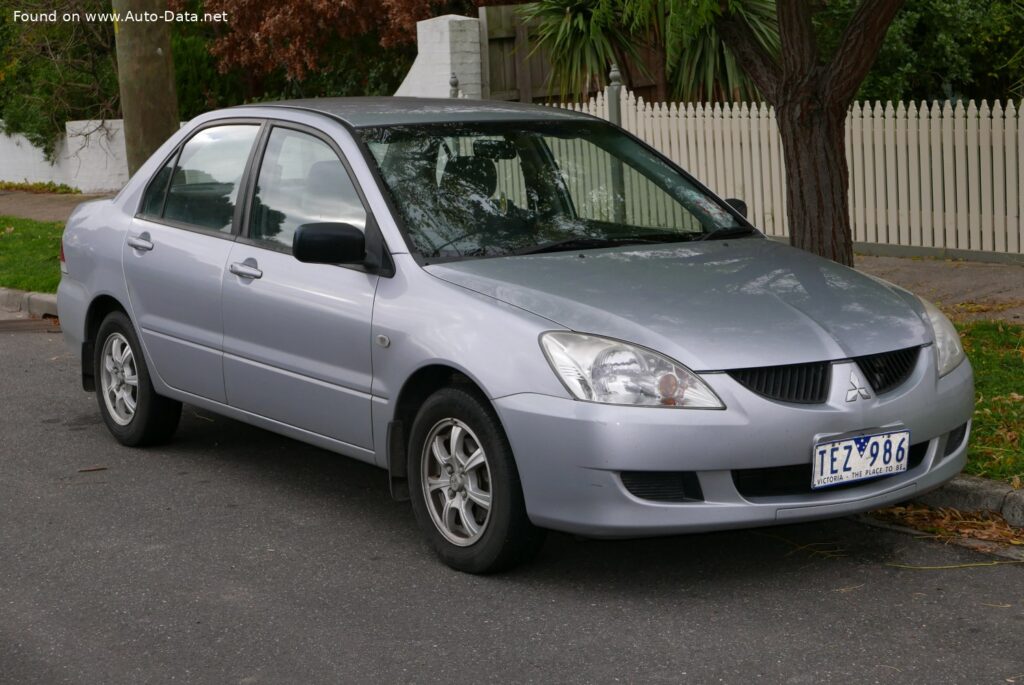
The Mitsubishi Lancer, a nameplate recognized for both everyday usability and rallying success, entered its eighth generation in 2003. The Mitsubishi Lancer VIII 1.6i 16V (98 Hp) sedan was a significant model in numerous international markets, notably Europe and parts of Asia, functioning as a dependable, economical, and practical compact family car. While the Lancer was known in the United States, this 1.6-liter version demonstrated Mitsubishi’s strategy of offering a diverse range of powertrains to meet varying regional needs for fuel economy and taxation. Production continued until 2007, upholding the Lancer’s reputation as a reliable and straightforward choice in the competitive compact sedan class.
Mitsubishi Lancer VIII 1.6i 16V (98 Hp): Overview
Positioned as an accessible and practical sedan, the Lancer VIII 1.6i 16V aimed to attract buyers prioritizing affordability, low operating costs, and Mitsubishi’s established durability. It represented a logical advancement over previous models, offering a more refined driving experience and updated styling while maintaining the core values of reliability and utility that customers associated with the brand.
Engine & Performance
The Mitsubishi Lancer VIII 1.6i 16V (98 Hp) was powered by Mitsubishi’s 4G18 engine. This 1.6-liter (1584 cm3) inline four-cylinder gasoline engine was designed for efficiency and consistent operation, rather than high performance. The engine featured a single overhead camshaft (OHC) design with four valves per cylinder, totaling 16 valves, and produced 98 horsepower at 5000 rpm. Torque output was 150 Nm (110.63 lb.-ft.) at 4000 rpm, providing sufficient power for city driving and highway travel.
The 4G18 engine utilized a multi-port fuel injection system and was naturally aspirated, emphasizing simplicity and dependability. Its front, transverse layout, combined with a front-wheel-drive configuration, was typical for the compact sedan segment, maximizing interior space and reducing manufacturing costs. Power was delivered through a five-speed manual transmission, a common and robust choice for this vehicle class, offering direct engagement and optimizing the engine’s power delivery.
The Lancer VIII 1.6i 16V offered respectable performance for its segment, accelerating from 0 to 60 mph in 11.2 seconds, with a top speed of 113.71 mph (183 km/h). These figures highlighted its role as a practical daily driver rather than a performance sedan. Fuel economy was a key strength, with a combined rating of 35.1 US mpg (6.7 l/100 km), due to its efficient engine and lightweight construction. This made it an appealing option for budget-conscious buyers and those facing higher fuel prices in its target markets.
Design & Features
The design of the eighth-generation Mitsubishi Lancer sedan showcased a clean, functional aesthetic prioritizing interior space and aerodynamic efficiency. With four doors and seating for five, it followed the standard compact sedan formula. Its dimensions – a length of 176.38 inches, width of 66.73 inches, and height of 56.89 inches, with a 102.36-inch wheelbase – ensured a comfortable cabin and stable handling.
The interior of the Lancer VIII was straightforward and ergonomic. While not luxurious, the materials and build quality were designed for durability. Trunk space was a practical 15.19 cubic feet (430 liters), suitable for groceries, luggage, or family items, reinforcing its versatility as a family car.
The Lancer featured a robust suspension system, with a spring strut setup at the front and a transverse stabilizer at the rear, providing a balance of comfort and predictable handling. Braking was handled by ventilated discs at the front and solid discs at the rear, enhanced by an Anti-lock Braking System (ABS) for improved safety, a vital feature for vehicles of this era. Steering was managed by a hydraulic rack and pinion system, offering responsive feedback to the driver. The car rode on 195/60 R15 tires mounted on 6J x 15 wheel rims, a common size balancing grip, ride comfort, and tire replacement costs.
Technical Specifications
| General Information | |
| Brand | Mitsubishi |
| Model | Lancer |
| Generation | Lancer VIII |
| Type (Engine) | 1.6i 16V (98 Hp) |
| Start of Production | 2003 year |
| End of Production | 2007 year |
| Powertrain Architecture | Internal Combustion Engine |
| Body Type | Sedan |
| Seats | 5 |
| Doors | 4 |
| Performance Specs | |
| Fuel Consumption (Urban) | 8.8 l/100 km (26.7 US mpg) |
| Fuel Consumption (Extra Urban) | 5.5 l/100 km (42.8 US mpg) |
| Fuel Consumption (Combined) | 6.7 l/100 km (35.1 US mpg) |
| Fuel Type | Petrol (Gasoline) |
| Acceleration 0 – 60 mph | 11.2 sec |
| Maximum Speed | 183 km/h (113.71 mph) |
| Weight-to-Power Ratio | 12.1 kg/Hp (82.7 Hp/tonne) |
| Weight-to-Torque Ratio | 7.9 kg/Nm (126.6 Nm/tonne) |
| Engine Specs | |
| Power | 98 Hp @ 5000 rpm |
| Power per Liter | 61.9 Hp/l |
| Torque | 150 Nm @ 4000 rpm (110.63 lb.-ft.) |
| Engine Layout | Front, Transverse |
| Engine Model/Code | 4G18 |
| Engine Displacement | 1584 cm3 (1.6 l / 96.66 cu. in.) |
| Number of Cylinders | 4 |
| Engine Configuration | Inline |
| Cylinder Bore | 76 mm (2.99 in.) |
| Piston Stroke | 87.3 mm (3.44 in.) |
| Compression Ratio | 10:1 |
| Number of Valves per Cylinder | 4 |
| Fuel Injection System | Multi-port manifold injection |
| Engine Aspiration | Naturally aspirated engine |
| Valvetrain | OHC |
| Engine Oil Capacity | 3.3 l (3.49 US qt) |
| Coolant | 5 l (5.28 US qt) |
| Space, Volume and Weights | |
| Kerb Weight | 1185 kg (2612.48 lbs.) |
| Max. Weight | 1750 kg (3858.09 lbs.) |
| Max Load | 565 kg (1245.61 lbs.) |
| Trunk (boot) Space – Minimum | 430 l (15.19 cu. ft.) |
| Fuel Tank Capacity | 50 l (13.21 US gal) |
| Dimensions | |
| Length | 4480 mm (176.38 in.) |
| Width | 1695 mm (66.73 in.) |
| Height | 1445 mm (56.89 in.) |
| Wheelbase | 2600 mm (102.36 in.) |
| Front Track | 1470 mm (57.87 in.) |
| Rear (Back) Track | 1470 mm (57.87 in.) |
| Drivetrain, Brakes and Suspension Specs | |
| Drivetrain Architecture | Front-wheel drive, Internal Combustion Engine |
| Drive Wheel | Front wheel drive |
| Number of Gears and Type of Gearbox | 5 gears, manual transmission |
| Front Suspension | Spring Strut |
| Rear Suspension | Transverse stabilizer |
| Front Brakes | Ventilated discs |
| Rear Brakes | Disc |
| Assisting Systems | ABS (Anti-lock braking system) |
| Steering Type | Steering rack and pinion |
| Power Steering | Hydraulic Steering |
| Tires Size | 195/60 R15 |
| Wheel Rims Size | 6J x 15 |
Legacy and Market Impact
The Mitsubishi Lancer VIII 1.6i 16V (98 Hp) held a crucial position in Mitsubishi’s global lineup during its production. While the Lancer name is often associated with the high-performance Evolution models, this variant showcased the Lancer’s more practical side. It was a car designed for the masses, offering a compelling combination of reliability, affordability, and fuel efficiency in regions where these qualities were essential.
In its primary markets, the Lancer VIII competed with established rivals like the Honda Civic, Toyota Corolla, and Nissan Sentra in the compact sedan segment. The Lancer distinguished itself through its robust construction, straightforward mechanics, and a reputation for withstanding challenging conditions, reinforcing Mitsubishi’s image as a producer of durable vehicles.
The eighth-generation Lancer, including the 1.6i 16V model, played a significant role in maintaining Mitsubishi’s presence in the competitive global compact car market. It didn’t necessarily introduce groundbreaking design or technology but perfected the formula of a dependable, economical, and practical family sedan. Its legacy is one of quiet competence and widespread accessibility, serving as a reliable vehicle for countless families and businesses. This generation bridged the gap between the more conventional styling of earlier Lancers and the more aggressive design language of the Lancer X. The Mitsubishi Lancer VIII 1.6i 16V (98 Hp) exemplifies Mitsubishi’s commitment to providing reliable transportation solutions in diverse global markets.