
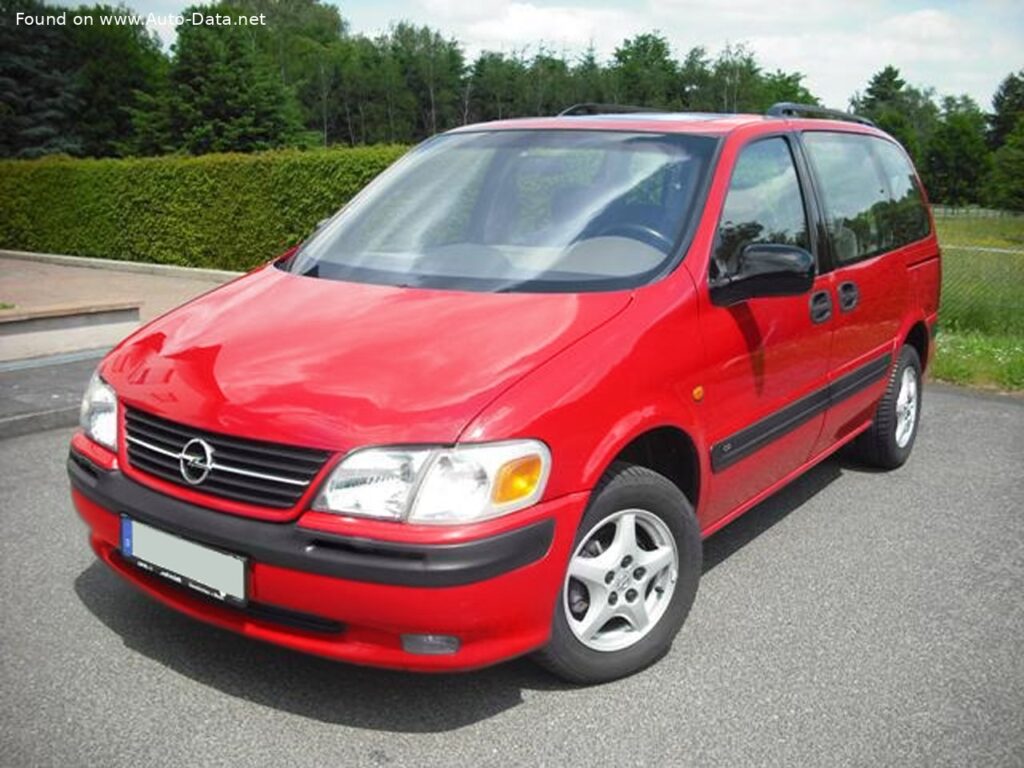
The Opel Sintra 2.2i 16V represents a notable, albeit short-lived, chapter in the European automotive landscape during the late 1990s. Introduced in March 1997 and discontinued by June 1999, the Sintra was Opel’s ambitious attempt to capture a segment of the burgeoning large minivan market in Europe. Unlike many of its European competitors, the Sintra was not an indigenous design but rather a rebadged version of General Motors’ second-generation U-body platform minivans, which were popular in North America as the Chevrolet Venture, Pontiac Trans Sport/Montana, and Oldsmobile Silhouette. This shared lineage meant the Sintra brought American-style spaciousness and practicality to European buyers, packaged with Opel’s design language and powertrain options tailored for the continent. The 2.2i 16V variant, with its 141 horsepower engine, was positioned as a capable and family-friendly option, emphasizing comfort and utility in a competitive market segment.
Opel Sintra 2.2i 16V: A European Adaptation
The Opel Sintra was a unique offering in the European market, primarily because of its North American roots. While European manufacturers were developing their own MPVs (Multi-Purpose Vehicles) focused on driving dynamics and compact dimensions, Opel opted to import a rebadged American minivan. This strategy aimed to provide European families with a vehicle offering significantly more interior space than many of its rivals. However, this approach also presented challenges in terms of adapting the vehicle to European driving preferences and safety standards. The Sintra’s brief production run reflects the difficulties in bridging these cultural and engineering differences.
Engine & Performance
Under the hood, the Opel Sintra 2.2i 16V featured a naturally aspirated, transverse-mounted 2.2-liter (2198 cm³ or 134.13 cu. in.) inline-four engine, designated by the code X22XE. This engine was a well-regarded unit within Opel’s portfolio, known for its reliability and balance of power and efficiency. Producing 141 horsepower at 5400 rpm, the engine provided adequate performance for a vehicle of the Sintra’s size and weight – 3648.65 lbs (1655 kg). Torque output peaked at 148.99 lb.-ft. (202 Nm) at 2600 rpm, delivering sufficient low-end grunt for everyday driving and highway overtaking.
Power was transmitted to the front wheels via a standard 5-speed manual transmission, a common configuration for European vehicles prioritizing driver involvement and fuel economy. Acceleration from 0 to 60 mph was calculated at 12.1 seconds, with a top speed of 113.71 mph (183 km/h). Fuel economy figures were rated at a combined 24.5 US mpg (9.6 l/100 km), with 18.1 US mpg (13 l/100 km) in urban conditions and 29 US mpg (8.1 l/100 km) on the open road. The engine’s multi-port fuel injection system and 10.5:1 compression ratio contributed to its relatively efficient operation for a vehicle of its class and era.
Design & Features
The Opel Sintra was designed as a full-size minivan, prioritizing interior space and versatility. Its five-door body style and seven-seat configuration made it suitable for large families or those needing substantial cargo capacity. Measuring 183.86 inches (4670 mm) in length, 72.05 inches (1830 mm) in width, and 70.08 inches (1780 mm) in height, the Sintra was a sizable vehicle by European standards. The 112.2-inch (2850 mm) wheelbase contributed to a comfortable ride and a spacious cabin.
The Sintra’s interior was highly adaptable. Minimum trunk space was 16.24 cu. ft. (460 liters), expanding to a cavernous 132.96 cu. ft. (3765 liters) with the rear seats removed or folded. This flexibility was a key selling point, allowing the Sintra to accommodate a wide range of cargo. Safety features included a front-wheel-drive architecture, coil spring suspension on both axles for a comfortable ride, and ventilated front and solid rear disc brakes augmented by an Anti-lock Braking System (ABS). Hydraulic power steering, utilizing a rack and pinion system, provided ease of maneuverability. The vehicle rode on 205/65 HR 15 tires mounted on 6J x 15 wheel rims.
Technical Specifications
| Category | Specification |
| Brand | Opel |
| Model | Sintra |
| Generation | Sintra |
| Type (Engine) | 2.2i 16V (141 Hp) |
| Start of Production | March, 1997 |
| End of Production | June, 1999 |
| Powertrain Architecture | Internal Combustion engine |
| Body Type | Minivan |
| Seats | 7 |
| Doors | 5 |
| Fuel Consumption (Urban) | 18.1 US mpg (13 l/100 km) |
| Fuel Consumption (Extra Urban) | 29 US mpg (8.1 l/100 km) |
| Fuel Consumption (Combined) | 24.5 US mpg (9.6 l/100 km) |
| Fuel Type | Petrol (Gasoline) |
| Acceleration 0-60 mph | 12.1 sec |
| Maximum Speed | 113.71 mph (183 km/h) |
| Weight-to-Power Ratio | 11.7 kg/Hp, 85.2 Hp/tonne |
| Weight-to-Torque Ratio | 8.2 kg/Nm, 122.1 Nm/tonne |
| Power | 141 Hp @ 5400 rpm |
| Power per Liter | 64.1 Hp/l |
| Torque | 148.99 lb.-ft. (202 Nm) @ 2600 rpm |
| Engine Layout | Front, Transverse |
| Engine Model/Code | X22XE |
| Engine Displacement | 2.2 liters (2198 cm³ / 134.13 cu. in.) |
| Number of Cylinders | 4 |
| Engine Configuration | Inline |
| Cylinder Bore | 3.39 in. (86 mm) |
| Piston Stroke | 3.72 in. (94.6 mm) |
| Compression Ratio | 10.5:1 |
| Valves per Cylinder | 4 |
| Fuel Injection System | Multi-port manifold injection |
| Engine Aspiration | Naturally aspirated engine |
| Engine Oil Capacity | 4.49 US qt (4.25 l) |
| Coolant Capacity | 6.23 US qt (5.9 l) |
| Kerb Weight | 3648.65 lbs. (1655 kg) |
| Max. Weight (Gross) | 5169.84 lbs. (2345 kg) |
| Max Load | 1521.19 lbs. (690 kg) |
| Trunk (Boot) Space – Minimum | 16.24 cu. ft. (460 l) |
| Trunk (Boot) Space – Maximum | 132.96 cu. ft. (3765 l) |
| Fuel Tank Capacity | 18.49 US gal (70 l) |
| Length | 183.86 in. (4670 mm) |
| Width | 72.05 in. (1830 mm) |
| Height | 70.08 in. (1780 mm) |
| Wheelbase | 112.2 in. (2850 mm) |
| Front Track | 61.42 in. (1560 mm) |
| Rear (Back) Track | 63.39 in. (1610 mm) |
| Drivetrain Architecture | Front wheel drive (Internal Combustion engine drives front wheels) |
| Drive Wheel | Front wheel drive |
| Number of Gears and Type of Gearbox | 5 gears, manual transmission |
| Front Suspension | Coil spring |
| Rear Suspension | Coil spring |
| Front Brakes | Ventilated discs |
| Rear Brakes | Disc |
| Assisting Systems | ABS (Anti-lock braking system) |
| Steering Type | Steering rack and pinion |
| Power Steering | Hydraulic Steering |
| Tires Size | 205/65 HR 15 |
| Wheel Rims Size | 6J x 15 |
Legacy and Market Impact
The Opel Sintra’s short production run and limited market success underscore the challenges of adapting American designs for European tastes. While it offered a compelling combination of space and practicality, it ultimately failed to resonate with European buyers who prioritized driving dynamics and perceived quality. The Sintra’s poor Euro NCAP crash test results further damaged its reputation. Despite its shortcomings, the Sintra remains a fascinating example of globalization in the automotive industry and a reminder that successful market entry requires a deep understanding of local preferences and standards. It paved the way for Opel to develop more successful European-designed MPVs in the future, learning valuable lessons from this ambitious, yet ultimately unsuccessful, venture.
