The Mercedes-Benz SLK (R172) SLK 250 CDI represents the third generation of the German automaker’s compact luxury roadster, produced from 2011 to 2020. While the SLK nameplate was known to American consumers, the SLK 250 CDI variant was primarily marketed in Europe. Introduced in 2012 and produced until 2015, this model combined the appeal of a two-seat, rear-wheel-drive convertible with the fuel efficiency and torque of a modern diesel engine. It demonstrated Mercedes-Benz’s engineering capabilities, proving a sporty roadster could also be economical, appealing to buyers who valued both driving pleasure and reduced running costs.
Engine & Performance of the SLK 250 CDI
The core of the Mercedes-Benz SLK (R172) SLK 250 CDI was its OM 651.980 2.1-liter (2143 cc) inline-four diesel engine. This powertrain showcased Mercedes-Benz’s advanced diesel technology, featuring twin turbochargers and an intercooler to optimize performance and efficiency. The engine produced 204 horsepower at 3800 rpm, providing ample power for spirited driving. However, its torque output was the defining characteristic: 368.78 lb.-ft. (500 Nm) available from 1600 to 1800 rpm. This broad torque band enabled brisk acceleration and effortless cruising.
Paired with a 6-speed manual transmission driving the rear wheels, the SLK 250 CDI offered an engaging driving experience. Performance figures were impressive for a diesel roadster, achieving 0 to 60 mph in 6.2 seconds and a top speed of 151.61 mph (244 km/h). The vehicle excelled in fuel economy, a key factor for its target market. It achieved a combined fuel consumption of 49 to 47 US mpg (4.8-5 liters per 100 km), with extra-urban figures reaching 58.8 to 57.4 US mpg (4-4.1 liters per 100 km). This efficiency was complemented by low CO2 emissions, ranging from 124 to 129 g/km, meeting Euro 5 emission standards. A Start & Stop System and a Particulate Filter further enhanced its environmental responsibility and diesel refinement.
Design and Features of the R172 SLK
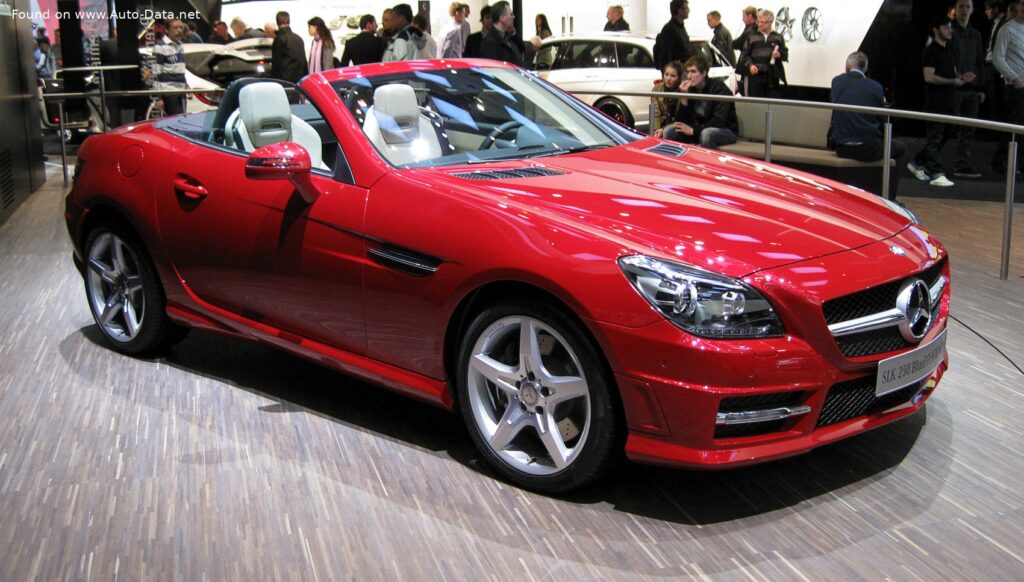
The Mercedes-Benz SLK (R172) generation represented a significant design evolution. Departing from the softer lines of previous models, the R172 adopted a more assertive and angular aesthetic, inspired by the SLS AMG supercar. This gave the SLK 250 CDI a distinct presence, blending classic roadster proportions with contemporary Mercedes-Benz styling. As a two-door, two-seat roadster, its primary function was open-air driving, facilitated by its vario-roof – a retractable hardtop that transformed the coupe into a convertible at the touch of a button.
The interior reflected Mercedes-Benz’s commitment to luxury and ergonomics. High-quality materials, meticulous craftsmanship, and a driver-focused cockpit created a premium environment. The R172 typically featured Mercedes’ COMAND system, offering navigation, audio, and communication functionalities. Safety was a priority, with standard Anti-lock Braking System (ABS), airbags, and structural reinforcements for occupant protection. The car’s dimensions – 162.76 inches in length, 71.26 inches (78.98 inches with mirrors) in width, and 51.22 inches in height – contributed to its compact and agile stance. Despite being a roadster, it offered a trunk space of 7.95 to 11.83 cubic feet (225-335 liters), depending on the roof position.
The chassis and suspension were engineered for a balance of comfort and sporty handling. It featured an independent McPherson strut front suspension with coil springs and an anti-roll bar, and an independent multi-link rear suspension with a stabilizer. Ventilated disc brakes at the front and disc brakes at the rear provided strong stopping power. The hydraulic rack and pinion steering system offered precise feedback, enhancing the driving dynamics of the rear-wheel-drive sports car. Standard tire size was 205/55 R16 on 7J x 16-inch wheel rims.
Technical Specifications of the SLK 250 CDI
| Feature | Specification |
| General Information | |
| Brand | Mercedes-Benz |
| Model | SLK |
| Generation | SLK (R172) |
| Type (Engine) | SLK 250 CDI (204 Hp) |
| Start of Production | 2012 |
| End of Production | 2015 |
| Powertrain Architecture | Internal Combustion Engine |
| Body Type | Roadster |
| Seats | 2 |
| Doors | 2 |
| Performance Specifications | |
| Fuel Consumption (Urban) | 37.9 – 36.8 US mpg (6.2-6.4 l/100 km) |
| Fuel Consumption (Extra Urban) | 58.8 – 57.4 US mpg (4-4.1 l/100 km) |
| Fuel Consumption (Combined) | 49 – 47 US mpg (4.8-5 l/100 km) |
| CO2 Emissions | 124-129 g/km |
| Fuel Type | Diesel |
| Acceleration 0 – 60 mph | 6.2 seconds |
| Acceleration 0 – 62 mph (0-100 km/h) | 6.5 seconds |
| Maximum Speed | 151.61 mph (244 km/h) |
| Emission Standard | Euro 5 |
| Weight-to-Power Ratio | 7.3 kg/Hp, 136.5 Hp/tonne |
| Weight-to-Torque Ratio | 3 kg/Nm, 334.4 Nm/tonne |
| Engine Specifications | |
| Power | 204 Hp @ 3800 rpm |
| Power per Liter | 95.2 Hp/l |
| Torque | 368.78 lb.-ft. @ 1600-1800 rpm (500 Nm) |
| Engine Layout | Front, Longitudinal |
| Engine Model/Code | OM 651.980 |
| Engine Displacement | 130.77 cu. in. (2143 cm³) |
| Number of Cylinders | 4 |
| Engine Configuration | Inline |
| Cylinder Bore | 3.27 in. (83 mm) |
| Piston Stroke | 3.9 in. (99 mm) |
| Compression Ratio | 16.2:1 |
| Number of Valves per Cylinder | 4 |
| Fuel Injection System | Diesel Commonrail |
| Engine Aspiration | Twin-Turbo, Intercooler |
| Valvetrain | DOHC |
| Engine Oil Capacity | 6.87 US qt (6.5 l) |
| Coolant Capacity | 10.14 US qt (9.6 l) |
| Engine Systems | |
| Start & Stop System | Yes |
| Particulate Filter | Yes |
| Space, Volume and Weights | |
| Kerb Weight | 3295.91 lbs. (1495 kg) |
| Max. Weight | 4155.71 lbs. (1885 kg) |
| Max Load | 859.8 lbs. (390 kg) |
| Trunk (Boot) Space – Minimum | 7.95 cu. ft. (225 l) |
| Trunk (Boot) Space – Maximum | 11.83 cu. ft. (335 l) |
| Fuel Tank Capacity | 15.85 US gal (60 l) |
| Dimensions | |
| Length | 162.76 in. (4134 mm) |
| Width | 71.26 in. (1810 mm) |
| Width Including Mirrors | 78.98 in. (2006 mm) |
| Height | 51.22 in. (1301 mm) |
| Wheelbase | 95.67 in. (2430 mm) |
| Front Track | 61.38 in. (1559 mm) |
| Rear (Back) Track | 61.61 in. (1565 mm) |
| Front Overhang | 34.25 in. (870 mm) |
| Rear Overhang | 32.83 in. (834 mm) |
| Drag Coefficient (Cd) | 0.30 |
| Minimum Turning Circle | 34.51 ft. (10.52 m) |
| Drivetrain, Brakes and Suspension | |
| Drivetrain Architecture | Internal combustion engine drives the rear wheels. |
| Drive Wheel | Rear Wheel Drive |
| Number of Gears and Type of Gearbox | 6 gears, manual transmission |
| Front Suspension | Independent, McPherson with coil spring and anti-roll bar |
| Rear Suspension | Independent multi-link spring suspension with stabilizer |
| Front Brakes | Ventilated discs |
| Rear Brakes | Disc |
| Assisting Systems | ABS (Anti-lock Braking System) |
| Steering Type | Steering rack and pinion |
| Power Steering | Hydraulic Steering |
| Tires Size | 205/55 R16 |
| Wheel Rims Size | 7J x 16 |
Legacy and Market Placement
The Mercedes-Benz SLK (R172) SLK 250 CDI occupies a unique position in the history of luxury roadsters, particularly within its primary European market. While the SLK competed globally with models like the BMW Z4 and Audi TT Roadster, the diesel-powered SLK 250 CDI offered a distinctive proposition. In Europe, where diesel engines were valued for their efficiency and torque, this model provided a compelling alternative to gasoline-powered sports cars.
Its reputation was built on Mercedes-Benz’s build quality, a hardtop convertible design, and a luxurious interior. The SLK 250 CDI stood out by combining driving enjoyment with exceptional fuel economy, a rare combination in the segment. For European buyers, it was a sensible yet stylish choice, offering long-distance touring with fewer fuel stops and lower running costs. This efficiency, along with Euro 5 compliance, made it an environmentally conscious option without sacrificing the prestige and performance of a Mercedes-Benz.
The SLK 250 CDI’s absence from the North American market reflects differing regional preferences, where diesel engines faced stricter emissions regulations and less consumer demand. Nevertheless, the SLK 250 CDI exemplifies Mercedes-Benz’s engineering versatility and strategic approach to global markets, offering a unique blend of performance, luxury, and diesel efficiency that resonated with its target audience.