
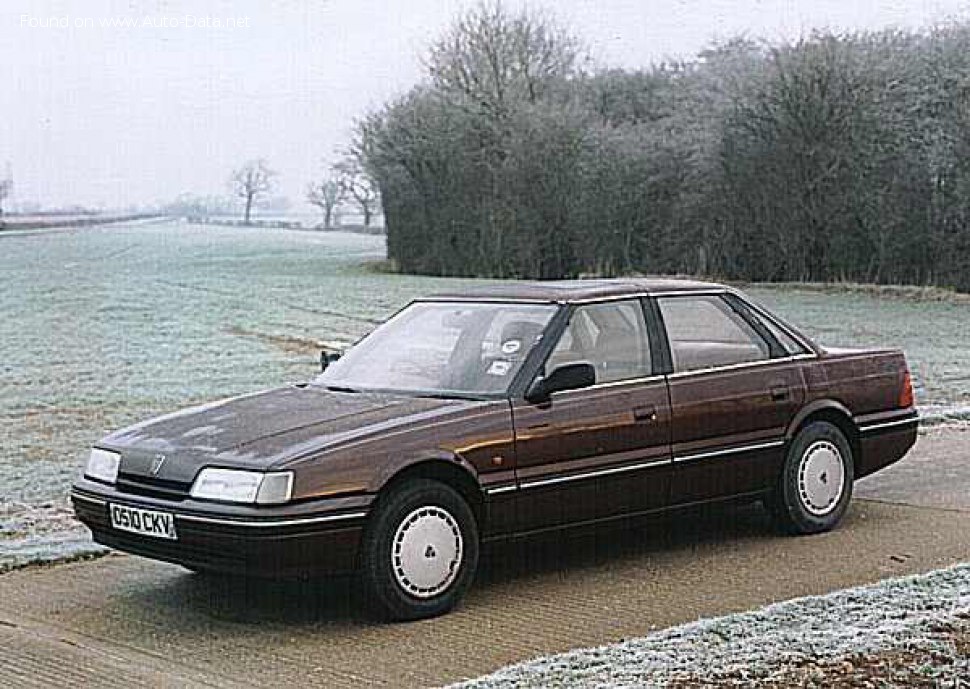
The Rover 800 series represents a significant chapter in the history of the British automotive manufacturer, Rover Group. Launched in 1986, the 800 was a direct successor to the Rover SD1 and was developed in collaboration with Honda, resulting in a platform shared with the Acura Legend (known as the Honda Legend in other markets). This Anglo-Japanese alliance aimed to produce a sophisticated, executive-class sedan capable of competing with established European rivals. The focus of this article is the Rover 800 827 SI/Sterling (XS) (177 Hp) Automatic, a premium variant produced between 1988 and 1991, which exemplified Rover’s aspirations for luxury and performance during this era. Positioned as a flagship model, the 800 series sought to blend traditional British luxury with Japanese reliability and engineering prowess, targeting discerning buyers in its primary European market.
The Rover 800 827 SI/Sterling (XS) (177 Hp) Automatic: Engineering and Design
Engine & Performance
At the heart of the Rover 800 827 SI/Sterling (XS) (177 Hp) Automatic was a powerplant derived from its Honda counterpart: the C27A-V6 engine. This naturally aspirated, multi-port fuel-injected petrol engine boasted a displacement of 2.7 liters (2675 cm³, or 163.24 cu. in.). Engineered with a V-engine configuration and a Double Overhead Camshaft (DOHC) valvetrain with four valves per cylinder, it was a testament to modern engineering for its time, promising both refinement and robust power delivery.
The C27A-V6 engine produced a respectable 177 horsepower at 6000 rpm, translating to a power-per-liter output of 66.2 Hp/l. Torque figures stood at 228 Nm (168.16 lb.-ft.) delivered at 4500 rpm, providing ample pulling power for a vehicle of its class. This power was channeled to the front wheels via a smooth-shifting 4-speed automatic transmission, emphasizing comfort and ease of driving over outright sportiness. Despite its executive cruiser persona, the Rover 800 827 SI/Sterling (XS) (177 Hp) Automatic was capable of brisk acceleration, achieving 0 to 60 mph in an estimated 8.9 seconds (0-100 km/h in 9.4 seconds). Its maximum speed reached 132.97 mph (214 km/h), making it a capable performer on European highways.
Fuel economy, while not a primary selling point for executive sedans of this era, was reasonable for its class and engine size. The combined cycle consumption was rated at 10 l/100 km, which translates to approximately 23.5 US mpg. Urban driving saw consumption rise to 12.7 l/100 km (18.5 US mpg), while extra-urban figures improved to 8.4 l/100 km (28 US mpg). The vehicle’s weight-to-power ratio was 7.9 kg/Hp, or 126.4 Hp/tonne, indicating a balanced approach to performance and luxury.
Design & Features
The Rover 800 827 SI/Sterling (XS) (177 Hp) Automatic was exclusively offered as a 4-door, 5-seat sedan, embodying the traditional executive car aesthetic of the late 1980s. Its design, a collaborative effort between Rover and Honda, featured clean lines and a relatively conservative profile that aimed for timeless elegance rather than ostentatious flair. With a length of 192.2 inches (4882 mm), a width of 68.11 inches (1730 mm), and a height of 54.84 inches (1393 mm), the 800 provided a substantial road presence. The generous wheelbase of 108.9 inches (2766 mm) contributed significantly to interior space and ride comfort, a key attribute for a car in this segment.
Inside, the Sterling trim level in particular was synonymous with luxury, featuring high-quality materials such as wood trim and leather upholstery, designed to create an opulent cabin environment. Comfort was paramount, with well-appointed seating for five passengers and a minimum trunk capacity of 15.72 cubic feet (445 liters), sufficient for executive travel or family vacations. Standard features for this premium variant included hydraulic power steering, ensuring effortless maneuverability, and an Anti-lock Braking System (ABS), a significant safety enhancement for the period. The vehicle rode on 195/65 R15 tires mounted on 15-inch wheel rims, providing a good balance between comfort and handling.
The chassis was designed for a comfortable yet composed ride, featuring a double wishbone front suspension and a coil spring rear suspension. Braking duties were handled by ventilated discs at the front and disc brakes at the rear, complemented by the aforementioned ABS system for improved stopping performance and control under adverse conditions. The front-wheel-drive architecture, a departure from the rear-wheel-drive tradition of previous Rover executive cars, was a direct influence of the Honda collaboration, offering benefits in packaging and interior space.
Technical Specifications: Rover 800 827 SI/Sterling (XS) (177 Hp) Automatic
| Category | Specification |
| General Information | |
| Brand | Rover |
| Model | 800 |
| Generation | 800 |
| Type (Engine) | 827 SI/Sterling (XS) (177 Hp) Automatic |
| Start of Production | 1988 year |
| End of Production | 1991 year |
| Powertrain Architecture | Internal Combustion engine |
| Body Type | Sedan |
| Seats | 5 |
| Doors | 4 |
| Performance Specs | |
| Fuel Consumption (Urban) | 12.7 l/100 km (18.5 US mpg) |
| Fuel Consumption (Extra Urban) | 8.4 l/100 km (28 US mpg) |
| Fuel Consumption (Combined) | 10 l/100 km (23.5 US mpg) |
| Fuel Type | Petrol (Gasoline) |
| Acceleration 0 – 60 mph | 8.9 sec |
| Acceleration 0 – 100 km/h | 9.4 sec |
| Maximum Speed | 214 km/h (132.97 mph) |
| Weight-to-Power Ratio | 7.9 kg/Hp (126.4 Hp/tonne) |
| Weight-to-Torque Ratio | 6.1 kg/Nm (162.9 Nm/tonne) |
| Engine Specs | |
| Power | 177 Hp @ 6000 rpm |
| Power per Liter | 66.2 Hp/l |
| Torque | 228 Nm @ 4500 rpm (168.16 lb.-ft. @ 4500 rpm) |
| Engine Layout | Front, Transverse |
| Engine Model/Code | C27A-V6 |
| Engine Displacement | 2675 cm³ (2.7 L, 163.24 cu. in.) |
| Number of Cylinders | 6 |
| Engine Configuration | V-engine |
| Cylinder Bore | 87 mm (3.43 in.) |
| Piston Stroke | 75 mm (2.95 in.) |
| Compression Ratio | 9.45:1 |
| Number of Valves per Cylinder | 4 |
| Fuel Injection System | Multi-port manifold injection |
| Engine Aspiration | Naturally aspirated engine |
| Valvetrain | DOHC |
| Engine Oil Capacity | 4.5 l (4.76 US qt) |
| Coolant Capacity | 8.6 l (9.09 US qt) |
| Space, Volume and Weights | |
| Kerb Weight | 1400 kg (3086.47 lbs.) |
| Max. Weight (Gross Vehicle Weight) | 1930 kg (4254.92 lbs.) |
| Max Load | 530 kg (1168.45 lbs.) |
| Trunk (Boot) Space – Minimum | 445 l (15.72 cu. ft.) |
| Fuel Tank Capacity | 68 l (17.96 US gal) |
| Dimensions | |
| Length | 4882 mm (192.2 in.) |
| Width | 1730 mm (68.11 in.) |
| Height | 1393 mm (54.84 in.) |
| Wheelbase | 2766 mm (108.9 in.) |
| Front Track | 1487 mm (58.54 in.) |
| Rear (Back) Track | 1450 mm (57.09 in.) |
| Drivetrain, Brakes and Suspension Specs | |
| Drivetrain Architecture | The Internal combustion engine (ICE) drives the front wheels of the vehicle. |
| Drive Wheel | Front wheel drive |
| Number of Gears and Type of Gearbox | 4 gears, automatic transmission |
| Front Suspension | Double wishbone |
| Rear Suspension | Coil spring |
| Front Brakes | Ventilated discs |
| Rear Brakes | Disc |
| Assisting Systems | ABS (Anti-lock braking system) |
| Steering Type | Steering rack and pinion |
| Power Steering | Hydraulic Steering |
| Tires Size | 195/65 R15 |
| Wheel Rims Size | 15 |
Legacy and Market Impact of the Rover 800 827 SI/Sterling (XS) (177 Hp) Automatic
The Rover 800 series, and particularly the premium 827 SI/Sterling (XS) (177 Hp) Automatic variant, played a pivotal role in Rover’s strategy to re-establish itself in the highly competitive executive car segment during the late 1980s and early 1990s. In its primary European market, the 800 competed against formidable rivals such as the BMW 5 Series, Mercedes-Benz E-Class, Saab 9000, Volvo 700/900 series, and even its Japanese sibling, the Honda Legend.
The collaboration with Honda provided Rover with a modern, reliable platform and a sophisticated V6 engine, which was generally praised for its smoothness and power delivery. This was a crucial factor for Rover, which had previously struggled with perceptions of build quality and reliability. The Sterling trim, in particular, was an attempt to elevate the Rover brand to a more luxurious standing, offering a compelling alternative to more expensive German marques, especially in the United Kingdom and other European markets.
Despite its strengths, the Rover 800 faced challenges. While the Honda-derived mechanicals were robust, initial models suffered from some quality control issues with interior trim and electronics, which somewhat tarnished its reputation. Furthermore, the front-wheel-drive layout, while practical, was sometimes seen as less prestigious by traditional executive car buyers who preferred the rear-wheel-drive dynamics offered by BMW and Mercedes-Benz. The car’s styling, though refined, was also criticized by some for being too conservative compared to some of its more distinctive rivals.
However, the 800 series achieved moderate success, particularly in the UK, where it became a popular choice for company car fleets and discerning private buyers seeking a blend of comfort, performance, and a touch of British luxury. The 827 SI/Sterling (XS) (177 Hp) Automatic variant, with its potent V6 and automatic transmission, embodied the top-tier offering, providing effortless cruising and a refined driving experience.
Today, the Rover 800, especially the V6-powered versions like the 827 SI/Sterling, is recognized as a significant classic car, representing an important era of Anglo-Japanese automotive cooperation. It stands as a testament to Rover’s ambition to compete on the international stage and offers a distinctive blend of British character and Japanese engineering integrity. For enthusiasts, it provides a comfortable and capable classic executive sedan that offers a unique alternative to its more common contemporaries. Its legacy is complex, marked by both its strengths in engineering and luxury, and the challenges faced by the Rover brand in a rapidly evolving global automotive landscape.
