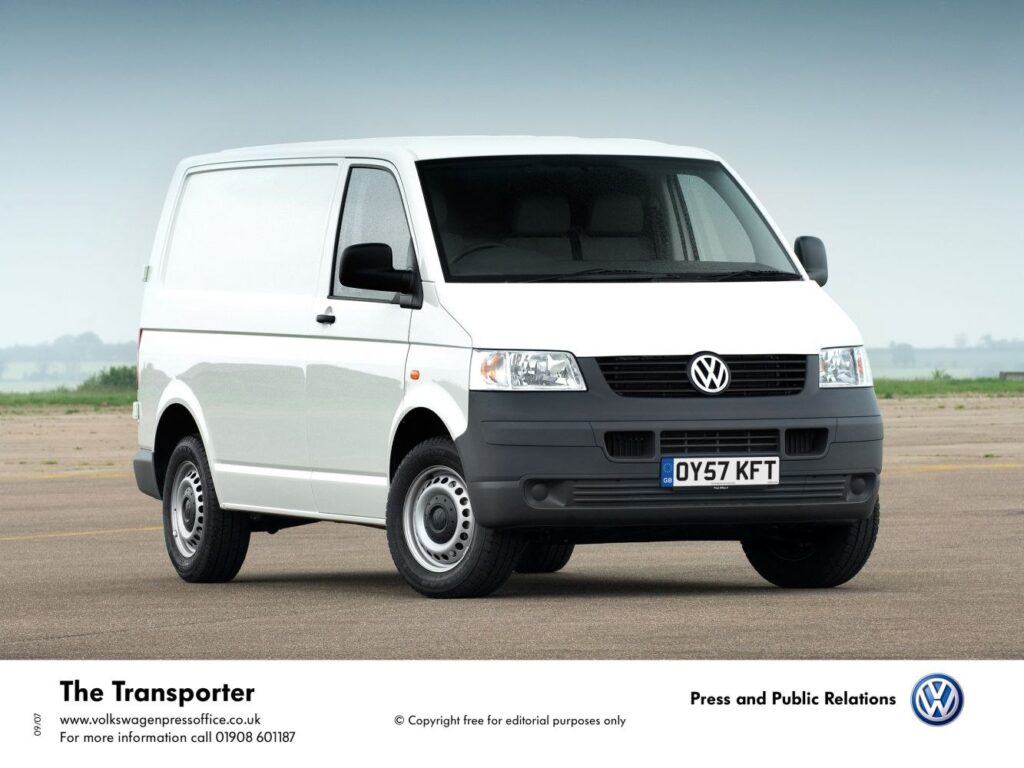
The Volkswagen Transporter (T5) Panel Van represents the fifth generation of Volkswagen’s highly successful and iconic Transporter series, a lineage tracing its roots back to the original Type 2 “Bus” of the 1950s. Produced between 2003 and 2006 for this specific variant, the T5 continued the tradition of offering a versatile and robust platform primarily for commercial use. While the Transporter has a storied history and a dedicated following globally, this particular T5 Panel Van model, with its 2.5 TDI (174 Hp) Tiptronic L1H1 configuration, was predominantly targeted at and sold within European and other international markets, rather than the North American market where Volkswagen offered different commercial vehicle solutions or passenger vans like the Routan. It quickly established itself as a benchmark in its segment for its blend of powerful diesel performance, sophisticated automatic transmission, and practical design.
The T5 generation saw Volkswagen further refine the Transporter’s capabilities, moving it into a more modern era with improved ergonomics, enhanced safety features for its time, and a broader range of engine and chassis configurations. The Panel Van variant, specifically the L1H1 (standard length, standard height) model, was engineered to maximize cargo space and utility, making it an indispensable tool for businesses across the continent. This detailed analysis will delve into the specific technical characteristics, performance metrics, and market impact of the Volkswagen Transporter (T5) Panel Van 2.5 TDI (174 Hp) Tiptronic L1H1.
Engine & Performance: Powering the Volkswagen Transporter (T5)
At the heart of this particular Volkswagen Transporter (T5) Panel Van lies a formidable 2.5-liter TDI (Turbocharged Direct Injection) diesel engine, an inline 5-cylinder unit renowned for its robust construction and impressive torque output. Codenamed EA153 / AXE, this powerplant delivers a substantial 174 horsepower at 3500 rpm, translating to a power-per-liter ratio of 70.7 horsepower per liter. More critically for a commercial vehicle, it produces a massive 295.02 lb.-ft. of torque, available across a practical operating range from 2000 to 2300 rpm. This low-end torque is crucial for hauling heavy loads, navigating urban environments, and maintaining highway speeds even when fully laden.
The engine employs a pump-nozzle (unit injector) fuel injection system, a technology that was cutting-edge for diesel engines in the early 2000s, providing precise fuel delivery for optimal combustion and efficiency. Coupled with a turbocharger and intercooler, the engine benefits from forced induction, significantly boosting its power and torque output while managing thermal loads. The valvetrain is a Single Overhead Camshaft (SOHC) design with two valves per cylinder, balancing complexity with durability and ease of maintenance.
Power is channeled to the front wheels via a sophisticated 6-speed Tiptronic automatic transmission. This gearbox offers the convenience of an automatic for stop-and-go traffic and long hauls, while also providing a manual shift mode (Tiptronic) for drivers who prefer greater control, especially when towing or tackling challenging terrain. This combination of a powerful diesel engine and a responsive automatic transmission allows the Transporter to achieve a 0 to 60 mph acceleration in a respectable 11.7 seconds, with a top speed of 113.71 mph. For a panel van of its size and capacity, these performance figures underscore its capability not just as a utilitarian vehicle but one capable of maintaining pace with passenger cars. Fuel economy for the extra-urban cycle was rated at 36.2 US mpg, an impressive figure for a vehicle of this type, especially considering its Euro 3 emission standard compliance, reflecting a focus on efficiency for its era.
Design & Features: Form Meets Function
The Volkswagen Transporter (T5) Panel Van in its L1H1 configuration (standard length, standard height) is a masterclass in functional design, prioritizing utility and durability. Its body type is a classic van, featuring 4 to 5 doors, typically including two front doors, one or two sliding side doors, and either a large tailgate or twin barn-style rear doors, offering flexible access to the cargo area. The cabin is designed to accommodate 2 to 3 occupants, providing a comfortable and practical workspace for drivers and their crew.
Measuring 192.52 inches in length, 74.96 inches in width (88.27 inches including mirrors), and 77.13 inches in height, the T5 L1H1 is compact enough for urban maneuverability yet spacious enough for substantial cargo. The 118.11-inch wheelbase contributes to a stable ride and ample interior volume. Crucially, the cargo area boasts a maximum volume of 204.83 cubic feet (5800 liters), making it exceptionally practical for a wide range of commercial applications, from parcel delivery to trades services. The robust construction allows for a maximum payload of 2039.28 lbs. and a maximum roof load of 220.46 lbs., further enhancing its versatility.
Underneath, the T5 features an independent suspension setup both front and rear, a significant advancement for a commercial vehicle of its time. The front employs a McPherson strut system with coil springs and an anti-roll bar, while the rear utilizes independent coil springs with a transverse stabilizer and trailing arms. This sophisticated suspension ensures a comfortable ride quality, superior handling characteristics, and better load stability compared to more rudimentary leaf-spring setups often found on competitor vans. Braking performance is handled by ventilated discs on both the front (12.13 x 1.16 inches) and rear (11.57 x 0.87 inches) axles, complemented by an Anti-lock Braking System (ABS) for enhanced safety during emergency stops. The hydraulic rack and pinion power steering system provides precise control and ease of maneuvering, especially important given the van’s size and potential loads. Standard tire size was 215/65 R16 on 6.5J x 16 wheel rims, providing a good balance of load capacity and ride comfort.
Technical Specifications
| Category | Specification |
| Brand | Volkswagen |
| Model | Transporter |
| Generation | Transporter (T5) Panel Van |
| Type (Engine) | 2.5 TDI (174 Hp) Tiptronic L1H1 |
| Production Start | 2003 year |
| Production End | 2006 year |
| Powertrain Architecture | Internal Combustion engine |
| Body type | Van |
| Seats | 2-3 |
| Doors | 4-5 |
| Fuel Consumption (Extra Urban) | 36.2 US mpg (6.5 l/100 km) |
| Fuel Type | Diesel |
| Acceleration 0 – 60 mph | 11.7 sec |
| Maximum Speed | 113.71 mph (183 km/h) |
| Emission Standard | Euro 3 |
| Power | 174 Hp @ 3500 rpm |
| Power per liter | 70.7 Hp/l |
| Torque | 295.02 lb.-ft. @ 2000-2300 rpm (400 Nm) |
| Engine Layout | Front, Transverse |
| Engine Model/Code | EA153 / AXE |
| Engine Displacement | 2.5 Liters (2460 cm3 / 150.12 cu. in.) |
| Number of Cylinders | 5 |
| Engine Configuration | Inline |
| Cylinder Bore | 3.19 in. (81 mm) |
| Piston Stroke | 3.76 in. (95.5 mm) |
| Compression Ratio | 18.5:1 |
| Valves per Cylinder | 2 |
| Fuel Injection System | Pump-nozzle (Unit Injector) |
| Engine Aspiration | Turbocharger, Intercooler |
| Valvetrain | SOHC |
| Engine Oil Capacity | 7.82 US qt (7.4 l) |
| Coolant Capacity | 7.5 US qt (7.1 l) |
| Kerb Weight | 4133.67 – 4574.59 lbs. (1875-2075 kg) |
| Max. Weight (GVWR) | 6172.94 – 6613.87 lbs. (2800-3000 kg) |
| Max Load | 2039.28 lbs. (925 kg) |
| Trunk (Cargo) Space – Maximum | 204.83 cu. ft. (5800 l) |
| Fuel Tank Capacity | 21.13 US gal (80 l) |
| Max. Roof Load | 220.46 lbs. (100 kg) |
| Permitted Trailer Load with Brakes | 5511.56 lbs. (2500 kg) |
| Permitted Trailer Load without Brakes | 1653.47 lbs. (750 kg) |
| Permitted Towbar Download | 220.46 lbs. (100 kg) |
| Length | 192.52 in. (4890 mm) |
| Width | 74.96 in. (1904 mm) |
| Width Including Mirrors | 88.27 in. (2242 mm) |
| Height | 77.13 in. (1959 mm) |
| Wheelbase | 118.11 in. (3000 mm) |
| Front Track | 64.09 in. (1628 mm) |
| Rear Track | 64.09 in. (1628 mm) |
| Front Overhang | 35.2 in. (894 mm) |
| Rear Overhang | 39.21 in. (996 mm) |
| Ride Height (Ground Clearance) | 6.5 in. (165 mm) |
| Minimum Turning Circle | 39.04 ft. (11.9 m) |
| Approach Angle | 22° |
| Departure Angle | 16° |
| Ramp-over (Brakeover) Angle | 14° |
| Wading Depth | 11.81 in. (300 mm) |
| Drivetrain Architecture | Front-wheel drive (ICE drives front wheels) |
| Drive Wheel | Front wheel drive |
| Number of Gears & Type | 6 gears, automatic transmission Tiptronic |
| Front Suspension | Independent, McPherson with coil spring and anti-roll bar |
| Rear Suspension | Independent coil spring, Transverse stabilizer, Trailing arm |
| Front Brakes | Ventilated discs, 12.13 x 1.16 in. (308×29.5 mm) |
| Rear Brakes | Ventilated discs, 11.57 x 0.87 in. (294×22 mm) |
| Assisting Systems | ABS (Anti-lock braking system) |
| Steering Type | Steering rack and pinion |
| Power Steering | Hydraulic Steering |
| Tires Size | 215/65 R16 |
| Wheel Rims Size | 6.5J x 16 |
Legacy and Market Impact of the Volkswagen Transporter (T5)
The Volkswagen Transporter (T5) Panel Van, and indeed the entire T5 generation, solidified the Transporter’s reputation as a segment leader in the European light commercial vehicle market. Its predecessors had already built a formidable legacy, and the T5 skillfully evolved this heritage by integrating modern engineering, improved comfort, and enhanced safety without sacrificing the core values of durability and versatility. The 2.5 TDI (174 Hp) Tiptronic L1H1 variant, in particular, stood out for its powerful engine and user-friendly automatic transmission, making it a highly desirable option for businesses that required both significant hauling capability and ease of driving in varying conditions.
In its primary markets, the T5 Panel Van faced stiff competition from other well-established European commercial vehicles such as the Mercedes-Benz Vito, the Ford Transit, and the Renault Trafic. However, the T5 consistently held its own, often outperforming rivals in terms of perceived quality, engine refinement, and resale value. Its sophisticated independent suspension system, a rarity in this segment at the time, contributed to a car-like driving experience that many competitors couldn’t match, enhancing driver comfort on long journeys. This made it not just a practical tool but also a comfortable mobile office for tradespeople, delivery services, and various small to medium-sized enterprises.
The T5’s impact extended beyond just commercial fleets. Its robust platform also served as the basis for the popular Multivan (a passenger van) and California (camper van) variants, further showcasing its inherent versatility and engineering excellence. The longevity of these vehicles, combined with Volkswagen’s reputation for reliability, ensured strong demand for used T5s long after production ceased in 2015 (with this specific variant ending in 2006). Even today, the T5 remains a common sight on European roads, a testament to its enduring design and build quality. Its ability to combine a powerful and efficient diesel engine with an advanced automatic transmission in a highly adaptable panel van package cemented its place as a true workhorse and a significant chapter in the Transporter’s storied history. The T5 generation ultimately paved the way for its successor, the T6, by setting a high bar for performance, utility, and driving dynamics in the commercial van segment.